Showing posts with label Nibelungs. Show all posts

Sunday, February 21, 2021

Another exorcism of thoughts: Who are the Nibelungs, Part 3 (final word on culture? magic?)

I should be doing something else, but I felt the urgency to at least make an attempt to put those ideas down before they are lost in the bliss of a Sunday in the sun. It connects to a serie of posts I started 6 years ago about what understanding of the "Nibelungs" I want to evoke in Lost Songs of the Nibelungs. We had the base assumption in Part 1, going something like this:

Historically speaking it would be the children of those desperate and armed refugees that settled among the ruins left by the Romans. They are to explore the deep forests and dark valleys, following whispered rumors of treasure, secrets and sorcery. They will leave their mark on the world, as it is their time.

The game is about their lost songs.

 And then we talked a bit about difficult topics of the past and future in Part 2, concluding like this:

It's a harsh world the Nibelungs live in, haunted by the evils of a lost civilization. But it's also a world of opportunity for man and woman alike to claim a part of and become legends if it is their fate. Within this legendary realm everything is possible and a Nibelung could rise from slave to king.

It is a semi-historical setting they live in, with the pagan believes of the old world struggling and fighting the rise of a new religion that threatens the very fabric of magic itself. The Nibelungs are all the Germanic tribes and their lost songs.

This leaves a couple of questions open, all of them are about getting an idea how those tribal people mapped the world around them. What patterns did they see? How did they explain the world and why? This is an exorcism of thought and not yet fully fleshed out. You have been warned.

A world without reason?

Culture is a collective mental state ... let's begin with that. It's also dynamic. My understanding of how that dynamic might work, is (among other things) derived from what I could gather in the (great and highly recommended!) book Authors of the Impossible by Jeffrey J. Kripal (a book that'd be featured in the research list I plan to include in Lost Songs).

So the firt step would be to get an understanding how our culture works, then extrapolate towards 550 AD, right? Bridging this cultural gap would make the past playable while adding the extra value of gaining a deeper understanding of that Germanic mindframe back then. In a sense, they already did all the work for us in the stories they told (or what we know of them), so there is that. However, reading those stories today (like, say, the Edda), always seems like it needs a whole lot of extra knowledge to get the references, the subtext ... all the symbolic stuff that you'd read in those stories that, by our understanding, comes down to magic.

There's no bridge. You see: reading those stories is like seeing an island in the distance, obscured by mist. What you deinitely can't do in a roleplaying book is make it an excursion into history and demanding of the reader to catch up to "get it right". No, nothing of that sounds right to me. And what would knowing the history more than, say, superficially actually bring to the table?

See? Like that. No bridge at all ... [source]
 

I've talked at length about how language should be used in the game (and you can start falling into that specific rabbit hole here). It's also easy enough to get an idea what clothes they wore or how they fought, what they paid with, all that good stuff, for sure worthy. What all the trivia doesn't do, though, is giving you a mindmap, of sorts, that brings to live what made those people tick. That a day started for them with the sun going up, not in the middle of the day, like it does for us now, gives you an inkling of an idea what I'm talking about.

But I digress. My goal would be to cook all of the above down to an abstract level where that other culture transcends 'just' by playing the game and without using any visual material other than description. The Narrative Generator is the biggest tool in this, but just one side of the coin.

However, to do this examination proper justice (to build that bridge), or so I've learned, we need to understand that culture is the collective decision to interprete the world as concluded by an intellectual elite, with what is negelected making a comeback in popular culture. In other words, if your world is run by reason and science, the spiritual will be popular in the stories we tell. That's the premise, that's the material for the bridge laid out..

People in the past didn't have it good ...

There is a popular understanding that life was hard in the past and people just didn't have the richness of experiences and safety we indulge in today in huge parts of the world. Stuff like "I wouldn't want to live in the 18th century ... all that misery, the health issues, the harsh living conditions. Horrible, horrible stuff." or some tune like that. I'm of two minds with this: for one, I agree. If someone growing up in our cultural environment would be transferred a couple of hundred years into the past, they'd most likely die fast. That doesn't mean, however, that the people living back then felt the same about their lives.

Off to the Dark Ages ... to DIE! [source]
 

There is that joke where one doctor tells another how he stopped drinking and smoking and eating unhealthy so he had a chance of a longer life, and the other doc just looks at him puzzled and asks: why would you want to live longer, if you had to live like that?! I always found this 'joke' stupid and unfunny, for the simple reason that it puts consumerism on a pedestal it doesn't belong. If you just live to consume, well, you don't live at all, imo. There is more, for sure, if you care to look.

Anyway, it all connects. I'll even raise you one: the neuroscientist Andrew Huberman had a great talk in a podcast the other day (see it here, it's worth your time), and he talked about the plasticity of the brain and how we can rewire ourselves to receiving dopamine awards for things we did rather than for things we consumed. Turns out (or so is my understanding), people that manage to do that, will need nothing else to thrive and be happy.

No need for expensive cars or meals or holidays or houses or whatever, just reading that one book, a page at a time, just doing that sport routine, doing the things that help you grow, is not only 'enough' to be content, it'll give you the energy to push harder, to go further. People producing material like crazy have unlocked that for themselves, one way or another. As a matter of fact, the best way to make this happen is pushing through stress. Do what you feel resistance against, and the brain will award you for it. Crazy (I'm still mulling over that, as a matter of fact).

Well, you are probably guessing what I'm hinting at. We are not wired to live like fat cats in comfy chairs, we are wired to do stuff. Our brains and bodies actually help us doing more than we would think we are able to achieve ...and to get by with way less than we actually have. Our genes haven't changed much in the last, what, 300.000 years? Assuming that we are just now able to live properly is preposterous.Commmon sense will tell you that, and science is right there with it, nodding wisely.

So there's no reason to believe that people weren't living fullfilled lives in 550 AD if the basic needs were met. There genes weren't different, the dynamics, generally speaking, would be the same as today or a couple of thousand years before that. They would laugh and love and sing and grieve and hate. kids would play, and have toys to do so. That said, they'd also live in very, very different surroundings than we do. Here is a little bridge to build up to that big bridge we are talking about: the dynamics apply, just on different surroundings, because it needs to work in the environment to allow survival and even growth.

I'd even submit that they didn't know less than we do, they just had different explanations and methods to get by (broadly speaking ... I'd fight you on this, though). That's the bridgehead.

Building a bridge across cultures, time and space ...

... with just some dice in hand. Wouldn't that be nice? Anyway, let's talk UFOs, because that's the logical next step. Why is it that we have more than 80.000 witness reports of encounters like that, all over the globe, and no proof? How is it that a lot associated with the UFO phenomenon relates so closely to religious experiences? It maps nicely (again, Kripal, quoting others). So nicely, in fact, that we can see the same dynamics between religious hagiography (basically stories what saints experienced) and UFO abductions ... or our ideas what those abductions are like.

I won't (can't!) go much into detail, but let's assume, just for the game's sake, that those phenoma are ... similar, only their interpretation in a different cultural environment will just turn up differently. Angels, fairies or aliens, all follow the same principle (abstractly speaking). I hope you see that bridge shaping up at this point. We can now conclude from our culture, to some extent, what that culture 1500 years ago might have set as priorities compared to us. There's the map, there's the pattern, if you will.

Not that I have done that yet to any reasonable degree. This is me playing around with some fresh impulses, so to say. But we know we can take the Enlightenment out of the equation. We can assume that life back then was way more spiritual than our lives today are. And going by the little I know about the paranormal and the unconscious and the idea of how all is connected, it is by no means said that we are entirely on the right track in our completely reason based cultural assumptions. So they might have compensated some of our advantages with knowledge now lost to us (as a matter of fact, that rising religion back in the day did their damnest to assimilate or kill that cultural heritage off). 

Who are the Nibelungs? (Part 3)

From what we can tell, it's been a very dynamic mix of different cultures settling down. In a way, the people starting their new lives in what would become Europe had their own intense culture war going. We know who lost, in hindsight. But how that war was fought is a different story. We also know of the tribal nature of those settlers, how they travelled a lot, and how they took impulses from everywhere. In that particular time, we can say we have lots of leeway to be creative within the imaginable. The smaller, the more isolated a tribe is, the more strange it could be.

Other than that, the Nibelungs are a spiritual people. How else could they have lived meaningful lives back then? Tapping into the (collective?) unconscious like that should offer some alleviation, help and even healing, but it also (for sure) brings our heroes a lot closer to things we'd love to keep in the dark nowadays. Those struggles back then were as real as today. Them going out to fight dragons or haggle with the gods should tap into the same sphere as us getting hunted or abducted by aliens. And just like we will find traces but no proof, because we tend to ignore those things in general, they might have encountered and fought those things for real (which is a leap I'll allow myself, since this is a game, after all).

What exactly that might mean and which symbols and systems to use to express it all in the game will be for me to explore in the future. A lot of it is already there. If you take a look at character creation (which is pretty much the same after all those years ...), you can end up with an elf, a dwarf or a troll. The sleight of hand here is that I'd argue that it is still as historically accurate as history can be. Ha!

Representing history accurately. Ha! [source]

One last thing. You might ask yourself, why go through all that to write a game, to which I have to say: it's fun, what else is there to know :) If there's value beyond that, we'll find out, I guess.

Sunday, February 14, 2021

Lost Songs of the Nibelungs: Mission Statement 2021

Time to tackle this beast again. While we work hard on getting my first take on a complete game published and distributed, it's always been my declared goal to make all this happen to allow Lost Songs to be my best effort. Because I care about it. I have been a bit silent about it on the blog, about where I am in that regard, but that's just me being busy and doing this on the side. As you will have noticed, my ramblings had gotten somewhat redundant and more and more, let's say, baroque in the last few months ... Most certainly because 2020 was a snail-suckling fuckfest of epic proportions. So now for something more productive.(Maybe, no promisses) 

That time again ... [source]
What you don't need ...

Here's one preconception that won't hold for Lost Songs: it needs to be a pastiche of some sort of existing game. If you want to trace the origins of this (and I make no effort to hide any of it here on the blog), you are free to go on a deep dive to find and see all of it. Or talk to me about it. I'll probably give you an ear full or two of half-assed theories about why Hit Points are Confidence and how that is actually psychologically sound, design-wise and in general. 

The truth is, you don't need another clone or re-hash or reiteration of games that already exist. Not from me, anyway. It's all out there, most of it for free, and if you by now aren't avoiding the sugar-coated money-milking machine that is corporate roleplaying, I don't know what to tell you other than that I have a bridge to sell for you ... Anyway, there is a world of games out there, catering to many of the same basic assumptions. There are bad takes and there are good takes. You are good in that department. Roam free, my friends ...

All I'm saying, is, that since all of that is out there, I feel no obligation what-so-ever to cater to that in any way shape or form. There is room for all kinds of experiements, and mainstream looks a bit too cozy and a bit too insane to me right now.

What to expect

As I said, I'm giving this my best effort. What this meant up to this point, was going as far as not only writing and testing and more writing about Lost Songs in the last, what, six years, going hard on seven? I also wrote and am about to publish a (completely different? to some extent different ...) roleplaying game, just to see what it takes. Just to be prepared. I'm not saying it to brag (there is nothing to brag about, tbh, it is what it is), I'm saying it to make a point: I want to publish a game, I need to see what it takes.

There is another dimension to this, and that would be the fact that it actually helps to have different projects at different stages in the air. The ideas hold each other in check, so to say (which means I will give The Grind some love as I go into the next stage with LSotN). All of this already took years and will take some more, if I keep the pace I'm having.

Many will have moved on by then, I presume (many already have). In a way, it's funny. If you go the distance, you don't care that much about the turnout. Attention in the age of the internet is fickle. If something can't be satisfyied within a forseeable future, people will move on. That's ok. I have made friends here and we keep in touch. The same will be true when I get Lost Songs out there. So I'm sure I can make someone happy when this becomes a reality.

[source]

There's also an extensive amount of research to this. For what I'm trying to do, it needs a exhaustive knowledge about history, psychology and game design. 'Exhaustive' means in this context, enough for me to be comfortable with the result. I actually want to have an inkling how people have lived 1500 years ago in Europe. What houses, what music, what food, what languages ... That's some dark history right there, with lots of unexplored areas, actually. Which is where psychology bridges the gap, I guess. And since I'm not writing a fricking novel here, game design is my form of expression.

That's what you can expect, then. If you care enough to stick around (or if the short attention span cycle brought you by in a couple of years from now). A game based on the potential exhibited so far here and with my other publications. Is that enough? I'd say, it's honest. Let's go from there.

What I aim for

It's not that there isn't any vision, and it might very well be out of my reach. Still, something to aspire to, so here it goes. I want players and DMs of this game to get an inkling what live had been like back then. To gain some insight into the kitchens of the old Germanic people. Playing Lost Songs of the Nibelungs, you should take away an idea how those legends of old came to pass and what they meant to the people telling them.

Not in the sense of a documentary, or anything like this. It'll still have zombies and tentacles and cosmic horror and Elves and Dwarves ... just through the lense of someone who lived 1500 years ago. See? That's the thing. It's not something the players need to bring to the table, it's something the game needs to evoke when it's played, not even when it's read. That's with the designer. If I'm not able to deliver that, I failed you when you actually decided to explore the game.

I keep saying that roleplaying games are a distinct form of medium, so this is what it takes to make that happen, imo. Player will be heroes, but they might die from the damage they received in a snow storm short before fulfilling their destiny. It should be a wild ride, the game should allow players to play the system to have their characters excell, but failing needs to be satisfying as well. The story told needs to be great, just from the system output alone. It needs to make the DM look good, offer a (plat)form of expession specially customized for this experience.

It all needs to come together, and I have a very specific idea about the layout, that will be very experimental (to say the least .. but it might just work). It needs to be complete, which might make another intensive play-testing campaign necessary .. In the end, I need to be happy with it. A good friend of mine said the game so far reinded him of a very complex clockwork of a system (a comment I still appreciate, after all those years). Problem with that is, that it takes little to go wrong with that big-time.

Either way, you probably guessed it by now, it will be very special interest :D

Goths, before it was cool [source]
Anyway, lets write this mother ...

You see, many, many construction sites. As it is, I can make that happen at the table, if I DM it. To some extent I can make it work if I'm accompanying a DM helming a game. It needs more than that, and if you actually read the above, you know I have set up some hard standards for this. So far it's a fun experience (and yes, I know I'm strange).

I'd love to see the following happen in 2021:

  • a complete collection of everything I did for the game so far (all 4 books)
  • collecting, expanding and summarizing my research into the Dark Ages
  • getting an idea what this should look like, as far as layout and artwork go (what can I do, what could I invest, how far can I push this) 

I expect this to keep me occupied for some time, with some fun projects on the side (we are play-testing/developing that module I have talked about, called THE RISE OF ROBO-HITLER, and it's a hoot). So I will keep you all informed (the three people reading the blog, ha!).

One last thing I have learned and will dare to share here: it doesn't matter as much how long it takes to get something finished, finishing it is what counts. That's what people need to have confidence in. I want this to exist, so it will exist. And as long as I have a say in how it will exist, it'll be something I will be proud of to have in the hands of others.

I wonder, of course, if anybody out there is still interested in seeing how this turn out. So if that's the case, it'd make me really, really happy to see a comment about that below. Show some love, if you feel like it. Gimme that vote of confidence. It goes a long way (as this might still go sideways, for some reason or another ...).

[source]

Saturday, February 13, 2016

Artwork: Lost Songs of the Nibelungs (Gallery of Ideas)

I originally planned to post something else, but then I got mail with the new concept art for the LSotN character sheet, saw it and thought "Damn, I gotta post this!" or something down that road. While I'm at it, I'd like to share some more things I've been working on. There's a lot more working behind the scenes than is happening at the blog right now. Anyway, here we go ...

New artwork for LSotN (concepts and ideas)

Feast yer eyes, me laddies! [original artwork by Vincent Leppert]
That's from the guy illustrating the book and I'm really lucky to get talent like this interested in this little Frankenclone of mine. Here's more:
WIP of a Roman aqueduct [by Vincent Leppert]
WIP of a combat scene for the rules [Vincent Leppert again]
Those are pretty clean, as you'd expect from vector graphics. Second stage (for the interior art, not the character sheet) is giving all that the feel of some old book illustrations. It'll look a bit like this in the end:

Vincent's sketch book ...
Again, it's not finished but it's all on a good way. I need to start with some work on the layout soon and there will be more posts like this in the (near?) future!

And some stuff by me at the end ...

What I got for now are some new ideas for the cover artwork. It's not as good as the stuff I get from Vincent, but here we go anyway. This is how the booklets for LSotN will look like for the pdfs (also WIP):


Covers I and IV will look like this. My main problem right now is deciding if the OSR sign should be on there, too. I'd like to have it (since it's the flag I rise here on the blog and all), but I'm not sure if the game would be recognized as OSR, as I really took a hard turn away from D&D and friends here. But that's maybe for another post (if you, gentle reader, have an opinion on the matter, please share it in the comments!).

That's it for now. Writing a game for publication is a long process, with lots of twists and turns, but it really feels like Lost Songs is getting somewhere, piece by piece (even started the play tests again, this time completely within the setting and it's looking good).

Opinions and feedback are, as always, very welcome. 

Friday, January 15, 2016

Principles of Magic 1: Oracle Dice (in LSotN)

I had one of those moments where pieces started falling into places and I'm happy to report that Lost Songs of the Nibelungs is now complete. At least in my head. Oracle Dice and Magic had been the two great unknowns so far and I had been looking for something that connects them and also works well with the system. What I came up with is bordering on the esoteric, but make no mistake: I'll only be using what I need and make the rest up as I see fit. This is about magic in a role playing game, not about magic in the "real world".

They knew their dice in 550 AD (the Platonic solids)

Alright, so I didn't know that someone actually found an ancient Roman d20:

How awesome is this! [source]
My first thought had been something like "I wonder what games they played with it ..." and my second thought had been about those symbols. But the first thing I found when googling about was that they already had an idea of the geometric forms we use in our favorite games. And not only that, they went as far as stating that those forms are the underlying structures of our world.

Here they are: d4, d6, d8, d12, d20 [source]
There had been four Platonic solids in the beginning (d4, d6, d8, d20), Aristotle had the idea of a fifth element he called Aether (d12) and those ideas might actually be far, far older than that, as there are theories that those Carved Stone Balls they found in Scotland could be somehow related to the same concepts ... But honestly, who cares. All I could think was: DICE! They had them, so using them in a pseudo historical setting is actually fitting.

So Sacred Geometry had been the next logic step, to be honest. Symmetry, the Golden Ratio, the ancient meanings of those beloved geometric forms needed exploring exploiting. At this point I'm still not as much reading as looking for connections. Okay, okay, there is a connection between those geometric forms and the elements. The d4 is fire, d6 is earth, d8 is air, the d12 is Aether and the d20 is water. There are 5 of them, so the union of them is actually a pentagram! That's nice. Golden ratio, magical symbolism, it's all in there. It's all done.

And there is some additional meaning. Fire is transformation, Earth is stability, Air is Change, Aether is Potential and Water is Protection. I can see it shaping up, but there is still something missing. The connection to that game I'm writing is still at large.

So where is that d10?

Yes, that one form is missing. It's one of those rare occasions where the d12 gets more love than the d10. And right there is the missing link: there is the 3d10 Random Territory Generator I use to build the world for the characters of Lost Songs and characters have 10 levels. And that is, again, a Platonic idea: macrocosm and microcosm! So the basic structure of the world and the development of the individual in Lost Songs are somehow connected to 10.

My next thought had been that I need to cook down those 3d10, so taking digit sum seemed to be my best shot. But that'd only result in digits between 1 and 9, so the 10 is actually missing. That worried me for a short time, but then I realized that the missing digit couldn't be anything else but the individuals shaping the world, which brought me full circle: the 10 is the key hole for magic, this is where the individual, be it god or fairy or human, step in to alter reality.

This is magic in Lost Songs of the Nibelungs ...

What we have here is a basic understanding how the world works and an idea how to change that. Let's have the ideas so far combined in one picture:


There is no system to speak of yet, but all the ingredients are there. The last important connection here is between the main Quality to weave magic (Wits) and the five elements and since every Quality has 5 advancement levels in LSotN, we have our first rule of magic: a character can handle 1 element per quality advancement in Wits.

This is where it gets a bit more complicated. We have 5 dice for the elements. It would be nice to have them connecting in a way consistent with Lost Songs, so doubles and triples are interesting, as are 1s and maximum results (as it is in Combat). That means (for one) that it might be useful to have a wizard roll all 5 dice at one point, but doing so every time seems like a bad idea, so how about doing something like D&D (for a change) and have them do it every morning during meditation (just like memorizing, well, close enough).

So they roll the 5 dice and read them, choosing a number of dice according to their level and as they see fit. Doubles, triples and so on, may draw additional dice into a wizards daily pool. This is a bit tricky, because it means that only the numbers 1 to 4 have the potential to trigger in all 5 elements at once, which means those numbers are STRONG. But I love the rule "high is good" and I won't start to change that with the game I'm writing, so there is a second layer to this where a high result with a die makes him ENERGETIC. And a third layer would be BALANCE, where all results synchronize ...

That's that in a nutshell. Expect me expanding on that in the near future. But the reason for this post, other than introducing the whole concept as complete as possible, was explaining the Oracle Dice. This is where it all connects to a World Engine.

No shit, the Oracle Dice are Noircana reloaded

Some of you might remember (okay, 2013, who am I kidding ... but please, play along) the vivid exchange I had with Porky (where are you, man?!) and Garrisonjames a few years ago about a system that would connect the basic values of a world with the rules of interacting with said world in a way that'd make it possible to trace everything back to it's source because of the signature things have.

This gives me hope that I finally arrived at a workable solution of the problem that came along with the idea. So what are the Oracle Dice? They are the big picture mirroring what wizards do to cast magic and that'd be the 5 elemental dice. This is what happens: the DM is to roll the elemental dice before characters are going on a quest and keeps that result during the whole adventure. Those are the Oracle dice and they connect to the surroundings in two ways. The first is the digit sum of the hex-field the characters are moving in (1 to 9) and to all magic that is done in the area (10).

It's a bit like the idea of environmental dice for combat. There are (as of now) three important rules: (1) a one with an Oracle Die is static, (2) every time a caster comes up with a double, triple and so on, it results in a local effect and the triggered Oracle Dice are re-rolled and (3) when Oracle Dice form doubles, triples and so on, there'll be a negative local phenomenon in effect.

That'll mean in the game that local wizards will be aware of the presence of other casters and might even get an idea what magic they did (and where). There is also the idea of Balance. Balance for Oracle Dice is when all dice are either maxed out or synchronized with the digit sum of an area. Holy man are considered the agents to bring that balance (every time they achieve that they should be allowed to let some wonders happen). Balance, of course, is always threatened ...

Final thoughts: if during a quest, for whatever reasons, all Oracle Dice change to be 1s, it results in a local cataclysm of sorts. If a wizards comes up with a 1 for an element already showing a 1, it might produce an additional die of the same element that stays in the area. There is three kinds of magic: ancient sorcery (classic education, "spells"), having fairy blood (wild magic) and holy men (a chosen path). Aether is what Spirit was on the character sheet and still the currency for casting anything in Lost Songs. Saves connect to this, of course, reducing Aether (Sanity Save) and potentially Wyrd. Ley lines will get interesting again. This system will be able to drive the narrative in unexpected and random directions in a meaningful way ...

And that is it

I know, it's a lot to begin with, but it is all there and connected (well, I already got some loose ideas for more, but this is what I can already tell). Now it needs lists and more lists, some reworking of Level Advancement and testing, testing, testing. But I already see the light at the end of the tunnel. Although I don't know how much I'll have to change in the future, I know that the ideas formulated above show the direction Lost Song is taking right now and might give those following the development of the game give an idea what the whole thing will look like :)

Oh, and one final thing: I know this all seems brutally complex right now, but the way it is set up, the heavy lifting is all with the DM. It will be an easy transition for the players (start tinkering with 1 element at a time, see what happens, get better at it over time as a player and with advancement, that kind of thing).

More when I get there. Opinions, ideas and impressions are, as always, very welcome!

Sunday, January 3, 2016

What's gone and what's happening (sort of a New Year's Resolution)

Because writing such a thing in June would look funny. And it's always good to announce stuff. I'll keep it short :)

Last Year is gone, but ...

What a year that was! Lots of changes (like moving 450 kilometers) and beginnings (like writing my own game). Other than the years before, I didn't stop blogging to compensate the waves of life, but embraced writing here as a way to keep at least some of the old routines and posted as regular as possible (close to 2 times a week, amounting to 90 posts!). Also had the chance to meet some of you awesome people and made new friends here (Yay!).

There can't be enough of the good stuff, so there should be more of the same in the coming months. I already have a backlog of things I want to write about (more free stuff from the hard drive, more D&D RC Oddities, way more about my crazy ideas and, I hope, some surprises) and I will try to post more often.

The only two things I really regret about last year (blogging-wise) is that I totally neglected to post more about the Goblin-Tribe Simulator and writing a adventure location for a zine that never happened. But I'm eager to tackle both as soon as I see an opening.

I also started some projects and even made progress. Let's take a look.

Projects!

Lost Songs of the Nibelungs: Some people are really into the game and some are at least curious. I'll take it all and thank you beautiful people for embracing the game that is created here on the blog! One of the hardest (and most important) lessons I've learned last year, was that you can't get them all. It is hard to see if a design choice is plain wrong or if it's a matter of choice, but there are occasions where I just have to say: Well, than Lost Songs is just not for you ... and that's totally okay. No, actually, it's crucial. This is not about opinion, but about what works. And if it's working, but just not for everyone, it still works for me. And what have I left when I'm giving away what drives me to write it just to make someone else happy? Nothing.

Anyway, let's close this one with a more positive note. A friend of mine not only took a liking on Lost Songs, he also started drawing interior art for the book and I'm really, really happy with the direction he is taking here:

Open in new Tab for more detail (art by Vincent Leppert)
There is more where that came from, so expect more of that soon as I start tinkering with the layout for Lost Songs.

Amazing Adventurers incredible Exploits 2e (short: AAiE! 2e): So +Mark Van Vlack  wrote a game once over a weekend, played it a bit, talked about it on his blog and moved on. The version of the game he had made was what he needed to make it work at his table. At some point I got a pdf of that game and fell in love: it's a diamond in the rough, a game where everything is random, from the character generation to the first adventure seeds. Strong characters might end up being Wizards, only with a cooking pot as their main beginning weapon. It features dozens of great random tables for everything. It's deadly, it's glorious and I thought it's very, very funny. Something like a "Beer & Pretzel meets Rogue-like" p&p RPG.

I also thought this game needs a proper layout and more art. We talked about it, I proposed a layout and some ideas and we decided to go for a completely revised version with additional content like "The Town" (a boom town that grows as the characters advance), new character classes (a turtle character class!) and more art. His writing, art and ideas, my editing and layout. The cover:

Art by Mark van Vlack, inkscape helped me make that cover ...
Honestly, this makes me happy (and I am proud owner of the first edition). We'll take the time needed to make it, but expect more about this in the coming months (and I totally believe it's going to go live this year). Here's what Mark is saying.

Nice Streets Above (aka NSA) by +Christian Kessler: I'm just helping a bit with the historical context here (English sources are scarce in this case) and will do some beta play-testing later this year. Although my participation is very small in it, I think it's worth mentioning here just to give this megadungeon based on a real location (I wrote about it a few years ago) some more attention: NSA will play in the Oppenheimer Kellerlabyrinth under Spanish occupation during the infamous Thirty Years War of the 17th century, using the Lamentations of the Flame Princess rules (and elements of horror, as you'd expect). Christian has some great ideas for it, does a mean job with art and layout and you can (and should) read about it on his blog.

I'm really looking forward to this one. Not only did I like what I saw so far, but it also plays in a dungeon I actually visited.

2016!

So all this will keep me somewhat busy. But apart from that I'm also writing my very own first adventure for publication right now: the Mines of the Screaming Stones (I wrote about it here) and will keep working on all the things I started over the years. The Goblin-Tribe Simulator being the first among many loose ends.

That's it for now. But who knows what 2016 will also have in store ...

Thursday, December 10, 2015

XP for Treasure (sneaking up on Level Advancement in Lost Songs of the Nibelungs)

Level Advancement for Lost Songs of the Nibelungs is a monster to write. Who would have thought (my guess? everyone knew, nobody told me). Anyway. I could go for big-ass monster post with thousand different ideas and directions (as I do by default more often than not, I'm afraid) or sneak up on that bastard to get double damage on the final delivery ... Yeah, let's try that last one and start with something related and harmless like "xp for treasure". It's also something that could easily be swapped for D&D (and friends), so that's good. Right?

XP for treasure doesn't work

For me at least. The very idea that gaining wealth is somehow connected to getting more experienced in life somehow sits wrong with me. I know, I know, it's about what you had to do to get that treasure. I get that. Same difference. For me it's more about how to spend it and that's how I did it in my D&D games. Characters got xp for carousing. And if that meant economies breaking down and people getting fat and decadent wherever characters decided to leave thousands and thousands of gold coins, so be it. That's part of the fun.

Well, it doesn't work that way for Lost Songs. Mostly because it's a somewhat historical setting and you can't always expect to find huge amounts of gold and get the opportunity to spend it all without travelling thousands of kilometers to the next metropolis (like Rome or Constantinople) beforehand. No, it really doesn't work that way. Sure, they party and all that, but it's a community thing.

Characters also got obligations to their tribe. Imagine, your parents and other families just like them, settled where they are right now just a few years ago. They sure could use all the valuables they can get their hands on. And there are gods to honor, don't forget that. Never forget that, actually. They could really get pissed. And finally there are those that helped your tribe getting where they are to begin with: the leaders and warriors (and the gods, of course, just to be sure ...).

This was not about spending or giving, this was about balance. You honor your guests to be honored when you are a guest. You honor your gods and leaders and families to get honored by them in return. So you don't bought that sword you got, you either received it as a gift or as battle trophy. It's a very different kind of thinking, but I believe a game like Lost Songs will benefit from such little details a great deal (same should be true for most fantasy games, actually).

Honoring your host for fun and profit 

Presents can be anything from pelts to war trophies from Monsters, simply gold and jewelry (but, you know, that stuff is not just laying around, it all got a history and what not), fancy weaponry, even hostages or exotic animals! A Good Will Save will determine how well those presents are received. It's just one Save, the group needs to decide who has to do that role, but the effect will be on all characters. So if the Save fails, the whole group looses some Wyrd. The gift is still accepted for it's value, but it will affect the course of their stay. A table about it might look like this (early test material):

Open in new tab for a closer look ...
The worth players invest in their tribe and the honor the tribe feels for receiving it will influence everything else that happens between quests. Players will at least get what they invested in Gold as xp and will be able to advance, but if the reception is poor, it might lead to ill will that will further damage the groups ability scores one way or another.

The idea here is to allow the blooming of a narrative for their stay at home, without it taking too much time. They arrive and honor the host (Good Will Save), Carousing (random table to decide if oracle dice get involved and/or opportunities arise) and advancement takes place.

After that the characters are back on the road, fully equipped for their new quest by their tribe ...

A final word on "oracle dice" and D&D-ifying

This is mentioned in passing on the document and right now it's nothing more than a loose concept. But I found it needs a random dynamic for the DM to use actively in the game (most of it is dealt with by active/passive player rolls). Oracle dice will be a random tool for the DM to see how the machinations of the world gear towards (or against) the characters. So with Tasks and Saves influencing characters on the player-side (changing Qualities and so on), there'll be a third roll doing very much the same on the DM-side of things. It'll even be possible to directly attack/threaten Qualities beyond what Saves already do ... But that's a post on it own.

If you use this system with D&D (and friends) you basically use the same procedures: one player offers the gift (roll appropriate Ability Score, like Wisdom or Charisma), keep everything regarding xp and change the effects to penalties or boni for reaction rolls. I'd use -4 after a critical fail, -2 with a normal fail, nothing for a success and a +2 for a critical success. Please let me know if you try this at home ...

The following weekend I'll post some more about Level Advancement and how to make a random character in Lost Songs. Also need to write a post about getting those xp :)

Tuesday, July 21, 2015

Third Part of Reading the Nibelunglied - Murderhobo Edition (spending gold big time since 500 AD)

Time to read some classic literature with the eyes of a gamer again: the epic medieval tale of the life and death of Siegfried von Xanthen and the revenge because on those who betrayed him, famous as Das Nibelungenlied. There are no surprises, there is only carnage (okay, and some love gold, let's not forget the booty here!). I'll quote from an English verse translation that can be found here, but I highly recommend giving a prose version of the text a chance. Check the translation first, as there might be some huge varieties in quality. If you like how it's translated, there is a good chance you'll love the story, too. One example of a prose translation can be found here.

Hagen doing his thing [illustration by Hermann Vogel]

Other parts of this series: Part 1 - Part 2

Previously on the Nibelungenlied

Our epic level hero Siegfried of Xanthen (at least level 20), wielder of the sword Balmung, invulnerable dragonslayer, king (by conquest killing everybody, of course) of the fairy realm of  the Nibelungs and prince of Xanthen, decides out of sheer boredom to court for the allegedly most beautiful maiden Kriemhild of Worms in Burgundy, so he makes his entry at the court of her brother, king Gunther, and it's all bashing skulls among friends and lots of rejoicing.

And yet, they won't show him the girl for at least a year. The guy has some serious anger issues about this kind of cock-blocking and is very happy to get an opportunity to vent some anger when the Saxons make a move to attack the Burgundians. The Saxons didn't see that one coming (bad intel, I guess) and it seriously ruined their day when Siegfried shows up and rips them a new one. Back in Burgundy everybody is very happy about the Saxons getting the boot (and sword ... and then the boot again) and king Gunther announces to throw a big ass party. This is where we enter our story again ...


FIFTH ADVENTURE: How Siegfried first saw Kriemhild


Unto the Rhine now daily / the knights were seen to ride,

Who there would be full gladly / to share the festive tide.
To all that thither journeyed / to the king to show them true,
In plenty them were given / steeds and rich apparel too.


It's like a free All You Can Eat at king Gunther's and people come from all over the place to fill their bags participate. No less than 32 nobles (they can be very specific about those things) and over 5.000 knights, lesser nobles and normal folks. Every one of them got a horse and some fine garments just for attending. I can't get tired of pointing out the HUGE amounts of serious cash those guys spend. Over 5.000 horses and party-themed shirts just like that ...

With so much testosterone in one place, voices get loud to bring out the eye candy. The verse variant is way more elegant about this, naturally.


"What were a man's chief pleasure, / his very joy of life,

An 't were not a lovely maiden / or a stately wife?
Then let the maid thy sister / before thy guests appear."
—Brave thanes did there full many / at heart rejoice the rede to hear.


It is pointed out that it'd make Siegfried very happy to see Kriemhild and king is eager to oblige:


"Thy words I'll gladly follow," / then the monarch said,

And all the knights who heard him / ere thereat right glad.
Then told was Queen Ute / and eke her daughter fair,
That they with maids in waiting / unto the court should soon repair.


The girls put on their best dresses and as much bling as a sane Mensch could carry without breaking a neck. Showing the queen sister and her maids like that in court obviously was a major highlight back then and the only way to explain this from our side of time must be the high amount of armed and horny lonely man hanging around in the vicinity.

Can't tell you how much I'd like to have seen this live and in color. I imagine the knights all being like "Uuuh, look! It's women!" and they all start pounding their chests and generally act like the apes we are. It is very biological, of course. Well, look at them going at it:


Full many a youthful squire / upon that day did try,

By decking of his person, / to win fair lady's eye;
For the which great good fortune / he'd take no monarch's crown:
They longed to see those maidens, / whom they before had never known.


Of course they make a big show out of it. We are at a kings court, after all. No less than 100 knights honor the queen and her daughter's entry with drawn swords. You can read this now either way you want (okay, maybe not that way ... man, you know who I'm talking to, just keep it civil, please), but I believe they stood there with their backs to the passage they form and the swords in the direction of some bold and desperate attendees ...


For her especial service / the king did order then

To wait upon his sister / a hundred of his men,
As well upon his mother: / they carried sword in hand.
That was the court attendance / there in the Burgundian land.


See? It's rather ambiguous, I'd say. Anyway, the queen, her daughter and their posse enter. One hundred and two beautiful ladies, seen for the first time by the guests. Civil unrest is a natural reaction to that, as one would expect. The historical source spares no detail:


Forth from their own apartments / they all were seen to go:

There was a mickle pressing / of good knights to and fro,
Who hoped to win the pleasure, / if such a thing might be,
The noble maiden Kriemhild, / delight of every eye, to see.


Since this is a story for the whole family and all tastes need to be satisfied, we now come to the romantic part of the Nibelungenlied. Some of you might have anticipated this eagerly: Siegfried sees Kriemhild for the first time. The DM bard goes All In with the flavor text:


Now came she fair and lovely, / as the ruddy sun of morn

From misty clouds emerging. / Straight he who long had borne
Her in his heart and loved her, / from all his gloom was freed,
As so stately there before him / he saw the fair and lovely maid.


Her rich apparel glittered / with many a precious stone,

And with a ruddy beauty / her cheeks like roses shone.
Though you should wish to do so, / you could not say, I ween,
That e'er a fairer lady / in all the world before was seen.


As in a sky all starlit / the moon shines out so bright,

And through the cloudlets peering / pours down her gentle light,
E'en so was Kriemhild's beauty / among her ladies fair:
The hearts of gallant heroes / were gladder when they saw her there.


Isn't that beautiful? She shines like the moon among stars. And now they are all sighing, this band of mighty warriors. Siegfried sees her and switches into insecure teenager mode:


He thought with heart despairing, / "How could it ever be,

That I should win thy favor? / There hoped I foolishly.
But had I e'er to shun thee, / then were I rather dead."
And oft, to think upon it, / the color from his visage fled.


He he, "the color from his visage fled". That's a guy in shock, I'd say. But he plays it cool and to great effect. Because that's what heroes do (as a true gamer would put it, he made his save ...)!


The noble son of Siegmund / did there so stately stand

As if his form were pictured / by good old master's hand
Upon a piece of parchment. / All who saw, confessed
That he of all good heroes / was the stateliest and the best.


Best I could find. I swear!
[Greek Olympic Statue and in the Public Domain]

Sure, he's posing, but wary observers might have been able to see the tension the picture captures so nicely. And he'd better look the part, since he's the hero of the day and people can't help but seeking the spotlight by praising him and putting fingers in his direction. As does this unimportant knight:


Then outspake of Burgundy / Gernot the valiant knight:

"To him who thus has helped thee / so bravely in the fight,
Gunther, royal brother, / shalt thou like favor show,
A thane before all others; / he's worthy of it well, I trow.


To this Gunther agrees and poor Siegfried is ordered in front of everyone to get the lady's thanks in person:


The king's knights hastened gladly / upon his high command

And told these joyous tidings / to the prince of Netherland.
"It is the king's good pleasure / that thou to court shalt go,
To have his sister's greetings; / to honor thee 'tis ordered so."


What now happens is, of course, the 500 AD variant of a Disney Movie. It's one of the key scenes in the whole piece and any good narrator worth his salt would throw in all the important elements of the story. So you get the epic love, displayed in public:


Whether he pressed friendly / that hand as white as snow

From the love he bore her, / that I do not know;
Yet believe I cannot / that this was left undone,
For straightway showed the maiden / that he her heart had fully won.


You get the envy that tends to come with such things:


Then thought many a warrior: / "Were it likewise granted me

To walk beside the maiden, / just as now I see,
Or to lie beside her, / how gladly were that done!"
But ne'er a knight more fully / had gracious lady's favor won.


There's even a kiss, to rub it in:


From all the lands far distant / were guests distinguished there,

But fixed each eye was only / upon this single pair.
By royal leave did Kriemhild / kiss then the stately knight:
In all the world he never / before had known so rare delight.


And it wouldn't be complete without the dark shadow of a fate most tragic sneaking into all that smooching:


Then full of strange forebodings, / of Denmark spake the king:

"This full loving greeting / to many woe will bring,
—My heart in secret warns me— / through Siegfried's doughty hand.
God give that he may never / again be seen within my land."


It's really impressive, the author covered all the bases here. Anyway, the party goes on for 12 days and the two of them are as clingy as you'd expect from a drop bear koala seeing an eucalyptus tree for the first time.

[source]
All is well in the realm of Burgundy. The hostages are freed and the HUGE AMOUNTS OF GOLD they offered as ransom had been declined. King Gunther's reasoning? "I'm rich enough, just don't play with swords again ...". So those guys caught a lucky break. And off they go.

All are leaving at some point, but none of the 5000 (and 32) guests didn't leave without the bags full of gold:


Full many a shield all laden / with treasure forth they bore:

He dealt it round unmeasured / to friends in goodly store;
Each one had marks five hundred / and some had more, I ween.
Therein King Gunther followed / the rede of Gernot, knight full keen.


According to historical sources the prose version I'm reading in parallel, that's the weight of a horse in gold. That's really a lot. Enough to advance a grown wizard to level 10 and leave some spare change for cocaine and prostitutes candy and ... I got nothin'.

Even our hero Siegfried wants to leave for his homeland, but is talked into staying. They tell themselves he's doing it for friendship, but we know why he's doing it, don't we? By the way, no one died in this chapter. There is so much friendship and happiness and good will, in fact, that the drama police showed up and made sure that the people are reminded once more of the ill fate that looms over our beloved hero's head:


'Twas her surpassing beauty / that made the knight to stay.
With many a merry pastime / they whiled the time away;
But love for her oppressed him, / oft-times grievously.

Whereby anon the hero / a mournful death was doomed to die. 


Thus ends the fifth adventure.


Siegfried had to fight an army of 40.000 men to get a first look at the girl of his dreams, what will he have to do next to see some leg, too? Find out in our next installment of Reading the Nibelungenlied!


(Or read the original, but where would be the fun in that ...)

Sunday, May 31, 2015

Reading the Nibelunglied, Part 2 - Muderhobo Edition (because it's been that way since 500 AD)

On we go with our reading of this classic tale of heroic envy, hate and betrayal and epic revenge. I'll quote from a verse translation (this one) and tell it from a gamer's perspective. If that's your cup of tea and you haven't seen Part 1 yet, feel free to use this link and start there. Part 3 can be found here. Although the verse translation has it's own charm, I highly recommend reading a prose translation of this epic. We've learned to read things for their story nowadays, not so much for the art of the verse and The Song of the Nibelungs is a story very well worth reading. A free online prose version of the text can be found here. Have fun!
First page of an old manuscript
telling the tale (ca. 1230 AD) [source]
Where were we? Ah, Siegfried had been introduced as high-level adventurer, a dragon slayer and conqueror of the Land of the Nibelungs. He is invulnerable, has a magic sword that cuts through anything (I'm actually not sure if he could cut himself with it ...) and a Cape of Invisibility that also gives him the strength of 10 giants. Not a guy you'd want to mess with, but right now he's out for the booty: the fair princess Kriemhild of Worms has vowed to never fall in love and that's the kind of invitation that makes our hero fall in love with her without even seeing what he's gambling for.

Anyway, he takes 12 of his cronies and off he goes to Worms. There it's all partying and brawling. End of chapter 3 it's been a year of mindless fun already and they have to see each other yet face to face (she's already sighing for him behind windows, we know that much). But now the Saxons are risking a big lip, so it's time for Siegfried to stop playing and kick some serious ass ...


Fourth Adventure: How Siegfried fought with the Saxons


Now come wondrous tidings / to King Gunther's land,
By messengers brought hither / from far upon command
Of knights unknown who harbored / against him secret hate.
When there was heard the story, / at heart in sooth the grief was great.


So the kings of Saxon and Denmark, Luedeger and Luedegast, decide to have some beef with the Burgunds residing in Worms. We don't know why exactly, but who needs reasons anyway, right? They will march towards the Rhine in no less than 12 weeks. So king Gunther calls his buddies for counsel and they are all like:


"Our swords ward such things from us," / Gernot then said;
"Since but the fated dieth, / so let all such lie dead.
Wherefore I'll e'er remember / what honor asks of me:
Whoe'er hath hate against us / shall ever here right welcome be."


Beautiful, isn't it? "Since but the fated dieth, / so let all such lie dead." Very death defying, very much what you'd want a knight to be like. And yet they know it's very short notice to muster an army and march against the Saxons before they arrive at their doorstep. All agree to ask Siegfried for help.

Being knights and all that, the king takes his time moping around until Siegfried notices something is up and asks "Why the long face?". Siegfried reacts all hero and offers to go over there and kick them where it hurts most:


"Back to their native country / the messengers may go;

They'll see us there right quickly, / let them full surely know,

So that all our castles / peace undisturbed shall have."
Then bade the king to summon / his friends with all their warriors brave.


No more than 1000 warriors needs Siegfried to make this happen and it's given easily enough. As we learn soon after, they'll face an army of 40.000 warriors. Just to keep it interesting, I guess. It's quite fascinating, too, that the core assumptions of D&D are well illustrated here: high level adventurers vs. hordes of level zero commoners = like mowing grass, so high numbers might sound impressive, but we (the initiated) all know very well how this is going to end ...

Anyway, off they go:


Then from the Rhine through Hesse / the hosts of knights rode on
Toward the land of Saxons, / where battle was anon.
With fire and sword they harried / and laid the country waste,
So that both the monarchs / full well the woes of war did taste.


Yes! Murderhobo-action! As soon as they are in the enemies land, they start to loot what they could carry and burn the rest. They even send back the baggage train as an incentive for the army to take what they want from the land. The ice cold logic behind this is to make those kings feel the pain of kicking this particular hornet's nest.

Siegfried rides ahead, scouting the area. He soon enough discovers the enemy's army:


He found a mighty army / that lay athwart the plain,
Small part of which outnumbered / all those in his own train:
Full forty thousand were they / or more good men of might.
The hero high in spirit / saw right joyfully the sight.


They are outgunned 40 to 1 and it makes our hero happy. So much butt to kick! But as fate would have it (or the author, as it is) he first encounters one of the kings, Ludegast, also scouting the area. It's a fight, of course:


When Siegfried struck in anger / far off was heard the blow,
And flew from off the helmet, / as if 'twere all aglow,
The fiery sparks all crackling / beneath his hand around.
Each warrior in the other / a foeman worth his mettle found.


They are not really equal, but the king is at least able to defend himself and ends up being a hostage. As a direct comparison thirty warriors see their king in trouble and charge to his side. While that first fight goes over 6 paragraphs, the fight against the thirty is more like a wuss slapping in two paragraphs. The gist of it:


Beneath his arm of valor / the thirty soon lay dead.
But one the knight left living, / who thence full quickly sped

To tell abroad the story / how he the others slew;

In sooth the blood-red helmet / spake all the hapless tidings true.

He went shithouse on those guys and left one alive to tell the tale. Then he takes his prisoner back to his guys, who are of course happy to see the king of Denmark as their captive. And yet, Siegfried ain't satisfied. He wants to take the enemies army head on, producing widows like others produce bad grammar:


"Ye warriors from Rhineland, / to follow me take heed,
And I unto the army / of Luedeger will lead.
Ere we again turn backward / to the land of Burgundy
Helms many hewn asunder / by hand of good knights there shall be."


And how eager they all are to charge an army 40 times stronger than theirs even though their hostage would most likely guaranty the end of all hostilities. No Sir, they're in for the carnage - and that's what they get.

You'll read in those verses about heroes getting cut down by even mightier heroes, rivers of blood and shattered shields. Siegfried and his buddies are always where the battle is thickest, even the Burgundians can't keep up with him. This is one happy slaughterfest and Siegfried is an artist among dilettantes.

So he mows his way towards Ludegar, the king of the Saxons and they start trading blows. This fight is evenly matched and goes on for a while. Ludegar even manages to shatter Siegfried's shield, no less. What followed made me laugh hard. Ludegar, you see, didn't know who he'd been fighting with the whole time, but with the shield gone he got a good look at Siegfried's crest and those guys knew their heraldry back then. Well, he recognizes the narrative power behind Siegfried and knows he's out of a fair fight:


"Give o'er from fighting further, / good warriors every one!

Amongst our foes now see I / Siegmund's noble son,
Of netherland the doughty / knight on victory bent.
Him has the evil Devil / to scourge the Saxons hither sent."


I imagine him saying it with as much gusto as could be expected from a guy in dire need of a new pair of underwear. So they make peace and the Burgundians take 500 hostages and two kings back to Worms. It must have been a very impressive battle. Worms, on the one side, lost merely 60 men (no knights among them, btw), but the losses of that other army went into the thousands. Most of it because of Siegfried, but there's a lot of name dropping in those paragraphs. Good show by all.

So the army is going home and messengers are sent to tell of the victory. One is ordered to Kriemhild who is very eager to hear if her sweetheart is alright. As it was the custom back then, she throws some gold at the messenger, promising him even more and then some favors:


When to her own apartments / was come the messenger

Joyfully addressed him / Kriemhild the maiden fair:
"But tell me now glad tidings, / and gold I'll give to thee,
And if thou tell'st not falsely, / good friend thou'lt ever find in me.


What can I say, he tells it all. More name dropping and Siegfried in every second sentence:


"Beneath their hands in battle / full many a hero fell,

Yet all the deeds of wonder / no man could ever tell,
Wrought by the hand of Siegfried, / when rode he 'gainst the foe:
And weep aloud must women / for friends by his strong arm laid low.


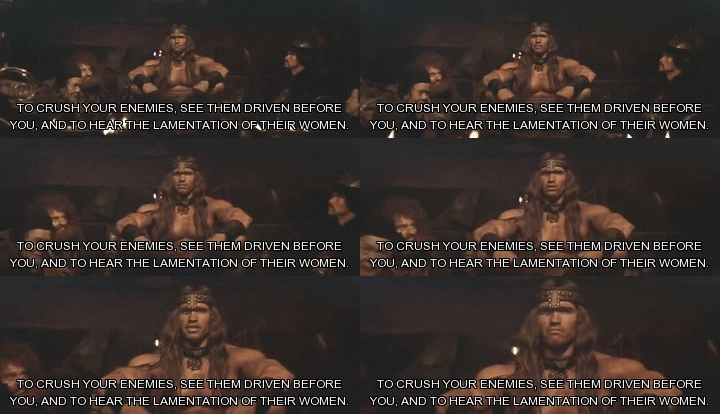
That's some early Conan right there. You know the scene I'm talking about:

Conan, what's best in life?


A striking similarity, don't you think? Siegfried really isn't that different from Conan, just more successful. Anyway, all this makes the princess very happy, of course. Hears it, rejoices, throws more gold:


Then spake the beauteous maiden: / "Glad news thou hast told me,

Wherefor now rich apparel / thy goodly meed shall be,
And to thee shall be given / ten marks of gold as well."
'Tis thus a thing right pleasant / to ladies high such news to tell.


Next the army arrives and is welcomed by the king of Burgund:


Shields full many brought they / all hewn by valiant hand,

And many a shattered helmet / into King Gunther's hand.
The riders then dismounted / from their steeds before the hall,
And a right hearty welcome / from friends rejoicing had they all.


Nice touch there, showing off the shattered helmets and shields to the king. Then the prisoners are brought before him. All are quite polite about the whole affair and make their peace right quick. The kings of Denmark and Saxon will have to pay a hefty ransom to get out of there again. And of course they have to vow that they won't do it again.

But the part with politics is short and the next thing we read about is our heroes chilling out and getting drunk, all displayed in beautiful verses:


Sweet rest then found the weary / their tired limbs to aid,

And gently soon on couches / the wounded knights were laid;
Mead and wine right ruddy / they poured out plenteously:
Than they and all their followers / merrier men there none might be.


They're all tended to (even the enemy) and those healers went home rich afterwards. This really is a strong theme in the whole story. There is no price to things, but even the lowest maid is made rich when helping the affairs of kings and heroes. Behold:


Who there had skill in healing / received reward untold,

Silver all unweighéd / and thereto ruddy gold
For making whole the heroes / after the battle sore.
To all his friends the monarch / gave presents rich in goodly store.


They just don't stop spending and the next thing you know is that the king seeks council how to reward his knights. A f*cking huge party, that's how. He takes 60 days (!) to prepare for the feast and all the knights get some time off to go home to their families. The ladies, of course, get wind of the party and start producing fancy skirts immediately.

And thus ends the fourth adventure.

Siegfried and Kriemhild have yet to meet each other and the party is where it will happen. But that will be part of another post.