Showing posts with label Review. Show all posts

Sunday, March 5, 2023

REVIEW: Of Dice And Men

Let's try a new thing. It will be a variety of "I read a book and talk about it", the difference being: I'm not doing it alone. My good friend Eric Diaz over at his (fantastic and fantastically productive) blog Methods & Madmen will read the same book and we will cross-post and talk about it. We've decided four books to start with (two of which offered by Eric, two by yours truly), all connected to the hobby one way or another. We talk about it, and see how it goes. The first one will be "Of Dice And Men" by David M. Ewalt, a book I wanted to read (and like) and now can't make my mind up about ... 

[source]
Character Sheet (what are we looking at?)

The "revised and updated" softcover version Of Dice And Men (ODAM, 2013) I perused clocks in at 285 pages, 32 of which are afterword, notes, acknowledgements and an index. Formally this book is done well, good formatting with no serious hickups in the editing (one word he kept repeating rubbed me wrong around the third time it was used, but that's all that comes to mind right now). Just from handling it, it's a nice book, pleasant to read, even.

Another positive observation up front: Ewalt consistently writes "role-playing games", with the "-" (the hyphen) connecting "role" and "playing" ("role-playing" is a verb, therefore the hyphen is correct). It is a conscious choice, because when quoting other sources, he uses their writing, which can be (and often is) different. I applaud that.

Somehow I care about this more than about if "gamemaster" is possible or not. If "storyteller" is possible, "gamemaster" sure as hell should be as well ... interestingly enough, Wikipedia's respective entries go by "role-playing game" and "gamemaster", so I feel vindicated.

Anyway, moving on, stated mission of this book is to offer "an enticing blend of history, journalism, narrative, and memoir", which is a tall order for 253 pages, but not impossible.

David M. Ewalt was an editor and wrote Advertisement for Forbes magazine, it seems, so there is nothing to gather about the guy's opinions whatsoever ... Not hating here, it's a plus in my book that he keeps a low profile, although writing advertisement is a stance in itself, right? His bubble is, according to his homepage, The Wall Street Journal, Reuters and Forbes. His job now is editor over at Gizmodo, again also writing advertisements ...

Good money, for sure, but it takes a special mindset to work in circles like that, and it shows in the book. At least it explains a lot how he constantly feels the need to denigrate his fellow gamer nerds (a group of gamers is a "stink" now, is it?) while telling everyone how great the role-playing is he's involved in is, implying his approach is more artsy (or whatever you'd say to "safe face" in front of an audience that'll judge you for the company you share but think you shouldn't).

Unfortunately that's a strong theme in the whole book and we will have to revisit it throughout, I'm afraid.

So this already is a mixed bag. I'll be honest and in-depth about my findings (and feel the need to state this because I feel it won't be a nice review in the end). Is this really "the story of D&D and the people that play it"? Let's find out!

In-Game Analysis (how does it play out?)

I will go through this roughly and from the beginning. Re-reading the introduction for things I could say about that already has me more critical about the text as reading it casually did. So keep that in mind. It nicely connects with the impression the book left with me, but we'll see if I'm able to connect those dots ...

The introduction it is, then. It seems to be the part of the book where the author aims to establish himself in the hierarchy of gamers as the "DM" of this book. As the moderator and the authority, if you will. It begs the question if the author just felt it necessary to build a defense against some hostile grognards, or if he just addresses the necessity of it.

I completely understand the urge, especially if one is used to write stuff published online. In a book, however, it appears to be a bit too defensive. I will not be very detailed about the structure of the rest of the book, but this introduction checks so many boxes already, a closer look at it helps to form and understanding how the book is written.

The introduction is titled "I am not a wizard" and starts with addressing the "hardcore fantasy role-playing gamers in the audience". The mainstream audience can just skip it and start reading. The text then switching to chum up to those "hardcore gamers" alluding that the "muggles" are gone now and we can talk business.

That's just a couple of sentences after claiming he isn't a wizard, so it is already a strange move to use a Harry Potter quote. But that's not even what bothered me (although I'm thinking now he meant not a "Wizard from that coast"?). It is the term "muggles" I object to, as it is abrasive while ALSO painting a less favorable picture of what he implies "hardcore gamers" think of the dirty masses.

It is divisive and I don't like that at all, especially when considering that no one reading that first paragraph would just skip it, so those "muggles" will read at least as far as to read being classified like that. It's not even cute, it's just cringe (if I'm generous).

[source]
 Moving on. Next, authority needs to be established. It reads like he wants to be the big man among equals, pointing out that he mostly uses 3e, because that's what he likes and plays, so if people think they need to criticize that, they can go and shove it up their asses (that's actually what he says ... if you don't believe me, just go and read that part on amazon).

Again, the only reason to be aggressive about this is that he expects some sort of backlash in that regard OR wants to establish hierarchy with a reader he thinks needs subjugating, because just stating that 3e is what he's playing now and what he likes would have been plenty enough.

Now imagine what someone would think reading that, who doesn't identify as "hardcore gamer" ... they'd have to think this sort of chest bumping must be necessary for some reason, which directly feeds into negative stereotypes already established. I'm so tired of shit like that.

Ewalt goes on and talks about how his session reports will at times not follow the rules of the game they played, but might take creative license in that regard to make it work in the book. First of all: obviously, duh. Secondly, that's not even how the session report sections are written to begin with, so why bring it up?

Feels like the "I'm the author here, and that's my skill, so shut up"-kind of way to, furthermore, establish authority over what he seems to perceive as a hostile reader? Again, painting what picture?

In closing he writes:
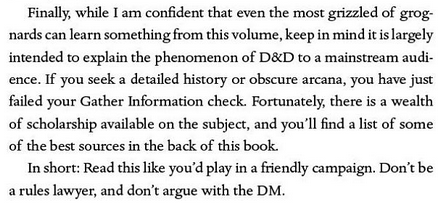
ODAM, p. 2

You read that as I do? Now he's protecting the "mainstream audience" from those evil grognards while snubbing the gamers as having "failed" in reading this properly.

But did they? The book claims to be "the history", not "a history", not "a short history", it's definitive. Nothing in the marketing actually gives any hint of this book being anything else but what it claims to be.

Anyway, he's (again) hinting the reader to go somewhere else. The last sentence, then, aims to cement his authority and advises to play it nice. It's funny, but if someone about participating in a game came at me as aggressive and divisive as that, I'd laugh them in the face if they ended it with "be nice to each other, this is a friendly campaign". Textbook passive-aggressive behavior, I'd say, and I don't care for it one bit.

This could (should?) have been done way more amicably. Easily. As it is, it starts the book off on the wrong foot, and every time he puts himself in relation to those (perceived) hostile readers, you'll see little stabs like that. Here's just a small selection:

  • says (as mentioned in the beginning) that others refer to a group of role-playing gamers as a "stink" (p. 56)*
  • explains how he's anxious to tell others since people have negative associations with the game, to a point where girlfriends leave (p. 75)
  • says gamers are a welcoming bunch, but then goes on to make an example how abusive gamers can be, alluding to something called "Arrogant Nerd syndrome", which isn't even a thing** (the story of Jonathan starts at p. 84) 
  • actually, this is worse than "just" showing how "abusive" gamers can be, it's inverting who's the victim here by saying that gaming should be a "safe haven" for nerds, but ostracizing them is understandable, because they can be, after all, difficult people ... and that's a shitty move***
  • he also dedicates three chapters talking about aspects of the hobby he doesn't like: traditional war-gaming, traditional role-playing and LARP, and I don't think he's giving them a fair shake just because it's not his thing ... more shitting on fringe aspects of the hobby

Let's leave it at that (see the footnotes for the venting). As I said above, it's written well enough, but what's showcased here is also evident in the whole book. Little stories and hints that seem innocent if encountered alone, but accumulate to something where the sum of the parts is uglier than the single encounters. A stink. Ha!

[Source]

Honest to god, I started reading this book to my wife, who's not a nerd at all, and she did not care for the tone of the book. I'm saying, it's not just me and it is important, imo, to highlight this aspect of the book before going into other aspects of it.

So what else is there to talk about? The history sections are excellent, from the very beginning of the idea of cooperative play in history, via early war gaming roots to the first conception of the rules that would become D&D and how that went viral in the seventies. All of that framed by Ewalt's gaming experience and intersected with gaming reports from when he started playing again (a D&D 3e campaign in a vampire apocalypse setting).

Mixed into that we get some D&D quotes, learn about some of the great minds of the hobby, now and then. Anecdotes, quotes from interviews ... Good show, and he runs strong with that until page 172, when Gary Gygax dies. After that, the book loses steam considerably, most of all because the history part of it is basically neglected. We learn how TSR fared after Gygax' departure, and how all of that ended in TSR being sold to Hasbro, but it's basically bullet points of names and dates.

It's just not where the development of D&D ended, or the cultural influence of it. It's just where the writer stops doing what he did well in the first three quarters of the book. We get more of the session reports and quotes and anecdotes, but even there Ewalt'll shift focus and introduce new stories. It doesn't always work, and that last third drags on until the author describes his pilgrimage to the origins of D&D and helps us see through his eyes what all the famous locations are now, which was a nice touch.

Beyond that, we get lots of fan-boying and shilling for WotC and the development of the D&D 5e, which I didn't care for. So, yeah, that's basically what you'll find in the book, without going that much into detail.

Awarding Experience Points (is it any good?)

A book can read well, but transport horrible ideas. Or better yet: it can hide terrible ideas behind a casual tone and a good reading flow. Not that ODAM is in any way, shape or form offensive, but it is "politically correct" while being uncritically vague and even favorable towards WotC and their business practices to a degree where boring just ends up being a vehicle for, well, advertisement or at least craving endorsement.

And sure enough, there are plenty of examples in the text where WotC is being presented favorably ALTHOUGH there is something to be said about the business practices of Hasbro and WotC in 2013 when this was published (the OSR was thriving back then for good reasons).

If not written in favor, that part of the history of the game is actually not present at all, instead we get a reference to another book for checking out the decline of TSR and nothing but praise for WotC "rescuing" D&D and moving on with the brand. No word on the counterculture movement and success of the OSR and the revival of the old editions ... Especially since he's obviously aware of "old gamers" and "edition wars" (as it is evident in the introduction).

And you don't have to be a "fan" to recognize this, but you have to mention it to cast a complete picture. WotC felt pressured to go back to those old roots because people turned away from 4e in troves.

At least Ewalt is honest about being an "ally" of the company and quite happy to support their drafting of 5e. He wants to be in on that action and is happy to be recognized as a "fan" by WotC. Even gets an invite, or so he writes.

All of that is problematic, in my view, as it goes against journalistic integrity to be biased like that, and "journalism" was claimed to be part of this "enticing blend". No xp for advertisement or networking framed as "journalism", I'm afraid (0/5).

[source]

History next. Those passages I enjoyed a great deal. It's well researched and cleverly put together. Lots of interesting trivia. The early years of the hobby sure as hell make for a great story, the good writing puts it to the next level.

But there is a huge stylistic shift after roughly 170 pages. The whole interplay between talking the home campaign (the narrative/memoir part) and the history of the game falls flat. The history part all of a sudden gets rushed and the home campaign gets neglected as well. With what is left, we go as fringe as talking about LARPs while important transition points in the hobby get ignored entirely or just mentioned very briefly.

The last 80 pages are full of odd choices like that, and I get the impression that the author didn't have the stamina to go it all the way (which would have ended in a far superior book, imo).

See, you can make fringe excursions if the main text has enough meat to carry a little extra context. This is well illustrated in chapter three, when Ewalt's talking about legacy war gaming (although I did not care much for the retelling of those battles). But when all the interesting bits fall flat (for instance, how the game developed beyond Gary's involvement), we are left with a boring mess of praise for Big Corp, at least three different session reports and an overall text that goes nowhere until it ends with a pilgrimage to something that isn't there anymore.

I have to admit, the end works for me. The whole idea of the tying the book together like that is nice, and my guess would be that it came up pretty early in the writing of the book. However, there are at least 150 pages missing, and that's a shame. Still, what's there is great (4/5).

Gygax, making history again ... [source]
Memoir and Narrative, now, are interwoven to form the skeleton the history is presented on. I liked bits of that, didn't like others. As with the whole book, it is all crafted by a skilled writer, but I still felt it lacking at times, especially when Ewalt tries to be non chalant about not liking his fellow gamers (the stink, it's an addiction, all being welcome means there are abusive people ... but I'm repeating myself) or blatantly paints an uncritical picture of those currently owning the game (WotC).

That said, I did like the idea of structuring the whole book that way (not the negative parts, but the private aspect of it). It works well until it falls short 172 pages into the book. And when he not tries to paint himself as "the gamer that isn't a gamer anymore but then falls prey to the addictive elements of it again and now plays a far more sophisticated version of the game", it is quite the engaging read.

Even the session report sections work most of the time. Again, until they don't because they have to carry the book in the last third while adding several additional new narratives.

Using this memoir/narrative angle, the book mostly manages to paint a picture of what the game can be and what its elements are in almost all dimensions (the roots, the social dynamics, how it plays, ...), and that's good, although not fully realized and with the caveats already mentioned (3/5 each).

Nice ass, though! [source]

In closing ...

When all is said and done, this is not "the" but "a story of D&D and the people who play it". The historic part is interesting and I wish there would have been more of that and not just the pre-history and the first 20 years or so. Our cultural dialogue with D&D is not over yet, as the latest WotC fuck-up about the license of the game gave ample evidence to gawk at.

Writing a 250 pages book (with only a third of that actually being about the history, if you take away the memoir/narrative parts!) and claiming there'd be no room to explore the history of D&D after Gygax left TSR just to avoid shedding a light on some "problematic" truths regarding Big Businesses Ewalt likes to associate with, is just bad style.

So how should we end this? Is it a good book in my opinion? Yes and no. There are so many shortcomings, masked by a well crafted book that reads well enough to actually work, that it comes down to a meager 2.5/5 (tendency towards the 2, after taking as close a look as I did just now).

The history part that is done, is done well and I enjoyed reading those passages. Learned something about the early history of the hobby, too. The rest was engaging enough for the first two thirds of the book and the last chapter.

What left a sour taste in my mouth was the blatant adulation for WotC and the constant (somewhat underhanded) misrepresentation of most the people that actually play those games as undesirable company. Add to that the missing history of the game after Gygax left TSR and a weak last third with a somewhat strong ending that would have needed a bigger book to work properly.

If that sounds like something you could stomach, you can sure go and get that book.

Let's see what Eric's saying about it (we coordinated publishing, but didn't read each others take ... what fun!): follow me there.

This has always been true ... [source]

* He just came up with it, btw., or at least I couldn't find an easy reference for it. People call their spouse "stink" or relatives, but not a group of nerds, as he implicates. At least not as wide spread as he'd make "us" (assuming a main stream reader? pleasing the WSJ buddies?) believe the term is.

** Try and google that, the only proper hits are referring back to his book, one making the (great!) point that he neglects talking autism in gaming while instead re-enforcing negative stereotypes again. Same pattern as with the "stink", all to make role-players look bad (or make it seem that they are perceived in a bad light). I think it's projection, but that's just my two cents.

*** I'll segue a bit into this in a footnote because I feel it's important: people are not socially awkward because they are assholes or abusive, it's because they are made feeling unwelcome and pressed into the fringes. And what happens in the fringes? Subcultures, which D&D is one of. Or was, it seems, given its popularity today. Anyway, point being, I associated with another subculture back in school, in Germany: the punks. And those had been REALLY socially awkward. For the same reasons. To now go and act as if those phenomena are just direct results of ones conduct instead of symptoms of something far more difficult to tackle (social dynamics of bullying and hierarchies and whatnot), is insincere. At best. "My people" have been excluded and ridiculed for a long time now, what Ewalt does implicates he's more like the people that didn't get along with nerds to begin with ... I wrote about this some time ago in detail, see Nerd Pride and Pop Culture going Full Circle.

Wednesday, August 18, 2021

Movie Review: The Green Knight (with SPOILERS)

We saw The Green Knight in a local cinema yesterday, and I have to say, it is a disgrace to the original. Calling this an 'adaptation' is stretching it so far that the Super Mario movie looks like a win in comparison. The audacity of that director to touch a classic like that without even a hint of an idea what the source is about (beyond the basic premise) to then project some very immature, pseudo-intellectual thoughts unto it (and I'm being generous here), seems very much to be a sign of our time. I want to talk about that a bit. Originally I started writing a comment on MeWe about it, had to stop in the middle to make it a post, as it very much concerns the state of what "art" is supposed to be nowadays and we can make a good example of this. This will contain spoilers and I will rant about this movie. You have been warned.
 
Preamble 
 
I have read a prose translation just last week. It had an essay by J. R. R. Tolkien attached where he talks about why this is an important work. I came prepared. If you want my two sentence take on the original (just as far as story goes), I see it as a pre-psychological examination of what is supposed to be the ideal man of the 14th century, measured versus Christian and social morality and values, tempted by seduction and fear of death. How Gawain (the best of knights) acts and why and what that means are themes that the author of the original masterfully played with. Let's talk about what the film did.
 
[source]


--**SPOILER ALERT**--

So Gawain is still King Arthur's nephew, but not even a knight. Instead the film begins with him waking up in a brothel, not knowing where his shoes are. He has no father, you see, and his mother seems to be a witch (as soon will be very clear, as she summons the Green Knight), so to flee facing this, he makes himself useless by drinking and whoring a lot. On Christmas eve the mother doesn't want to go to King Arthur's court and sends Gawain alone so she can do some witchcraft. Arthur is all splendor and father figure, but weak and decaying (a returning theme here, kudos to the actor actually pulling that off). Enough of a father figure, though, to be present enough at christmas to ask little Gawain if he is the man Arthur hopes him to be. Gawain says no, the queen says 'Not yet'. Then the Green Knight appears with his challenge, and Gawain, primed like that, jumps on the challenge without understanding a single word of it.
 
In the original Gawain protects the King from himself (Arthur wants to take the Green Knight head on) and takes the challenge willingly. Here? Not so much. Gawain thinks they are playing a game and is surprised that he just beheaded somebody, even more that it didn't take (side note: he gets to use Excalibur for the beheading, which should have done the Green Knight in, since it's all Morgan Le Fay's doing). A year goes by (just like in the original), but nothing changes for little Gawain, just more drinking and whoring and a bit fighting when the mother is addressed. Then the King appears to push him a bit to go to the Green Chappel and find out what's up (which in the film is supposed to be 6 days travel due north). He doesn't want to, but goes nonetheless. Scenes of the brooding mother are interjected throughout. Two days later he meets a stranger on the remains of a battle field. The stranger pretends to help, but sends him into a trap instead, where he is bound and gagged and left behind ... to die!

I kid you not. The camera moves from his concerned face through the forest and back to his dead and decayed remains, then back through the forest and then to the concerned face again. Next thing you see is him encountering a ghost and interacting with it. Actually, this is the point in the film where the quest turns psychedelic and 'magical' (before that magic is shown as something people like Merlin and the witches are the cause for, after that it's the land itself). It is reduced to nothing more than Gawains soul travelling the in-between to face death through the Green Knight's axe. The whole seduction part of the original (the core of the piece, according to Tolkien) is just one more random encounter, again with a massively changed focus. The frame is there, but the picture drawn is something else (and, I'd argue, lesser) than what the original had to offer.

In the end, the fox that accompanied him ushers a warning not to go (a warning like that was in the original, but mainly to elevate Gawain's resolve, here, again, it's all twisted and changed). Gawain chases him away and enters the boat that would lead him to the chapel (there is no obvious reason why the boat or the small river is necessary, he could have walked, again underlining the underworld-character of the scenery ...).

When confronted by the knight, he offers his neck to be chopped off, but flinches the first time (like in the original, but not with the same effect or for the same reason ... again, twisted and changed). The second time around, Gawain flinches again and asks "Why like that", just to get a "How else" as an answer. Before the third attempt goes through, he flees, screaming he can't do it, runs home, gets his low-status fling pregnant only to have the baby taken away from her (she wanted to be his lady, ended up being his brooding station ... many witches and a Merlin had been involved), he becomes king, gets married to a princess (witches and the mother, again).
 
He stays a coward long enough to see his son die on the battle field (the kid, for sure, believing the lies about the great Gawain, thinking it would make him invincible as well, because blood and all that ... that's only implied, though), and in the end, before "they" run down the gates to get to him, he sees all the women excerting power over him, leave him. Sitting alone in the throne room, realizing his unavoidable doom ... his head falls of and the scene cuts back to the chappel, before that last attempt with the axe.
 
Gawain is in the know now. He has been dead all the time, his life would have led to nothing. He gets rid of the garb that is supposed to protect him and tells the Green Knight that he is ready. The Green Knight says something to the effect of "Good boy, and now off with the head ...", which is how the movie ends. You don't see the actual death, the original ending is off the table, too, at this point.
 
If you disagree with my take on this being a dead Gawain, travelling to the great beyond, I'd just like to add that there is actually a scene where he sees himself decaying AND he brings it up in a discussion with the lady in the castle, where green is associated with decay. The director also uses the the old 'god shows the character how his life would have turned out to let him find peace'-trope*** to bring that shit home. So yeah, you can disagree, but dismantle that for a hot second ... 
 
Analysis (light spoilers)

What we have here is the story of a loser boy that believes the stories about knights and heroes enough to be forced into a quest by his mother and a sick father replacement, dies two days into the quest due to his naivity only to get tormented some more and get killed in the end again, this time accepting his fate, because being alive would have sucked way more (he came to this conclusion himself?).
 
It inverts and perverts the Heroe's Journey, which should be bad enough, but it also categorizes the relationship between men and women as evil and toxic. The mother is a witch, love doesn't exist, only obligation does, the idea of maturity through trial and initiation is a lie, institutions are a lie ... They went as far as having Gawain's shield, in the film a portrayal of the Holy Mother instead of the pentagram in the poem, splintered in front of him (which he laments, for unexplained reasons, more than anything else in that scene).
 
Now, in Symbolism, Mother Mary is The Throne of Wisdom, she is a positive influence on Jesus, helps him finding his way and bear his cross. A positive representation of the relationship between men and women. Psychology has caught up to that, actually, so it's not only the Bible talking about this. All of this is shat upon in that movie.
 
It'd be the hip thing to say "it is deconstructing Christianity and its cultural influence as a lie", but I don't think it does the harmful ideas given air in this movie any justice at all. This is, plain and simple, an aestheticization of Satanism*, and not the cute kind of Satanism people like to flirt with, but the serious kind that aims to pervert you towards uselessness.

The methods to convey those ideas are the most effective propaganda tools available to humanity: the film is drowned in music, the scenes are hypnotic, always aesthetically highlighting something irrelevant to veil the interaction and intentions between the characters (something you can see quite well in the discrepancy between Arthur's gravitas and his decay, for instance).
 
It's one sleight of hand like that after another. You don't question what you see because the film never asks those questions. It rather takes your attention to something else, something 'magical', and lets the interactions stand as something 'given', as if it is reality. That is some powerful psychological manipulation right there!

Really, just take all the glitter and lights on face value. What does it add up to? Beautiful noise, nothing more. Abusing the original like this only adds to the diversion by claiming the story is in dialogue with something bigger, but it only pays lip service to that (or attempts to corrupt it).
 
We need to start looking closer ... (no spoilers here, I think)
 
In the end, it's either very shallow and nice to look at, or it's hiding something very ugly while trying to inject certain values into an unassuming viewer. I tend to believe it's the latter, for the reasons I state above. 

Readers might be inclined to think this is about Christianity since I talk Symbolism and Satanism and what-not. They are mistaken**. This is about the values we held high in our society and culture for a long time.
 
Those values are, naturally and to some degree, influenced by the religions surrounding us, and as far as Sir Gawain and the Green Knight is concerned, an early idea of Christianity is a key element and needs to be considered. However, we, as a society, had been on a good way to transcend religious values into a set of staples that exist independant to religion (at least I'd argue as much).
 
It seems we are learning the hard way now that these values need to be upheld and protected. Taking movies like The Green Knight apart in public is part of that process. I know my reach, so this is of no significance for any Hollywood type out there ... still had to say my piece. But I see this happening again and again. Star Wars is a good example, Wanda Vision seems to be another one (see where the * leads). The US Comics scene has massive problems with telling 'good' stories, and the successfull ones seem to hide questionable messages. 
 
In a discussion on MeWe an online friend wrote that a lot of the public discourse today isn't about right or wrong, it's about having values or not having them. I agree with that a lot and I believe it applies here. Could I be off with my assessment? Maybe. You've seen me argue my case, I can provide sources for all of that (if I haven't already), so to take that apart, you should at least be able match that. I'm confident I can hold my ground, but would be happy to hear some great counter-arguments about it.
 
So would I recommend seeing this movie? Well, actually, yes. Avoid paying for it, if that possibility arises (in a legal way, of course), but yeah, if you've read the above (even if you disagree with my take), see the movie. The visuals are often stunning, as is the soundtrack, and there are some nice little story bits in it, all things told, so you'll most likely not be bored. I'd use some of the visuals for my games, for sure (and some of the ideas to portray evil, heh).
 
Far more important, though, would be trying to see what I saw, verifying it, if possible (it maybe all in my head, after all). If nothing else, I believe it can help creating an awareness for some ugly trends and ideas manifesting in our culture. Just because something is nice to look at, it doesn't mean it's virtues or 'true'.

If you have seen the movie already, I'd be happy to hear your thoughts on it. Can you see my points? Where am I off?

I'll leave it at that (although I'd have to say more, I think I said what I needed to say).

* Jonathan Pageau has a great take on Satanism like that. See the video here on yt.

** I'm not a Christian, but I appreciate the positive influences Christianity had in our culture (there's lots of bullshit, too, mainly stupid politics, but anyway). If pressed, I'd say I'm a Daoist. If I were pressed to explain that, I'd say it's like Zen Anarchism (in that Zen is the little brother of Daoism, and thinking like that makes you an anarchist, it seems). 

*** Only thing is, where that insight comes from is not explained. If that's something the character is alluding to, it's even more stupid than I assume it is.

Saturday, June 17, 2017

Free RPG Day 2017: Random Encounters

So I've been checking drivethru on their EVERY DAY is FREE RPG DAY promotion and fell in love at least twice. There's some great stuff out there, but I want to highlight just a couple of items I think worthwhile for one reason or another. Here we go ... Free RPG Day!


FIRST IMPRESSION: Nice Cover, name-drops the Space Dandy ... good enough for me.

FIRST LOOK: A short one with 21 pages. The players are bounty hunters IN SPACE, the DM is actually the opposition, trying to get rid of the players. The engine is card based and uses poker chips as currency. No chips and you are out of the game ... Clean layout, no artwork, has a character sheet at the end.

VERDICT: I like it. Seems to be a fun one-shot game if all players and the DM are on the same page. Only thing I'd house rule immediately is that players need to be out of the game once the character is dead. "Need to be" because the DM wins if all players lose all their chips and the players win if the DM loses all of his chips ... so creating a new character and bringing new chips to the table might be a no-no. But it is easily enough fixed by having them work for the opposition (they get the chips they lost to play some opposing force supporting the DM, maybe?). Or something. Anyway, seems like a fun little game and you can get it FOR FREE! (PWYW)


FIRST IMPRESSION: Nomadic tribes on a landscape made out of flesh ... very weird, good enough for me.

FIRST LOOK: Evocative layout and art, very rules lite, just 8 pages long. Players are leaders of a tribe trying to survive in a very weird environment. Wizards are called "Moulders", which is quite nice. Sounds like fun, too.

VERDICT: This is a gorgeous little booklet, lovely done. If you are into rules lite systems, this works as-is, but it's easily enough used as a setting book for anything you want to use. Very much worth checking out, imo. And you can get it for free, of course! (PWYW)


FIRST IMPRESSION: I liked title and cover, actually reminded me of Wall-E for some reason before I read a word about it ... good enough for me.

FIRST LOOK: The first surprise is that this is a big one. A completely fleshed out rpg running 150 pages. The premise is interesting, too. Humanity is gone and left all kinds of service robots behind. Players play those robots and explore the apocalyptic wastelands for a number of reasons (purpose, spare parts, energy) ... yeah, that's Wall-E alright.

But it's also so much more. Spielberg's horror movie A.I. is in there (that movie is so cruel ...), some Philip K. Dick, a bit Star Wars, the Hitchhiker's Guide, lots and lots of sources can fuel a setting like this. The system seems a bit inspired by White Wolf's d10-system, which I like quite a lot, so that's a plus. It also has lots of moving parts, random creation of ruins, sample characters and lots of scenarios. Good advice, too.

VERDICT: This is the full package! I love it and I want it in dead tree format. I'm really happy I stumbled across this game. Concept, layout, game design, all top notch and it sounds like a fun game. Definitely something I'd like to DM. And it is FREE! (maybe just for the Free RPG Day promotion, so you might want to get into that action ...)


FIRST IMPRESSION: Liked the cover, name-drops DieselPunk ... you guessed it.

FIRST LOOK: A complete game, 210 pages strong. Chapters are hyperlinked, which is a nice touch. Artwork is public domain or free and all over the place. The whole thing has a strong DIY-vibe and is full with ideas and concepts. Took me a while to realize that the first half is a rather generic system you can use for everything and the second half is where it gets into DieselPunk as one possible scenario. The writing is excellent if you like funny and the system seems to be very light.

VERDICT: I'm not sure I'll ever get to DM it, but it's one hell of a good read and I'd definitely play a character in that system. While my first impression had been less favorable, it grew on me while I read parts here and there and I got to say, if this is a hobby effort, it's quite impressive. Good show and, of course, FREE! (PWYW)


FIRST IMPRESSION: I had read good things about this game, remembered it ... and here we are.

FIRST LOOK: 77 pages, professional layout and artwork, there is a epub-version with the download. Very rules lite and kid friendly, as you'd maybe expect from a game like this. It goes after a short introduction directly into character creation, which I think is a mistake (it should give at least a basic concept of what the game is about and how it works before going into detail, me thinks). On the other hand, it's all atmosphere and setting. I respect that.

VERDICT: Lots of flavor and lots of OZ to get here. The system is "roll under" which is something like personal Kryptonite for me (I just can't roll that way ... early conditioning or whatever, sorry GURPS), but that's changed easy enough (it's really a very light system). It's as much usable for something of an "adult" campaign as you'd expect from a game like that: not at all. This is a game you play with children, maybe after you've read the books with them to let them explore OZ themselves. But that's not a bad thing. On the contrary, I think it might be a great way to get young ones into the hobby. Highly recommended if you can find use for it, even just as a setting book. And it is [drum roll] FREE! (PWYW)

Honorable Mentions

The Maze Of Memory (fun little OSR-rpg with a great premise ... free for the weekend, I think)

Wolf-packs and Winter Snow (primeval LotFP clone, could go well with Fleshscape above ...)

Motobushido (card-based rpg about motorbike-riding Samurai in a post-apocalyptic world ... great fun)

SLÜGS! (LotFP last years entry for Free RPG Day ... a great read from cover to cover)

And that's that. I know there is lots and lots more like it. If you have any suggestions, please leave them in the comments for others (and me!) to check out. I know I fell in love with Engine Heart. What a great little game, definitely recommended! So happy :)

Also, I have a little PWYW module out there in the wild: Monkey Business! So maybe you want to check it out while you are over there looting (if you haven't already).

I wanted to end this with something like "Now go and hunt for those magical Vaginas!", but thought better of it ... Have fun gaming and sharing the love, folks!

Thursday, January 12, 2017

Revisiting a Classic 2 - Vampire: The Masquerade (First German Edition, 1993)

Vampire: tM has been HUGE in the 90s and when the German translation of it hit the shelves (the second English had been the first German ...), I was no different than many, many others. We played it for a while and then stopped. Now, 20 years later, I take another look at those books to find out ... well, to find out what I'll find out. Spoiler: it's more different than we played it back then and way more "old school" than most of the old school today. This is Part 2.

New to this series? Here's Part 1!

Second things second ...

Did Vampire fail as a game because it succeeded as a business model? Is this even the proper line of inquiry? I don't know. What I know is that I lost interest in the White Wolf splat book orgy way before I lost interest in the game. I mean, it had been kind of insane, right? V:tM 2e (English version) saw 57 publications between 1992 and 1998. And that's just classic Vampire! There'd been several other lines, Werwolf: The Apocalypse being the strongest among them (I think).

Then they revised it in '98, published and re-published it all until they actually discontinued the whole thing in 2004 ... to start the franchise completely anew the same year and revive the "classic World of Darkness" (cWoD, not oWoD as I wrote in Part 1) again in 2011. Sheesh, that's a lot of canon. No 2 (c)WoD group ended up with the same game, for one reason or another.

Add discrepancies between the different rule sets and the lack of compatibility that came with it and you have a beautiful mix for all kinds of edition wars, splat book wars, variant wars ... So boring. You invest hundreds and thousands of credits into a game, just to start from the beginning every 6-something years, you make it your own every time and then you fight for it because you want to be more right about your decisions than others. Sounds very much like the D&D publication history, right? Still don't see the appeal.

Once a year in Leipzig ... the WGT! [source]
Anyway, the World of Darkness was a phenomenon and made lots of people earn a decent buck. So many, in fact, that the game is still running strong today. At least where I live (Leipzig, home of the famous WGT - Wave Gotik Treffen) and on several strong communities all over the internet. Add PoD for almost the whole product catalog and high availability (most local game stores will have some of it or can order more quite fast, amazon has a decent selection, lots of cheap used books and so on ...).

Well, they couldn't have known in the beginning. The 2nd English edition was published just one year after the first edition and the German translations had been even more behind, which left the game quite, let's say, innocent and untouched from all the bloat that was about to follow. Back then we didn't draw as much inspiration from the World of Darkness as we'd get from movies like Interview with a Vampire and The Lost Boys or comics like Preacher ...

Actually, I think it's safe to say that they hit a nerve with their game. Urban Fantasy was already in the gaming subconscious in the 90s and is still running strong today. White Wolf managed, if nothing else, to constantly add to that some way or another. They still do. As a matter of fact, I just saw a huge part of the SyFy series The Magicians and it's a picture book Mage: The Ascension campaign (without being associated with WoD).

That's why it worked for me back then and still kind of does today. But back to the book ...

BOOK 1 - The Riddle

Chapter 1: Introduction

The introduction chapter is remarkable for a couple of reasons. Of course you get the basic "what is role playing"-part and there are some words on the position of the storyteller and the players. All of it is written as if the reader is completely new to the hobby, building references to the nature of the game and about telling stories in general through common denominators like playing cops and robbers or board games. That's one way to do it and, as such, completely unremarkable.

Where it gets interesting is as soon as they finished talking about characters and describe what a "Brut" is (English equivalent seems to be the "coterie" or pack the characters form). It actually becomes part of the "hierarchy" implicit in the games structure that is: storyteller - players - characters - group.

That is something you see rarely (and I think something White Wolf than dismissed at least for the revision) and I think it's a good thing. Role playing is not only a bout playing a character, it's about playing a character that needs to function in a group. It's the first time they make that point in the book and pretty early established, at that. We will encounter this again later.

Another great piece from the book
by Tim Bradstreet [source
Another thing the introduction does, is explaining some core terminology of the game. Interestingly enough, this is solely focused on becoming a Vampire and what that means, which then, in conjunction with a few sentences about the winning or losing in Vampire, ends the whole affair with the spirit of the game: what's it like to be a Vampire.

I think this is nicely done, leading the reader from having no idea to knowing the gist of it without already overloading it with choices or details. The only thing I felt a bit out of place here were the parts about Vampire LARP, but I guess it's fair to mention it here, as it gets a little bit more detail later in the book.

Prepared like that, we can dive into the World of Darkness as a setting in the next chapter ...

Chapter 2: Scenery

The World of Darkness is a Gothik Punk setting and we get to read about that, true to the introduction, through the eyes of a Vampire. This is the first impression we get. A transition from our world to that much darker and scarier counterpart of that world, where Vampires actually exist. Streets full of blood, corrupt politics, decline of western culture, overpopulation, all that experienced in an endless night and trapped in the cities because creatures more dangerous than vampires wait outside the city limits. Horrors facing horrors.

It's a nice blend, ending with the idea that Vampires try to keep as much humanity as possible to keep sane in a cruel world, before we dive into the World of Darkness proper and learn about the social hierarchy of the Vampire society. This is still keeping on the surface, but we get an idea how old Vampires could really be, like biblical old. And it introduces the concept of a "prince", something almost every city will have in one form or another.

That's what Gothik Punk is nowadays: a fashion statement ... ah, well,
can't make that shit up [source]
Again, I admire the structure here. After introducing a couple of new terms, we go back to Vampire politics and intrigue, which then leads to the necessity of rules for a Vampire society and introduces the Traditions, the rules enforced on most Vampires and what happens to those who break them. A good example how a setting informs a style of play, hierarchy and plot before the rules.

Next we learn about different Vampire sects, Camarilla, Sabbat, Inconnu and all those different political groups and their ideas. This slowly gets more and more detailed, going slowly from the outside to the core, conveying general knowledge to allow a reader seeing how it all connects.

The next part is, consequently, about the different clans and their origins. A nice twist here that this introduction really is about the origins of the clans instead being about what you could be playing. So the learn here that the Brujah had actually been guardians of knowledge before they fell from grace and ended up in the desolate state they are when we enter the game.

The way this is set up, a reader will have to wonder what of it is true and what kind of scheme is behind all of it. Why are the Brujah held in this state of desolation? Is it all a big scam from one of the old ones? Part of the Djihad? I found it very inspiring. You get just enough pieces of the whole to wonder what it all might mean. That's good writing.

This is a meaty chapter and before it really goes into detail about the generations and origins of Vampires, we also get to read about lesser clans and other oppositions, like werewolves and witch hunters. It all sums up to a quite delicious Urban Fantasy mix and it makes quite clear that the Vampire characters players will get to play are monsters, for sure, but very low in the food chain.

The end of this chapter is a lexicon not of game terms but of slang terms, used by Vampires and divided between general terms, old terms and slang. I love that. The idea is that you can get a sense of a Vampire age by the language he uses, which is solid advice to begin with, but getting that close a look into the culture at this point is just gold. I really enjoyed reading this although it's basically a list of entries with short explanations.

Chapter 3: Storytelling

Notice the pattern here? After getting a head full of ideas and concepts, the next thing you'll read (when reading it in order) will be about how to make a story for the game out of it. Still no rules, just a world, a couple of ideas and some basic structure to get them told. That's what I'm talking about. The book is taking the reader/storyteller by the hand, teaching basic knowledge about the craft before anything else and it's about telling good stories.

Role playing games being a medium with it's own set of peculiarities (compared to books or movies or what have you), this whole chapter is a lot about the dynamics between storyteller, players and the rules and the things you have to consider when telling a story in a role playing environment. It's all solid advice.

Actually, I had been a bit afraid encountering the tendency I've seen in other storyteller games, where the story always trumps the rules (which always means that storytellers should ignore die results that harm the story, like a character dying, for instance). But no, they actually say that you have to find your own way handling it, but ignoring bad die results because they might hurt the story, will hurt the game instead in the long run. So what a good storyteller does, is finding a way to make the result work despite the bad consequences.

This doesn't mean the rules have to be obeyed by the letter, but the storyteller will always have the last word (which is good), he just should consider the implications if he openly ignores the rules to change some outcome (which is true).

This chapter also talks about different player motivations to participate in a role playing game, about storytelling techniques, in general and advanced, gets a bit more specific about LARPing Vampire and how important props and the right surroundings are for the game's atmosphere (never play during daylight hours, use lots of candles ...) and has a nice list of do's and don't's.

At the end we get an excerpt from the Book of Nod about the biblical origin of the Vampires in the cWoD.

And that's the first three chapters (or 75 pages) of the book. I'll say it again, this is good writing and a great introduction. It leaves the mind spinning with possibilities and ideas while establishing all the pieces necessary for the game. At this point someone aiming to be the storyteller of a Vampire campaign, might already have a general concept or idea what he'd or she'd like to do and how. I think that's impressive.
The kind of story* I had in mind in the 90s ... [source]
It really shines with it's general advice. I mentioned at the beginning of Part 1 that this game really informed how I DMed all my later games and this is why. You don't get that by reading the Rules Cyclopedia and I don't know about any game before Vampire that explained role playing the way Vampire did (if you know one, please share in the comments!). If you read a bit on my blog, you'll know it all had a lasting impression on me.

Part 3 will be about BOOK 2 -The Becoming

After reading about a quarter of the book, we finally get a glimpse of the rules. Just the basics, really. And then we get to make characters and plan proper campaigns in the cWoD. All this will be discussed in Part 3, of course. In the near future (I might mix it up a little and write about something else in the meantime ... let's see how people take it).

I have to say, I enjoy good old Vampire a great deal more than I should. Already have an idea for a campaign, too. Well, maybe I'll make a final post with a campaign hook and all the ideas I have collected so far. We'll see.

When writing this and doing the research, I found out that they changed a lot with the revision of the rules in '98 and I started to wonder at what point people entered the game and which editions they read or what their impressions had been. Is there a huge difference to what I described here? I'd be happy to hear some thoughts on that, if someone is willing to share!


* I mean the Preacher comic, of course, which I was a huge fan of back then. A Vampire, a preacher and an assassin go into a bar ... never gets old. Was the source for some great stories, too. I just got to re-read it and I have to say, it's still fun (just not very pc ...). Btw, ignore the tv show. It has nothing to do with the comic. Nothing.