Showing posts with label Mean Monsters. Show all posts

Tuesday, June 28, 2016

The Dragon's Cough Part 2 (a low level scenario for the D&D RC)

Including: why dragons might have minions
and
introducing the Black Ear Kneesnappers goblin tribe

And here we go, the second part of that sick dragon adventure scenario I wrote about the other day. This one will start describing the minions, contacts and enemies of the dragon with some alternate (and community fueled!) adventure seeds for good measure somewhere down the road. I'll also give some notes about my thinking here to make this reproducible and all that (turned out to be the main part of that post ...). For rules I use the D&D Rules Cyclopedia (D&D RC) and house rule were I think it's necessary, but it should be easily adaptable with the whole D&D family ... This will have more parts than I anticipated.

Here's the introduction to the whole thing and here's Part 1

[source]
Do dragons have minions?

Or are they solitary creatures? That's a very difficult question to answer, I think. They'd most certainly have contacts, if they are of the talking sort and already around for hundreds of years. Wizards. maybe, or other dragons. There's a multitude of possibilities for allies of all sorts, actually. And the use of alignments in D&D makes it even more likely that they seek contact with theirs.

I don't necessarily think they mingle or are any other kind of social, even the lawful ones should be reclusive, going by literary examples alone. But (and this is a BIG "but") in the worlds D&D usually describes, it's not the dragon that is the alpha predator. He might be among them, even rank somewhat high if he gets old enough. But in a game (the D&D RC, in this case) where heroes get as high as level 36, wielding powerful items and magic on a planetary scale (to give but one example), a dragon might have to know his way around to be able to survive. And that means for starters alliances and gathering knowledge, followed closely by intrigue or manipulation or brute force were necessary (and possible).

Because a poor 12 hd creature might manage to be on a rampage for some time, but will die just as fast if the wrong parties get involved. And dragons being creatures of habit, stealing thousands and thousands of coins for a pile to sleep on will get powerful people involved sooner or later (emphasis on sooner, I'd say). So there is that. Dragons might need influence to ensure survival and that means allies and contacts.

With minions it's a bit more tricky, but I think in part also a consequence of the former thoughts. Or that's one aspect of it, at least. it's practical to have satellites to do the dirty work or represent you a little less ... conspicuous? Dragons just don't walk the streets of the next big city (well, they could, but that'd mean lots of stress on a vanilla setting like, say, Mystara ...). Using proxies, representatives, surrogates or anything else like that is very likely, then. And that means minions.

A second point would be that D&D RC dragons sleep a lot and I doubt that they'd do something like that unprotected in areas with dense population and way too curious types around ... Minions are a logical consequence because of that, too.

Getting the point across: a cleaning fish in action ... [source]
But there is yet another, (in my opinion) far superior argument. Dragons are big and complex quadrupeds and most (if not all) other creatures that size will attract symbiotic relationships with lesser creatures to make life easier for each other (like those "cleaning stations" described here). This being fantasy, we have with dragons not only giant dinosaurs, but sentient giant dinosaurs and I'd argue that their needs are to be expanded by that dimension. In other words: goblins could be to dragons what cleaner fishes are to, say, giant moray eels ...

One final paragraph about solitary dragon variants, though. There are those dragons without speech or hiding at the fringes of civilization. They could very well be solitary, terrorizing their surroundings without consequence for a long, long time. It's not what I'm trying to do here, but still a very worthwhile encounter to have in a campaign.

Minions and Contacts 1

Back to minions. I think symbiotic relationship describes my approach to this best. The dragon we are talking about here, Arez, has (needs) a territory with a radius of roughly 12 km and a lair that fits his size (double that during winter times, btw). I furthermore assume that he'll try to keep up to date about it, so he'll need sentinels and scouts. It might have small settlements in such a territory or even trading routes through it and goblins might not be able to move everywhere freely, so it needs eyes and ears and daggers as well (maybe even beyond the territory).

The rest is politics as you know it: bribes, rumors and the occasional poison accident. Stuff like "There are goblins in those hills, but they are mostly harmless and keep out of our way ..." or "Oh no, we don't hunt in those woods. They are cursed." or "Yes, they have tried to mine in that area, had a small settlement even. But they all got sick and died, so our thinking is that it's bad luck to settle there." or something like that. People will have reasons to avoid key areas and won't have a clue that it's because a dragon is living there. Hiding in plain sight and all that.

Anyway, the general ideas of "why" and "how" aside, it is just as important to individualize those working for and with a dragon. As I wrote somewhere else (I know it's in here somewhere, for instance), it's boring to just have a set of numbers for an encounter. It's also something a monkey could come up with, so when writing an adventure, it's the least important part. Beauty is in the specific. at least that's what I'm trying to show in this post. Here is my first example:

The Black Ear Kneesnappers (a Goblin Tribe: 45 normal, 23 young, 11 invalid)

Those mean little buggers are the loyal servants of Arez the Derisive. They worship that dragon, carrying idols and little keepsakes with them as good luck charms (dragon toe nails or scales, stuff like that) they (more or less secretly, at least without consent) gather during dragon cleaning shifts.

They tattoo their ears with their deeds up to a point where those ears appear black from a distance.

They might be about in the territory as soon as the sun is down or all day if the sky is covered in clouds. Their first impulse is to run for back-up and strike with force (if they think it's worth it or a threat), ideally from an ambush of sorts. They are clever about it, too. Other than their lucky charms, they prefer to wear black or dark green cloths and appear healthier, better equipped and cleaner as their "unemployed" counter parts in the mountains. They also carry no treasure other than their charms, because, why should they have coins? To go for a pint in the next pub?

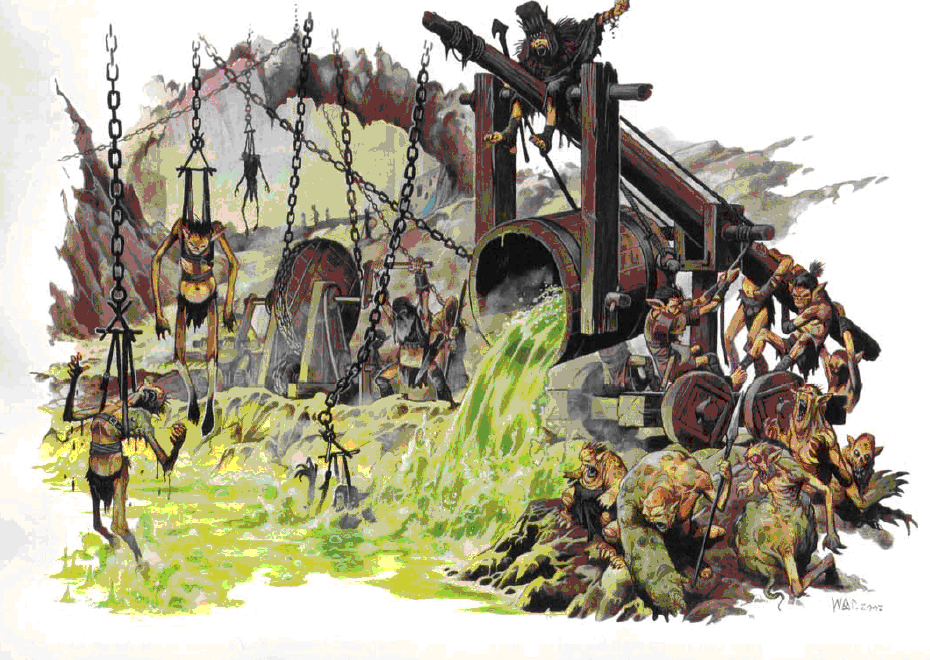
Bonus Escalation Seed: Once the goblins realize the potential of the
dragon mucus, they might end up doing something like this ... [source*]
Tactics: if they hit a target with a 16 or more it means that they saw an opening in a characters defense and go for the knees instead  of doing normal damage(characters need to make a save versus petrification or fall down and getting as much damage as they rolled over target). They also love collecting ears, so if a character falls unconscious, 1d2 Blackear(s) will take the time (one round) to cut off that characters ears (each Goblin going for one ear) and waving them triumphantly accompanied with some savage screams and dancing (giving all goblins in this fight +1 to attacks and morale from each round that happens until the end of the fight).

Goblin monster stats as per page 180 in the D&D Rules Cyclopedia (and something every DM should know by heart, right?). Use the following table to make it a bit more colorful:

Diversity Roll (d6 each for 1d4 of the encountered group):
  1. Female Warrior (prefers to attack men, goes for the nuts with a 16 to-hit or higher with the same result as described above, her intimidating presence also raises morale by 3)
  2. Veteran (a old and experienced goblin, will fight with a small bow and shout tactical advice, give all goblins a +1 to hit, has some ear lucky charms ...)
  3. The Crazy (check every round if this one does something totally irrational like attacking a tree or barking, there's a 50% chance that he acts normal and the manic nature of this guy gives all other goblins a +1 to damage)
  4. Shaman (level d3 goblin cleric as per page 216, D&D RC)
  5. Wokan (level d3 goblin magic user as per page 216, D&D RC)
  6. The Sick (the goblin metabolism is mostly able resist the bronchitis draconis, but goes through horrible changes if infected (a 1 in 20 chance) ... the resulting dumb and slimy goblin hulks gain double hd and two attacks per round with their natural bone weapons ... everyone fears them and they stay to die)
Current affairs: The tribe is on high alert right now because of the bronchitis and the mean attitude that seems to come with it. The weak of the tribe have sickness duty most of the time and half of the rest is out and about, either looking for herbs or for threats (which are a plenty and part of  later post). The rest is protecting the lair and the young. Because of that they are out there all day, sun or not.

Thoughts on Part 2

Well, first of all I hope this is useful, of course. It's not necessarily how I would put something like that down for my campaign notes, but it shows the thought process and illustrates the result as you'd expect it in a blog post. It's also full of the things I tend to hand wave if I haven't written them out in advance.

Arez really digs those sleazy pulp novels ...[source]
Just as I wrote above, beauty is in the detail. Those goblins aren't that much different to what you'll find in the book, but they have individual combat tactics and will leave an impression on adventurers who happen upon them. They have a bit culture and some motivation, the rest is still chance (if and when they are encountered and how they react).

Next up will be some individual servants of the great Arez (a senile dwarf assassin with a thing for poisons and a somewhat mad writer among them) and some contacts ... There are at least two more parts in this thing.

Thoughts and ideas are, as always, very welcome. I already have some additional adventure seeds from some great comments and if you got an idea or something you'd do different, please share it with us. I'll collect all of that and put it in the final post as variant adventure seeds for this scenario!


* Originally an illustration from the 3e Book of Vile Darkness ... I mean, if nothing else, at least it had some decent artwork.

Wednesday, July 10, 2013

Hannibal (On the Essence of Evil)

A few words about Hannibal the tv show. I just adore it. Unbelievable that they managed to air a whole season of it, with another one following in 2014. For me, it redefines psychological horror. It's so rich in dark subtext, that even with nothing happening on the screen, the viewer gets a feeling of suspense and dread. Complex and intelligent, a rare treat.

Here is a quote from Bryan Fuller (found on wikipedia):
"'What would David Lynch do with a Hannibal Lecter character? What sort of strange, unexpected places would he take this world?' I'm a great admirer of his [Lynchs] work and his aesthetic and his meticulous sound design. Those were all components that I felt very strongly needed to be part of our Hannibal Lecter story. Between Lynch and Kubrick, there's a lot of inspiration."
David Lynch and Stanley Kubrick.. he's not just paying lip service here, I honestly believe they pulled it off (not necessarily at eye level, but close enough). Writing, sound and visuals are as good as money can buy and the actors are stellar. Way above what should be possible in a tv show (and maybe comparable with Game of Thrones in this regard).

Hopkins doesn't do it for me, really.

Mads Mikkelsen is a brilliant cast as Dr. Hannibal Lecter. I read somewhere that his thick accent makes him unbelievable and that's so far from the truth, it almost hurts. It benefits the role a great deal. As a viewer you're bound to know who Hannibal Lecter is. You know he is a cannibal and as evil and dangerous as they get. And Mads Mikkelsen is exactly that - for the viewer. But not for the cast. They take him serious and ask him for advice. They even act after it! It's that discrepancy that makes it work for me.

You have to wonder... (source)
The show is, to give an example, a lot about the fine art of cooking and there are quite a few scenes with the characters sitting at a table and Lecter serving something that looks delicious, explaining in detail what they are about to eat. And then they enjoy it, talking about other stuff. The viewer has to think "They're not eating chicken, fer crying out loud!". It get's me every time. It's almost like a running gag, but scary at that. One time at such an occasion Lecter states, rather nonchalant,  "I like to have friends over for dinner." and I couldn't help but thinking - yeah, right, nicely cooked with a good glass of vine.

The Essence of Evil

The script does a lot to help making him one of the most effective villains I've seen in a long time. It adds to Mikkelsen's calm and reserved presence. How he interacts with his surroundings and shapes events, with a few notches here and some misdirections there, is just delightful to behold. And evil. Nothing redeems this character, all his actions and motives are irrevocably distorted. Only the viewer is to understand that for a very long time and Lecter keeps being in control so long, it's unnerving. But in a good way (as far as tension goes).

With all the serial killers portrayed in the show, he is the most evil one. By a long shot. Which seems very difficult at times, because those are examples for some very creative writing and good acting (Spoiler! One was breeding mushrooms on his comatose but living victims... End of Spoilers!). But even they are for him just means to an end. If you ever asked yourself what the term evil could entail, Hannibal Lecter, as staged in this show, is the paradigm for it.
___________________________

What to use in The Game?

It might be pretty difficult to implement a character like Hannibal Lecter into a D&D game, but not impossible. One idea could be to use a city crawl with a heavy social context in a vanilla setting (civilized, the day to day horrors of a D&D setting merely rumors). Hannibal would be, to take a fantasy analogy, an alchemist of sorts and a pillar of the community. Wealthy and with status, but well liked by the people for his "good" advice. Not so much a spider in a web, but the core of an onion, so to say. Not a Big Player, but a great manipulator.

Famous for his great dinners and responsible for the declining minds of at least one wizard doing terrible experiments, one or two cannibals and a few nobles with horrible hobbies (to give but a few random thoughts). The social structure around him is his playing field, his manipulations nearly undetectable (the suicide of the brewery's owner drove his wife into madness, which in turn put enough pressure on the son to become a cruel drunkard, because he had the potential, but he had to be the new boss in the brewery and this led to a series of violent behavior from his unhappy workers, the weakest of those pushed hard enough to hurt their families, until one of them bashed his new bosses head in... always just a notch, coming clean all the time).

(As a side note: in the Settlement as Class idea I proposed two posts ago, he would deplete WIS. Catching him would refresh the ability score with time, making the town a better place to live in.)

It could also be a lich, totally content with perverting the unsuspecting humans living in villages and castles nearby. It's like Fuller said: what influence would such a character have on the world he lives in...

Have any of you ever had a serial killer as part of the D&D game?
___________________________

That's it, my love letter to the show. If you haven't had a chance to see this by now or were reluctant about giving it a try, I hope my unfiltered praise helped getting it on your radar. DMs of Lamentations of the Flame Princess or fans of David Lynchs work (or psychological horror in general) should have a lot of fun with it.

It's nothing for children, though. Very mature content, not for the faint of heart.

Fanboy: Out

Saturday, June 15, 2013

Kazek Del before the Fall (Part 1)

Karik Thel - Island of the Floating Trees

Untouched nature (source)
The island is located in a hemiboreal climate. Forest hills and ravines are the dominant scenery, mild summers and harsh winters the norm. It measures ca. 3.000 square kilometers, which is, according to The Measurement of Things, very nearly the size of the Yosemite National Park. It equals 16 ten mile hexes, if I've done the math correctly (using wikipedia for the formula and the 10 miles for "d"...*).

Elder Elemental? (source)
Magic is strong on the island, so naturally the fey folk feel at home here and earth elementals are very common and very much like the trolls in the scandinavian legends. Nature not only thrived here, but was very much able to defend itself against humanoid colonisation attempts or ruthless exploitation. Those were the good times.

The Mushroom Wizard

One entity living on the island became famous beyond it's shore and was only known as The Mushroom Wizard**, named so for the mushrooms apparently growing in his enormous beard. He seemed to be able to appear anywhere within the island at will and was rumored to have some weird control over the earth elementals living on Karik Thel. He was a strange fella indeed, irritating behaviour and incoherent blathering being among the more favourable descriptions, weird and crazy are close seconds.
Scene is from Hannibal, s01 e02 (found here). and
inspiration for the Mushroom Wizards minions.*** 

The scariest among the many legends told about him, was the one about the shroom zombies he created. Humanoids, completely covered in mushrooms, were his minions and dangerous foes for those opposing them.

ShroomZombies

Basis is your normal zombie, but the longer they exist, the more intelligent they get, so for every hd after the initial two, add +3 to INT. They gain their ability to speak with an INT of 7 and memory about their past live with an INT of 10. This process stops at the initial INT the creature possessed. If the creature is slaughtered within the fungus network**** and had 13+ INT, the network stores it's memory. It might spawn an organism copying the slaughtered ShroomZombie within 1d4 weeks, ensuring some sort of immortality, but no more advancement of INT (might advance otherwise, though). They are not dead, which might come as a surprise for a cleric.
They also have no will of their own, but the more intelligent they are, the more complex are the orders they can carry out and as soon as they regain their full personality (INT restored) they're no longer under his controll, but part of the fungus network and forever marked by it.
Resting a ShroomZombie in humid earth within the fungus network regenerates 1d4 hp per day. For advancing the ShroomZombies I'd alter the Zombie Chaotic Advancement Table (C.A.T.) I did some time ago (here) to something like this:

ShroomZombie Advancement
(1d8+1d12, every uneven result adds 1 hd):
2  Masked puppet: No visible mushrooms grow on this ShroomZombie and he might pass as a human. The Mushrrom Wizard uses him as a puppet and is able to see, act, speak and even cast spells through the creature (one spell per hd and +1 every time this comes up).
3  BRAINS!!: This one is trained to go for the brain. Every successful attack starts (in addition to damage dealt) with holding the victim (STR resolves), Two successful and unresolved attacks mean the victim is grappled and the next attack is going for the head (I'm using this rules). A succesful attack now also needs a successful save vs. death (-1, -2, etc.) or the victim looses conciuosness for 1d4 (1d4+1, 1d6, etc.) rounds. 
4  Infectious: Once damage is dealt to the zombie, a character gets a save vs death +4 (+3, +2, +1, etc.). Failure means he'll turn into a ShroomZombie in 1d6 (1d4, 2, etc.) days. CON declines in that time to zero. Alter one aspect every time this comes up again. 
5  Groping: One attack more per round, up to three attacks. After that a DEX (additional -1 every time this comes up) check is needed to keep balance because of the wild attacks. Two attacks do each 1d4 damage, three attacks each 1d3. Upgrade either DEX penalty, number of attacks or damage of one attack. 
6  Psychedelic spores:  When in a fight, mushroom tubes on this ShroomZombies body start pumping spores into the air (1d4 times for one round per day, if this comes up again, alter either by +1). Save versus poison +4 or under the effect of the Feeblemind spell for 1d4 turns.
7  Faster: They don't loose initiative automatically when this comes up the first time. After that they get faster every time. 
8  Wailing: They wail a lot and summon 1 (2, 3, 4, etc.) ShroomZombie(s) more every 3 rounds. (Wandering Monster checks, too). 
9  Slime spitting: When hit, spits slime at facing enemy. 1 load (+ one more load for every time this is rolled) for 1d4 (1d4+1, 1d6,, etc.) acid damage. 
10 Extra meaty: More flesh to hit! +3 to hit points for every roll. Getting this for a second time is upgrading the zombie by one more hd, Four times equals two extra hd and so forth. 
11 Better saves: Save as Fighter one level better (+1 every time this comes up) than hd indicate. 
12 Armoured: Thick mushroom growth protects them. +2 to AC every time this comes up 
13 Paralysing touch: Save vs. paralysation or paralysed for 1d4 (1d4+2, 2d4, etc.) turns. Elves and anything bigger than an ogre are immune (might change too, if it is rolled again). 
14 Hit the head: They can only be killed if you destroy the brain! Using the rules I proposed for aimed hits I'd go for 12 hp damage needed to annihilate a standard zombie ((3 x 2hd) + 6 (AC, because brain is protected by skull)). This comes up again, it needs one more point of damage every time. Damage to the rest of the body may immobilize it, but doesn't kill it. 
15 Fear effect: This one looks much more disgusting than other ShroomZombies! Save vs. spells (-1, -2, etc.) or don't fight him for 1d4 (1d4+1, 1d6, 1d6+1, 1d8, etc.) rounds. 
16 Regeneration: They regenerate 1 (2, 3, etc.) hp per round (without the need to rest in humid earth). Damage from magic sources or from fire can't be regenerated. Finding and destroying the fungus network, destroys the ShroomZombies raised by it, too. 
17 Diseased: Taking more than 6 (5, 4, 3, etc.) points of damage from those zombies could result in a disease. Save versus poison (-1, -2, etc.) or random illness (DM's choice). 
18 Exploding: Death blow makes this one explode because of the gases inside. Gory damage is 1d4 (1d4+1, 1d6,, etc.) in a 5 (+2 every time it comes up) feet radius. DEX negates. 
19 Remembering early: Basic motoric memory (INT +2 up to INT 7). A zombie might remember or possess something dangerous/useful (1d6: (1) level 1 spell (defensive), (2) level 1 spell (offensive), (3) level 2 spell (defensive), (4) level 2 spell (offensive), (5) magic weapon, (6) magic item) and is able to use it.
20 Strange humanoids: Roll 1d6 to determine: (1) kobold, (2) hill giant, (3) dwarf, (4) troglodyte, (5) orcs, (6) elf. Roll one more time for special enhancement (and keep rolling if it comes up again...).
For what purpose the Mushroom Wizard creates those creatures he fondly refers to as shroomies is unknown. Some say he wages war for a strange godling, others believe he punishes those that crossed him somehow. It might as well be some weird initiation rite. But that's just the way of the Mushroom...

Kobolds, dwarves and humans are up next

But for today that's enough. Writing a setting, regardless how small, produces more questions with every paragraph written, I suppose. And a map would be nice, too.


*This raises, for me at least, the question what area really is covered by a 10 mile hex. The way I did it, we're talking 195 sqare kilometers (for those recalculating, I'm using 1 Mile = 1.5 Kilometers), which would be very nearly the area covered by American Samoa and just a little bit bigger than Washington, D.C. (according to this, again)! It covers a lot of ground. Is there any standard? The math already done, maybe? To give this a little bis more perspective: using 5 Mile hexes would mean an area with ca. 48.71 square kilometers (let's say 50) and would amount to 60 hexes covering the 3000 square miles area.
**There will be a follow up post about Magic and Wizards, talking about Mushrooms as familiars, fungus networks and their usage for travel and spell storage and the strange minds that are the result of too much exposure to psychedelic mushrooms, if you are a M-U. Please consider this a primer...
***Really a fan of Hannibal here. If you've seen the episode, you know what I'm aiming for with this. For those interested, but unknowing (spoilers ahead), this episode was about a psychopath that cultivated mushrooms in living but comatose people.
****From Wikipedia: "Though mushroom fruiting bodies are short-lived, the underlying mycelium can itself be long-lived and massive. A colony of Armillaria solidipes (formerly known as Armillaria ostoyae) in Malheur National Forest in the United States is estimated to be 2,400 years old, possibly older, and spans an estimated 2,200 acres (8.9 km2). Most of the fungus is underground and in decaying wood or dying tree roots in the form of white mycelia combined with black shoelace-like rhizomorphs that bridge colonized separated woody substrates." This news about plant communication via fungus networks is also very interesting.

Tuesday, February 12, 2013

Shifting Dungeon: The Undying Slave Kraken of Kas the Bloody

This is an example of a 3D shifting mini-dungeon, like I talked about the other day. Took me longer than I thought. What a surprise. This little scenario might be put anywhere before a dungeon. Some might consider it a trap, but I saw smaller Dungeons than that, so I guess both is right. Okay, here is my example...

Well, to begin with, there is no picture of this dungeon. So:

It's a shifting 3D Dungeon,
damn hard to make a picture of...
The Undying Slave Kraken of Kas the Bloody

Background

To protect his lair from nosy intruders, Kas the Bloody (mighty wizard of ill reputation, wielder of the staff Skinflayer) build this shifting passage to crush them all. The powersource for this dungeon is the enslaved and enhanced undead gigantic pet kraken Oggie. He resides in his slimy pool under the dungeon and moves the mucous 10*10*10 foot tiles with his phantom tentacles*.

One unit is 10*10*10 feet.
The Kraken (powersource)

This creature is in command of an gigantic 6.000.000 pieces structure, using the pieces of it as if they were its tentacles.
It's the wizards masterpiece. Intelligent and quite playfull, it holds about 3d10(+8) creatures of any kind in the maze it forms. Its favourite so far is a gelatanious cube, but it grew quite fond of a small group of 7 crafty kobolds that managed to stay alive in there (3 hd, tough buggers with a mean attitude and tools). Other creatures are up to the DM to insert. It might even be a person the characters are looking for (or some other MacGuffin).
It feels creatures that are inside of it and knows exactly where they are, as long as they are putting pressure on the stones. It is able to move its head in the structure, but does so only on rare occasions. Basically it tries to kill intruders either with the creatures already in the structure (which it thinks is great fun) or by shifting them as high as possible and into a pit trap.
As soon as it's prey is dead, it moves the bodies into its mouth. But it really likes to delay the process and play with its prey as long as possible.
The kraken moves deliberatly in any direction with a speed of 50 units per turn in any direction (but does so only, if he gets really annoyed by something). It is pretty tough and clever, how tough is for the DM to decide (I'd go with 15 to 20 hd and 2d10+5 bite damage), INT I'd say is about 18. He has treasure like a black dragon with the same hd would have, down in his slimy and poisonous pool. He is to be turned like a lich. Killing him will let the structure collapse (which means certain death for those in there, barring very few loopholes and some creative ideas).

The kraken, courtesy of LotR (source: here)
The setup

From the entry on it's a long and straight tunnel up to the center. The 10' blocks it seems to be build of, are full of strange carvings, a lot of scratches and a very resistant dark green moss. 60 feet in it blocks the entrance with a loud bang. As soon as the characters are in the center, the dungeon starts to shift. The kraken will try to route them to a random threat (roll 3d100 and one d8 for position). From now on shifting occurs every 10 minutes. Corridors after every shifting period will lead to threat, too. At least it is the easiest way.
The tiles move very slowly (that's why the movement rate is 1d10 per direction), so getting crushed isn't that likely. But it will test the characters capabilities and it might move creatures towards them, too (arriving after 1d6 shifting turns. The kraken goes even as far as staging ambushes to help the other monsters in there or to rescue them, if it feels like it (use Monster Reaction Table, kobolds get a +2, the cube a +3).

Navigation

To a great deal this depends on the set of D&D rules used. I'd go with the skill acrobatics (basically DEX + 1d20 vs. a difficulty, in this case 20**) or DEX -5 vs. 20 (without the skill) for every shift. Anything above 20 is used to alter the results in the direction the group wants to go. Failing the skill check means a character might get lost (the DM moves him in a random direction for the difference the character failed to reach 20. The character might be able to find the other by closing the gap. Critical failure means the character is stuck and might be crushed to death (2d10+5 points damage, save for half).
It is important to know where to go in this moving maze, so research and a goal might be a good idea. A Magic User might not be able to find the powersource (it being an undead creature and whatnot), but a cleric might. Scrying is an option, though. It is possible for the characters to discover some writings of those trapped here before. Something like "saw the exit above!" scratched in common unto the wall (they'll have 10 minutes between every shifting phase, so there is some time to explore). If a DM wants to handle this randomly, he might assign (again 3 times 1d100 and a d8) locations for stones with messages. Or more features, like a broken stone, for instance, that might be a safe place to hide and rest, stuff like that.
They will need light sources to navigate the dungeon.

Features

Assign x, y and z each with 1d100, direction with 1d8. Those tiles move with the others, so take the shifting result, but roll the d8 again for directions. If the characters are within ten tiles of a feature, they might find it between shifting. If they cross paths during shifting, they might see it. Features are:
  • 1d10 Stones with messages (1d6: 1, 2, 3 "saw the exit above!", 4, 5 "the kraken lurks below", 6 "the black stone holds treasure").
  • The black stone: Fractured and blackened by a fireball. Some treasure might be found here.
  • 1d6 kobold holes: those smart little guys know how to navigate the dungeon by the pattern of the stones and have dug off holes in some stones as safe havens.

It's all about the numbers

All the DM has to do is keeping track of a few numbers (encounters, features and characters) How close those numbers are gives a DM the distance and relations to each other. What level a group should be is entirely up to the DM and depends on how it's used. If they just have to pass through, if they need to stay inside or if they have to kill the kraken will mean a different difficulty setting. This is a very clever beast and a lot depends on how a DM handles it and how creative the players are.

I hope some of you will give this a try.

Of course a setting like this can't replace the classic "normal" dungeon. I get that. But I think of it as some kind of fantasy variant of a safe. If magic was real and magic users were something like the hackers in the 21st century, how would they protect their stuff? Simply by putting a heavy metal door and some monsters in front of it? I don't think so.

Feedback, as always, would be very welcome.

*Octopi are really quite cunning, strong and aggressive. I mean, really, check this scary video:


I pity the shark...

**I handle skills in connection with endurance and it is possible to use endurance to make the skill check. Read the whole story here.

Wednesday, December 19, 2012

How to pimp a zombie

I wrote about this yesterday and wanted to start showing what I was talking about as soon as possible. So here is my second take (after the goblins) on monster advancement tables: Zombies. Have fun!

Brainless dead tinkering table (1d8+1d12):
2  Pimped: Somebody tinkered with the zombies. Stitches, strange fluids, you name it. Roll again and see what was done to them. This is now part of a zombie masters* m. o. and my be encountered again (if he isn't caught). 
3  BRAINS!!: They go for the brain. Every successful attack starts (in addition to damage dealt) with holding the victim (STR resolves), 2 successful and unresolved attacks mean the victim is grappled and the next attack is going for the head. A successful attack now also needs a successful save vs. death (-1, -2, etc.) or the victim looses consciousness for 1d4 (1d4+1, 1d6, etc.) rounds. 
4  Infectious: Once bitten by a zombie, a character gets a save vs death +4 (+3, +2, +1, etc.). Failure means he'll turn into a zombie in 1d6 (1d4, 2, etc.) days. CON declines in that time to zero. Alter one aspect every time this comes up. 
5  Groping: One attack more per round, up to three attacks. After that a DEX (additional -1 every time this comes up) check is needed to keep balance because of the wild attacks. Two attacks do each 1d4 damage, three attacks each 1d3. Upgrade either DEX penalty, number of attacks or damage of one attack. 
6  Turn off: One category harder to turn every time this comes up. 
7  Faster: They don't lose initiative automatically when this comes up the first time. After that they get faster every time. 
8  Wailing: They wail a lot and summon 1 (2, 3, 4, etc.) Zombie(s) more every 3 rounds. (Wandering Monster checks, too). 
9  Goo spitting: When hit, spits body fluids at facing enemy. 1 load (+ one more load for every time this is rolled) for 1d4 (1d4+1, 1d6,, etc.) damage. 
10 Meaty: More flesh to hit! +3 to hit points for every roll. Getting this for a second time is upgrading the zombie by one more hd, Four times equals two extra hd and so forth. 
11 Better saves: Save as Fighter 2 (3, 4, etc.). 
12 Armored: They have random pieces of armor on them. +2 to AC every time this comes up 
13 Paralyzing touch: Save vs. paralyzation or paralyzed for 1d4 (1d4+2, 2d4, etc.) turns. Elves and anything bigger than an ogre are immune (might change too, if it is rolled again). 
14 Hit the head: They can only be killed if you destroy the brain! Using the rules I proposed for aimed hits I'd go for 12 hp damage needed to annihilate a standard zombie ((3 x 2hd) + 6 (AC, because brain is protected by skull)). This comes up again, it needs one more point of damage every time. Damage to the rest of the body may immobilize it, but doesn't kill it. 
15 Fear effect: They look much more disgusting than other zombies! Save vs. spells (-1, -2, etc.) or don't fight them for 1d4 (1d4+1, 1d6, 1d6+1, 1d8, etc.) rounds. 
16 Regeneration: Whatever forced them back to unholy live wants them to stay that way. They regenerate 1 (2, 3, etc.) hp per round. Damage from holy or magic sources or from fire can't be regenerated. Finding and destroying the unholy source responsible for the undead, destroys the undead raised by it too. 
17 Diseased: Taking more than 6 (5, 4, 3, etc.) points of damage from those zombies could result in a disease. Save versus poison (-1, -2, etc.) or random illness (DM's choice). 
18 Exploding: Death blow makes them explode because of the gases inside (or because the evil spirit bursts out of them, etc.). Gory damage is 1d4 (1d4+1, 1d6,, etc.) in a 5 (+2 every time it comes up) feet radius. DEX negates. 
19 Remembering: Basic motoric memory (INT +2 up to INT 7). A zombie might remember or possess something dangerous/useful (1d6: (1) level 1 spell (defensive), (2) level 1 spell (offensive), (3) level 2 spell (defensive), (4) level 2 spell (offensive), (5) magic weapon, (6) magic item) and is able to use it. 1 in 20 (1 in 10, etc.) zombies can do that. Those make expensive trophies for collectors or pets for zombie masters... 
20 Strange origin: Roll 1d6 to determine: (1) parasite in humans, (2) plant infection in humans, (3) fungi in human, (4) animal, (5) humanoid, (6) monster. Roll one more time for special enhancement (and keep rolling if it comes up again...).
Rolling 5 times on this table should result in a zombie variant that is not too strong, but a challenge for low to mid level characters. With about 10 times it gets messy. Ghouls are a possible result by design and many effects complement each other (10 would alter 14, for example, either by adding 3 to the damage needed to destroy the head or by adding a hd with the same result).

* For every level a zombie master has, he can choose one alchemist/magical alteration for his zombies (just choose or roll).

Tuesday, December 18, 2012

Encounter hooks and chaotic advancement tables

A week ago I wrote this post about goblins. The basic idea was to let them advance fast to a certain degree and give a DM some ideas for goblins in general plus a random on-the-fly generator for any specific encounter with those misfits.

Stuff for a Monster Manual?

I have to admit, it did something to my brain. Now I think it would be a very good idea to use this method on several monsters in a loose series of posts. The way I see it, it's a streamlining process that, in combination with the basic monster stats available, allows a DM to add setting- or location-relevant encounter behaviour, gives monsters a (fast) way to advance without being to clonky and all that with only a little prep-work but high reusability.

This is nothing new per se, but I'd like to get away from using monsters as generic one-offs. Any group of monsters the players could encounter, should not only be recognizable individually, but also be able to evolve and be different if encountered again. This is one point. The limits of this advancement is another important point. Those limits define how individual groups of the same type of monster are within the same "rules". Variety is a good thing, but at a certain point it makes everything that is encountered unpredictable. And a setting full of unreliable variants paralyzes play.

Ideal Monsters for doing this

Those are the first ones I can think of. Suggestions are appreciated.

UNDEAD:

  • Zombies & skelletons - Are they fast or are they out for brain? Are they infectious? Invisible? A plant or animals? There are so many different variants for zombies, why not try and put them all in one nifty random table?
  • Ghosts - Poltergeists, level-drain, ectoplasma as weapon, gotta love the variety. But in this case I think it would be nice to have a table of origins connected with it.
  • Intelligent corporal undead - Again, a big one. Vampires, ghouls, undead out for revenge or possessed by a demons, you name it. To get all of them into one table will be a challenge, but I'll try.


HUMANOIDS:

  • Goblins - I did those already :)
  • Orcs & Co. - Tribal rituals (out for human flesh, strength in unity, etc.), likes and dislikes (trading, beneficial social behaviour, combat, crafts, domestication), territories (where and how they like to fight and live, settlers or nomads, architecture, stuff like that).
  • Giants, troglodytes, kobolds, etc. - Uh, this is a lot. Might keep me posting for months to come...

MISCELLANEOUS:

  • Golems - Okay, this might be a no-brainer. Materials, protections, abilities, it's all there. Just needs to be summarized and utilized for advancement (maybe like a construction manual for magic users, with upgrades and all that).
  • Aberrations - Again, more like a construction manual for the little nasties, not beholders and some such.
  • Demons - More likely usefull for the minions, have to think about this one.


The focus here should be on advancement for groups of monsters that are used more or less often and should have an impact on the setting. If forced to DM without preparation, I want to be able to wing it with a few rolls. I hope this idea has some merit for some of you out there, too.


Monday, December 17, 2012

A halfling in peril...

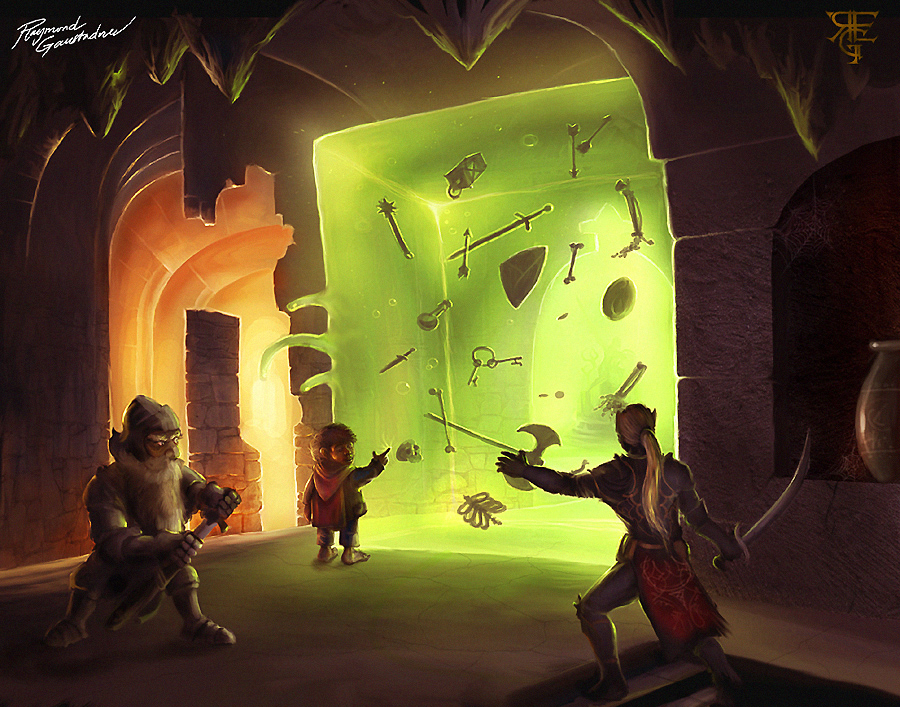
It just happened the other day that I needed to show the guys what a gelatinous cube looks like and this was one of the first pictures showing up:

You gotta love that halfling! Picture by Shockbolt on deviantart.
I thought it's awesome and wanted to share...

Monday, December 10, 2012

Ill deeds and utter escalation (a spin on goblin mischief)

It's pretty early here and I started reading something about goblins and how underdeveloped they are in D&D. Yes, I thought, they are. Poor guys. But what to do about it? Making them stronger or giving them levels won't make it better, just more of a challenge. But that's not what they should be about. The end of a train of thought like this is most of the time: yeah, well, it's all about fluff, setting and Tuckers Kobolds. Even weak creatures can be a challenge, yadda yadda yadda. This time? Not so much. Maybe, I imagined, they could get stronger every time they manage to do some kind of mischief. Some random advantage, more connected to the location than to the creature (but not only). And the longer they get through with it, the more it escalates, the stronger they get.

So I need something like a chaotic advancement table for goblins and some light rules with it to make it stick. I only have to come up with 19 (because, reading this over at Monster and Manuals, it's all about the math) fun ways to make this work...

Goblin escalation (1d8+1d12):
2 Delicate deformation: Maybe it was the waste? Anyway, now they mutate. Roll again on this table and whatever comes up is somehow related to the mutation. 
3 Spontaneous animal control: You want a pig-stampede in your town? Didn't think so. But somehow the goblins not only managed to cut the animals loose for mayhem, they also seem to have a strange kind of control over them (animals worth 10 hd). Every time this comes up, it escalates even more (+5 hd every time).
4 Uncanny alchemy: They don't know what they do, but it explodes and they know how to handle that. Whatever strange ingredience they use, area of effect is 5 feet, damage is 1d4 and a save versus poison because of the wicked smoke this produces (failing means -1 to attacks for 1d6 rounds). For escalation either add 5 feet, upgrade to 1d6 (then 1d8, etc.) damage or -2 to attacks for 1d6+1 rounds. Repeat. 
5 Gibbering goblins: Those guys talk gibberish and have a lot of fun doing it. You think, the words make sense or are at least in a language you know, but if you start listening, it gets irritating fast. Save vs. spell or be irritated for 1d4 rounds (-1 to all actions). If this comes up again, it's either irritating for 1d6 (1d8, 1d10, etc.) rounds or it's -2 -3, -4, etc.) to all actions. Mix according to taste. 
6 Food enhancement: They found some food storage and are now with a full stomach! 2 more hit points per goblin every time this is rolled.  
7  Unusual protection: Pots, pans, barrels, whatever they find, they use for protection. Every time this escalates, add +1 to the AC. 
8  Leg fixation: This is like playing rugby. They run between the legs or duck behind you as soon as you step back. If fighting more than one goblin, DEX-check every round or you trip over one of them. If this came up more than once, it's -1 (-2, etc.) for the DEX-checks. 
9  Joyful clubbing: They have fun hiting things and it shows. They get +1 to melee attacks. With a critical hit they hit a sensible area (grotch, eye, etc.). Roll this again and it's either +2 (+3, etc.)to hit or a sensible area with a attack roll of 19-20 (18-20. etc.). 
10  Random hiding: Are they playing hide and seek now? For every goblin you're able to see, there is one hidden somewhere behind your back for a surprise attack. You can't shake the feeling that the one showing himself does so on purpose. If this comes up again, there are two hidden behind you. 
11  Verbal humiliation: Are they making fun of you? They sure are laughing! Morale goes up +1 every time this comes up. 
12  Speedy gobos: Sugar rush or coffee, they seem agitated. Whatever ini-system is used, they get a bit faster every time.  
13  Painfull aim: Whatever they throw at you, be it book, vegetables or stones, it hurts. They get +1 to ranged attacks up to 10 feet away. With a critical hit they hit a sensible area (grotch, eye, etc.). Roll this again and it's either +2 to hit, up to 15 feet away or a sensible area with a attack roll of 19-20. 
14  Sneaky buggers: Ah, they've just been here! But where are they now? You hear some noise or find a trail, but the goblins are gone already and it takes one round to catch up. Roll this again and it takes two (three, etc.) rounds to find them. 
15  Manic manure: What? They are growing?! Yeah, one in six goblins is bigger than the others. As big as a (small) dwarf and with a lot of muscles. +1 to melee attack damage. Roll this again and it's one in five goblins (then one in 4, etc.) or +2 (+3, etc.) to damage. 
16  Unfortunate ducking: Something seems always between you and the goblin you wanna hit. They always get a cover related AC +2. If a melee attack indicates a miss by one or two, a save vs paralysation is needed or the weapon is stuck for 1d4 rounds (STR-check possible every round). Roll this again and it's either AC +4 (+6, etc.) or stuck for 1d6 (1d8, etc.) rounds. 
17  Coordinated backstabbing: One goes for the attention another, one for the liver. If fighting more than one goblin their dirty fighting tricks give one of them double damage. Roll this again and two of three do double damage and so on. If two of three goblins may make double damage, three goblins will attack one target, if four are needed, four will attack, etc..
18  Trippy traps: Buckets on door frames, pepper explosions, needles on unusal places, they booby trapped everything! Whenever characters search an area and goblins are around, there is a trap. Save vs. magic wands or (1d6): 1. 1d4 damage 2. blind for 1d4 rounds 3. nausea for 1d4 rounds (-1 to all checks) 4. cough attack for 1d4 rounds (-1 to all checks) 5. slippery ground and shards (no running, DEX-check or tripping into something nasty for 1d4 damage) 6. Glue! (fixed to surface for 1d4 rounds or STR). Roll this again and the traps just got a little bit more nasty (1d6 damage, longer duration, etc.). 
19  Gluey fingers: How did they manage to steal this wand out of your pocket?! After every fight with a group of goblins, one of them and one random item of the characters possessions is missing. Roll this again and two (three, etc.) are missing. 
20  Magical affinity: they saw a wizard do his stuff, now they gesticulate wildly and mumble strange words. There is a 5% chance per encounter they copy some spell they saw to half of the effect. Add 5% every time this comes up. The goblin managing to copy the spell, will be able to do so again with a 1 in 6 chance. After that, add +1 to the roll for every time he manages to do so (up to 5 in 6).
Basically goblins adapt pretty quick in any situation, but only up to a certain point. I'd say no more than 10 escalations per location, then they got what they want (mayhem and destruction) and are on the run. But they keep two of the 10 rolled advantages they got (plus the mutations extra). If a number did came up more than once, they keep only the advantage of the first roll. But if a tribe had the advantage to begin with, the next possible increase stays (and so forth). This way they could evolve with time.

Or just roll a number of times on the table to see what a random tribe of goblins might be made of. Works both ways.

Please let me know if you came to use this. Feedback would be much appreciated.