Showing posts with label Adventure Seed. Show all posts

Wednesday, January 22, 2025

Lost Songs of the Nibelungs Part 2: Playtesting 2025 (Setting up a campaign)

Hey, folks. How's things? It's 2025 now, and we can start making new promises to break them later this year. Fun times ahead, I'd say. Anyway. In this post I want to talk about how Lost Songs made its way back into my top pile to work at. I know, I'm slow. I also keep getting things done, so speed isn't all that if you eventually get to see results. Point in case: a revision of LSotN is underway and making progress, to a degree where I'm setting up a little online game with friends to give it all another spin to see where it wobbles. Here's how I set up that campaign ...

this is a lose series, but here is Part 1 anyways.

The Plan

I've collected some ideas over the last months and looked at what I got as well as what needs doing. Nothing serious, just some preliminary scouting. As one would when getting back into a project that actually was on pause for some time. It never left my mind, but other things piled up to a degree that Lost Songs took a back seat, like, waaay back on the bus.

As soon as I felt confident enough to get something started, I set up a doscord server for it and invited the couple of people that could be convinced to give this a shot.

That the first thing: I love working this on discord. Lots of nice ways to organize the information for the campaign with the revision running in the background. And I can do it on the road easily, which is a huge plus.

It's amazing how much changed in the last 10 years in that regard. Nowadays we have AI to help with research (I basically use it like I used search engines when that was still a thing) and it is a blast. Quick, too. Also something that can be done anywhere easily (I'm falling in love with Grok right now). For instance, when I wrote the Tribe Generator for the game, a quick discussion about what would make a tribe helped me getting the numbers just right enough to hammer it into a table.

Good show.

Wouldn't use AI to write or design a game for me (because I actually enjoy doing those things!), but it offers great research and reasoning on all kinds of topics. It is, just as with the art, a great asset to have on hand.

The plan, then, is to revise the game as I prepare and then playtest the game, adding stuff as need be while I'm at it. Right now setting and tribe are done. Here's what I did so far.

The Setting

What you see here is the result of the revised Sandbox Generator. Can't show the thing itself yet, as it'd contain information the players are not yet privy to. This is basically what their characters can know:

"This is it. After years of wandering around, your elders decide the spot to settle down: a huge chasm between mountains, hills and forests. Uneven land that doesn't see a lot of sun, but fertile nonetheless. The elders say waterghosts carved the grooves into the valley here, leaving only the hard rock to stand guard above the rich streams coming down from the mountains. It is land suited for miners and artisans, hunters and gatherers, not farmers. Here is your fate. The new roots your tribe is destined to strike. But you are not alone in this valley. Two other tribes have arrived here. One, a strange folk with even stranger mores, is indifferent to you. The other, a tribe led by powerful women, is outright unfriendly, although not hostile. You will make a home here either way. This is where your songs begin."
Typical longhouse.

"IMMEDIATE SURROUNDINGS & LIVING

Water created the extensive chasm your tribe located in by eroding all the soft stone and leaving harder stones throughout the valley it created. It created a hugely complex and fertile biome full of little lakes and rivers, cliffsides and little waterfalls, moss and forest as well as natural caves. Your tribe settled on the west side of this area, directly on the foot of a huge mountain you call "Grey Man" (Graumann) because clouds kept hanging on his peak like grey hair throughout the summer you arrived here. Since all of this is not easily accessible, longhouses are spread all over the place and in the strangest places, the chief's great longhouse having the highest position on the western slope. All of it is connected with little trails, but some tribesmen even made stone steps and little wooden bridges here and there to have those homes better connected. Many homes expand into the mountain as well, partially using natural caverns, partially carving new rooms into soft stone."
"Established routes lead west up into the mountain where several mining operations dot the slope, east into the valley, mainly for hunting, and north towards the closest settlement that will trade with you, four days travel away."
"Your immediate neighbors are a strange people on the north border of this chasm. They are quite elusive, but what you found of them are wooden frog figures and weird markings. Some of your tribe have seen them in the distance, but they mostly just ignore you and you have no quarrels with them. They seem to have settled on the lake that is mostly hidden in thick fog and forms a natural border before the land grows from chasms into thickly forested hills further north."
"The other tribe is situated close to the south border of this area, just where the chasms transition into forested hills. What you know is that it is a tribe led by female warriors, but other then that no contact has been made. Rumors among your people say that they despise you for your lack of warriors, but you know nothing for certain.
Other than the Graumann to the west, this area is nested between fertile hills with beautiful woods and rivers as well as more high mountains to the southwest, the predominant of them called "King's Crown" (Königskrone") by your people. This is good land, rich and fertile."
The Tribe

This part needed some more rules and tools to allow for some variety (I'll share them later in this post). The sandbox has always been the first strong indicator what kind of people a group's tribe consists of. Why would they settle where they ended up settling? What kind of skills and trades would come with the territory? What opposition (as far as they are aware of it) are they willing to face? Stuff like that could easily be deduced from the hex they are dropped in and the immediate surroundings.

But I needed some more meat on that, mainly how their migration there went, what they gained and what they had to leave behind. It'd change, to a degree, their reasoning for staying where they ended up staying, but not in a bad way. Beyond that I wanted to have some soft numbers for the size of the tribe (ended up going with "families"). If anything, it gives a GM more to work with while being set up quite fast.

Here's what I shared with my players:

"So what's your tribe like? Well, the place they chose to stay, despite the other tribes settling there, already tells us a lot. They are accustomed to living in mountainous areas, so miners and smiths they should be as well as hunters and animal farmers. The blight that is Christianity has not yet reached your people, so they believe in a variation of the old gods and follow their traditions. Migration lost you the majority of your warriors, but despite that your elders feel confident about your fate in this chasm. You can draw from a rich history of sophisticated craftsmen and you have among your people some very capable weapon smiths and artisans."
"Where the Chief's Longhouse was build

Your holy men had seen the place where you were to hold the ritual in their dreams, just two days before your track came across it. It was held that same night, under a huge thunderstorm. The mountains in the east, it seemed, fought the mountains in the west in the sky. Thor was busy drumming that night. It had been at the peak of the ritual when a massive lighting strike hit the side of the Graumann, the short bright light dotted with the rocks it detonated from the mountainside. The next morning, at first sunlight, they found among the debris a huge shattered quartz, all glitzy and pink. The biggest piece build the foundation for the chief's longhouse right where it struck the ground, the smaller pieces had been distributed among the nobility and brought much honor to their houses. They called that night the Invitation of the Mountain, and it has always been regarded as a good omen."
"The place of that ritual is where your people hold official gatherings.  It is a stone platform floating over the valley and it offers a great view of the Graumann as well as the chief's majestic longhouse at the base of it. At the beginning it was not easy to get to the plateau, as it stands somewhat isolated. Now there is an ornate wooden bridge leading to it. Three holy sheep are held on that platform to keep the grass short."
"Other then the player characters' families, the tribe is 167 families strong. Around 120 of them have build their longhouses close to the chief's house, the rest is scattered all around, equally distributed towards mountain, the valley itself and along the trading route you established north."

Ideas like the ritual, the other two tribes close by and the trading route all spun naturally from tools used to set up the sandbox and the tribe. 

New Rules: The Tribe Generator

The revised Sandbox Generator still needs some more work, but what I can share today is the Tribe Generator. It might even be useful in other games. Either way, it'll tell you something about Lost Songs, so here we go.

Like with character creation, all it needs is a roll of 3d6. It'd be used right after completing the sandbox. Everything else follows from that. The individual results will give you:

TRIBE GENERATOR (3d6)

Your tribe is …

1 barely there (lowest column)
2 weak (lowest column)
3 quarreling (middle column)
4 desperate (middle column)
5 confident (high column)
6 strong (high column)

Your ancestors are …

1 primal (+10 families)
2 secluded (-10 families)
3 odd
4 honorable (+20 families)
5 noble (+30 families)
6 sophisticated (-10 families)

Your tribe lost …

1 the weak (-30 families)
2 the warriors (-20 families)
3 the royalty (-10 families)
4 spiritual leadership (+10 families)
5 wealth (-10 families)
6 history
The sum, now, will give you a base number of families that needs to be modified by the individual results:

             High   Middle   Low

3-5:          80        60        40
6-8:        140      120      100
9-12:      200      180      160
13-16:    230      220      210
17-18:    260      250      240

The sum also reduces the base number further. In the end, each player character adds one family to the result. Example:

"This tribe is (5/6/2) confident with sophisticated ancestry to build on, but lost their warriors on their migration to this valley."
That gives us a Base Number of 200 (high column) modified by -10 (for being sophisticated), -20 (for losing the warriors), and -13 (the sum itself), resulting in 167 families PLUS the number of players.

It's quick while offering lots of little details to work with and a rough estimate of how big a tribe actually is (a "family" would have an average of four people).

That's it for now

This is where we are at. Next is character creation and the final touches on the sandbox, as well as a calendar and elements for all the hexes ...

But about this we will talk another time. It'll be an interesting year in that regard, I think. I wonder how much my sensibilities changed since I last touched the game. And if I'm finally able to overcome the road blocks that made me shift my focus on other projects.

For now I can say I'm having fun with it. And I'm again and again surprised how much was already done. Anyway. More to come.

I wish you guys all the best for 2025!


Tuesday, June 28, 2016

The Dragon's Cough Part 2 (a low level scenario for the D&D RC)

Including: why dragons might have minions
and
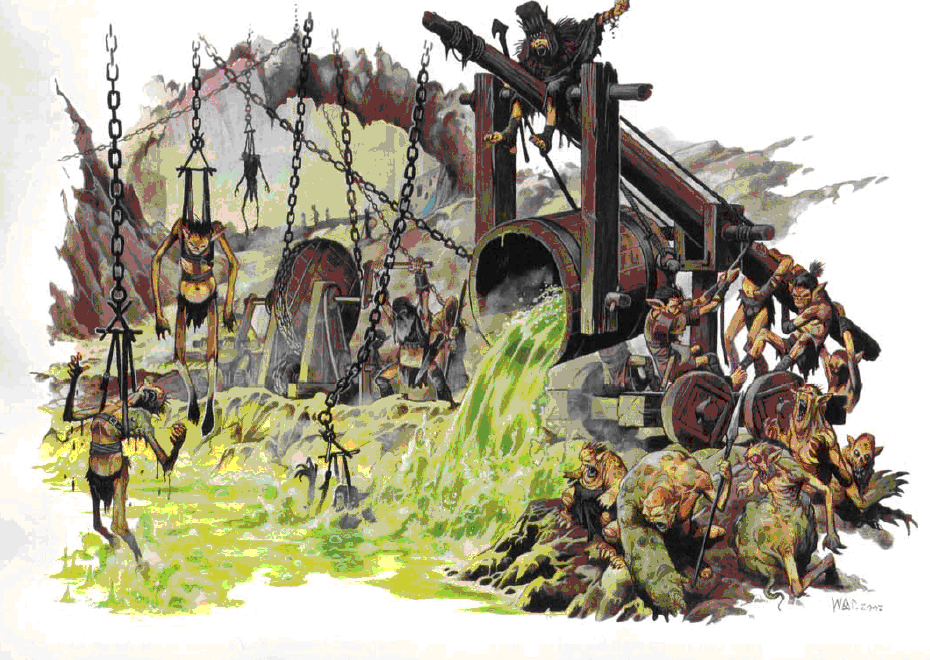
introducing the Black Ear Kneesnappers goblin tribe

And here we go, the second part of that sick dragon adventure scenario I wrote about the other day. This one will start describing the minions, contacts and enemies of the dragon with some alternate (and community fueled!) adventure seeds for good measure somewhere down the road. I'll also give some notes about my thinking here to make this reproducible and all that (turned out to be the main part of that post ...). For rules I use the D&D Rules Cyclopedia (D&D RC) and house rule were I think it's necessary, but it should be easily adaptable with the whole D&D family ... This will have more parts than I anticipated.

Here's the introduction to the whole thing and here's Part 1

[source]
Do dragons have minions?

Or are they solitary creatures? That's a very difficult question to answer, I think. They'd most certainly have contacts, if they are of the talking sort and already around for hundreds of years. Wizards. maybe, or other dragons. There's a multitude of possibilities for allies of all sorts, actually. And the use of alignments in D&D makes it even more likely that they seek contact with theirs.

I don't necessarily think they mingle or are any other kind of social, even the lawful ones should be reclusive, going by literary examples alone. But (and this is a BIG "but") in the worlds D&D usually describes, it's not the dragon that is the alpha predator. He might be among them, even rank somewhat high if he gets old enough. But in a game (the D&D RC, in this case) where heroes get as high as level 36, wielding powerful items and magic on a planetary scale (to give but one example), a dragon might have to know his way around to be able to survive. And that means for starters alliances and gathering knowledge, followed closely by intrigue or manipulation or brute force were necessary (and possible).

Because a poor 12 hd creature might manage to be on a rampage for some time, but will die just as fast if the wrong parties get involved. And dragons being creatures of habit, stealing thousands and thousands of coins for a pile to sleep on will get powerful people involved sooner or later (emphasis on sooner, I'd say). So there is that. Dragons might need influence to ensure survival and that means allies and contacts.

With minions it's a bit more tricky, but I think in part also a consequence of the former thoughts. Or that's one aspect of it, at least. it's practical to have satellites to do the dirty work or represent you a little less ... conspicuous? Dragons just don't walk the streets of the next big city (well, they could, but that'd mean lots of stress on a vanilla setting like, say, Mystara ...). Using proxies, representatives, surrogates or anything else like that is very likely, then. And that means minions.

A second point would be that D&D RC dragons sleep a lot and I doubt that they'd do something like that unprotected in areas with dense population and way too curious types around ... Minions are a logical consequence because of that, too.

Getting the point across: a cleaning fish in action ... [source]
But there is yet another, (in my opinion) far superior argument. Dragons are big and complex quadrupeds and most (if not all) other creatures that size will attract symbiotic relationships with lesser creatures to make life easier for each other (like those "cleaning stations" described here). This being fantasy, we have with dragons not only giant dinosaurs, but sentient giant dinosaurs and I'd argue that their needs are to be expanded by that dimension. In other words: goblins could be to dragons what cleaner fishes are to, say, giant moray eels ...

One final paragraph about solitary dragon variants, though. There are those dragons without speech or hiding at the fringes of civilization. They could very well be solitary, terrorizing their surroundings without consequence for a long, long time. It's not what I'm trying to do here, but still a very worthwhile encounter to have in a campaign.

Minions and Contacts 1

Back to minions. I think symbiotic relationship describes my approach to this best. The dragon we are talking about here, Arez, has (needs) a territory with a radius of roughly 12 km and a lair that fits his size (double that during winter times, btw). I furthermore assume that he'll try to keep up to date about it, so he'll need sentinels and scouts. It might have small settlements in such a territory or even trading routes through it and goblins might not be able to move everywhere freely, so it needs eyes and ears and daggers as well (maybe even beyond the territory).

The rest is politics as you know it: bribes, rumors and the occasional poison accident. Stuff like "There are goblins in those hills, but they are mostly harmless and keep out of our way ..." or "Oh no, we don't hunt in those woods. They are cursed." or "Yes, they have tried to mine in that area, had a small settlement even. But they all got sick and died, so our thinking is that it's bad luck to settle there." or something like that. People will have reasons to avoid key areas and won't have a clue that it's because a dragon is living there. Hiding in plain sight and all that.

Anyway, the general ideas of "why" and "how" aside, it is just as important to individualize those working for and with a dragon. As I wrote somewhere else (I know it's in here somewhere, for instance), it's boring to just have a set of numbers for an encounter. It's also something a monkey could come up with, so when writing an adventure, it's the least important part. Beauty is in the specific. at least that's what I'm trying to show in this post. Here is my first example:

The Black Ear Kneesnappers (a Goblin Tribe: 45 normal, 23 young, 11 invalid)

Those mean little buggers are the loyal servants of Arez the Derisive. They worship that dragon, carrying idols and little keepsakes with them as good luck charms (dragon toe nails or scales, stuff like that) they (more or less secretly, at least without consent) gather during dragon cleaning shifts.

They tattoo their ears with their deeds up to a point where those ears appear black from a distance.

They might be about in the territory as soon as the sun is down or all day if the sky is covered in clouds. Their first impulse is to run for back-up and strike with force (if they think it's worth it or a threat), ideally from an ambush of sorts. They are clever about it, too. Other than their lucky charms, they prefer to wear black or dark green cloths and appear healthier, better equipped and cleaner as their "unemployed" counter parts in the mountains. They also carry no treasure other than their charms, because, why should they have coins? To go for a pint in the next pub?

Bonus Escalation Seed: Once the goblins realize the potential of the
dragon mucus, they might end up doing something like this ... [source*]
Tactics: if they hit a target with a 16 or more it means that they saw an opening in a characters defense and go for the knees instead  of doing normal damage(characters need to make a save versus petrification or fall down and getting as much damage as they rolled over target). They also love collecting ears, so if a character falls unconscious, 1d2 Blackear(s) will take the time (one round) to cut off that characters ears (each Goblin going for one ear) and waving them triumphantly accompanied with some savage screams and dancing (giving all goblins in this fight +1 to attacks and morale from each round that happens until the end of the fight).

Goblin monster stats as per page 180 in the D&D Rules Cyclopedia (and something every DM should know by heart, right?). Use the following table to make it a bit more colorful:

Diversity Roll (d6 each for 1d4 of the encountered group):
  1. Female Warrior (prefers to attack men, goes for the nuts with a 16 to-hit or higher with the same result as described above, her intimidating presence also raises morale by 3)
  2. Veteran (a old and experienced goblin, will fight with a small bow and shout tactical advice, give all goblins a +1 to hit, has some ear lucky charms ...)
  3. The Crazy (check every round if this one does something totally irrational like attacking a tree or barking, there's a 50% chance that he acts normal and the manic nature of this guy gives all other goblins a +1 to damage)
  4. Shaman (level d3 goblin cleric as per page 216, D&D RC)
  5. Wokan (level d3 goblin magic user as per page 216, D&D RC)
  6. The Sick (the goblin metabolism is mostly able resist the bronchitis draconis, but goes through horrible changes if infected (a 1 in 20 chance) ... the resulting dumb and slimy goblin hulks gain double hd and two attacks per round with their natural bone weapons ... everyone fears them and they stay to die)
Current affairs: The tribe is on high alert right now because of the bronchitis and the mean attitude that seems to come with it. The weak of the tribe have sickness duty most of the time and half of the rest is out and about, either looking for herbs or for threats (which are a plenty and part of  later post). The rest is protecting the lair and the young. Because of that they are out there all day, sun or not.

Thoughts on Part 2

Well, first of all I hope this is useful, of course. It's not necessarily how I would put something like that down for my campaign notes, but it shows the thought process and illustrates the result as you'd expect it in a blog post. It's also full of the things I tend to hand wave if I haven't written them out in advance.

Arez really digs those sleazy pulp novels ...[source]
Just as I wrote above, beauty is in the detail. Those goblins aren't that much different to what you'll find in the book, but they have individual combat tactics and will leave an impression on adventurers who happen upon them. They have a bit culture and some motivation, the rest is still chance (if and when they are encountered and how they react).

Next up will be some individual servants of the great Arez (a senile dwarf assassin with a thing for poisons and a somewhat mad writer among them) and some contacts ... There are at least two more parts in this thing.

Thoughts and ideas are, as always, very welcome. I already have some additional adventure seeds from some great comments and if you got an idea or something you'd do different, please share it with us. I'll collect all of that and put it in the final post as variant adventure seeds for this scenario!


* Originally an illustration from the 3e Book of Vile Darkness ... I mean, if nothing else, at least it had some decent artwork.

Sunday, June 19, 2016

The Dragon's Cough Part 1 (a D&D RC low level scenario)

Something new every now and then. A post with an adventure! Inspiration was yours truly being down with the sickness, thinking about how rare it is that people talk about sick monsters and what great adventure hooks those could make. I also wrote a post announcing this experiment here, so if you haven't read it, you might want to check it out. And here is the first part of that little scenario with a sick dragon ...

Introduction

This is meant as a short level 1 adventure scenario. I always thought it's nice to give low level characters a chance to confront high level critters with a fair possibility of survival. In this case it's a 313 years old talkative and sleepy large green dragon with a heavy case of what goes as a bronchitis draconis, mucus and acidic coughs all inclusive. It won't be complete, more like a collection of (weird?) ideas for the DM to throw some meat at.

I'll use the D&D Rules Cyclopedia for the rules here, so Labyrinth Lord is a good bet if you look for compatibility.

The Dragon

Arez'kjolterr-Hunwellz'charou (a.k.a. Arez the Derisive) is really miserable right now. Mean and slimey coughs, feverish hallucinations and some outright nasty chest pains have kept him out of business for two weeks now and word already spread into strange places (see The Wizard in Part 2). Nowadays Arez mostly keeps hidden deep in his lair, nursed by a handful of his most trusted servants (meaning: the weakest, see The Black Ears Kneesnapper Goblin Tribe, Current Affairs in Part 2).

Arez the Derisive
  • AC -1
  • HD 12*** (69 hp)
  • Large Monster
  • Move: 120' (40') Flying: 300' (100')
  • (Ground) Attacks: 3 attacks with a +2 attack bonus each, for instance 2 CLAWS/1 BITE but also WING (36' range, save vs. petrification (with damage of the attack as penalty) or be stunned), KICK (saving throw vs.  paralysis or be knocked down) and TAIL  attacks (same against airborne enemies); CRUSH (surprised) enemies within 10' radius, save vs. death ray to avoid, ignoring the save (which means getting damage, of course) and bringing something pointy towards the dragon does double damage and get a +4 on the attack
  • (Air) Attacks: also +2 attack bonus to attacks; up to 5 attacks when HOVERING (2 claws, 2 kicks, 1 tail, always needs to land after 1 round hovering); may attack two times with claws when SWOOPING, will catch up to 2 victims if attack rolls are 18-20
Additional Notes to Combat (D&D RC, p. 170): "When a flying dragon attacks an aerial target, it gets two claw attacks and one bite attack, but cannot use wing, kick or tail attacks. When attacking a ground-level victim from the air, a dragon can use one Crush, Hover, or Swoop attack (as described below), but no two in combination."
  • Breath Attack: Cloud of Chlorine Gas 3 times per day in an 50' x 40' x 30' area
  • Damage: 3d8+4 for Bite/Crush; 1d10+2 for claws/kicks/wings/tail; current hp as damage for breath attack (save vs. breath weapon for half damage)
  • Save as: F24
  • Morale 9
  • Treasure: see below
  • Intelligence 12
  • 4750 xp
Spells (4/4/3): Charm Person (m), Hold Portal, Shield, Sleep (2x m), Ventriloquism (m) // Entangle (m), Invisibility, Locate Object, Mirror Image (m), Web (2x m) // Clairvoyance (2x m), Fireball (m), Haste (m), Hold Person

A sick green dragon is a sad thing to behold, cuddling his
favorite logs and being miserable and all that blues ...
Current Tactics

Arezkjol is weak as a kitten right now (has only a quarter of his hp) and knows it. He hides in a small cavern close to his most precious treasures (believing that they somehow support the healing process) accessible only by one small and hidden entrance (he has ways to get in and out of there, if need be). He spends his days with cuddling his favorite logs, light reading, heavy whining and lots of sleep (60 % chance that he is asleep at any given moment, with a 20 % that he's trying to get there if he's awake).

He won't use his breath attack in here, because it might destroy some of his treasures and thinks that crushing enemies is kind of gross. But strenuous actions like fighting will provoke some coughing and that mucus is very acidic, if random. Every round of fighting the dragon has to make a save versus petrification (as F12 in this case) or cough the whole next round, spitting huge clumps of mucus all over the place. Everyone in front of the dragon has to make a save versus Dragon Breath to avoid getting slimed for 2d6-2 acid damage per round until the mucus is somehow scraped off or the victim is dead. There is a huge dry clump on one walls of the cavern with the sad remains of a goblin in it that could give hints.

This dragon's left claw is crippled, so he'll only do d6+2 damage with it. But don't be sorry for the sod, he's still as mean as they get ...

Territory & Lair

Arez claims a territory with a size of roughly 453 square kilometers (a radius of 12 km or about the size of San Jose) or twenty 6 km hexes. Mostly it's forest, of course, so any forest region in a campaign could be used here. Since it's a green dragon, it's very likely that he'll seek the proximity of some sort of civilisation to play his mean games with. He'll also have spies all over the place, even beyond his territory, to keep an eye on all interesting things, like adventurers out for some dragon blood, interesting artists and politics in general.

There is a (at the moment) a chance of 90 % that Arez's servants are aware of adventure groups above an average level of 4 travelling through the territory and the chance of 20 % that the sick dragon will be made aware of it. Low level adventurers will most likely get ignored, as everyone is either busy with real threats or looking for herbs.

The lair should be a well hidden cave complex with some clever and deadly traps (green dragon!). The inner sanctum will be fancy, artful even, and roomy with lots of wood ornaments. Among Arez's personal prisoner is the famous writer Gonimas Hirrenfort who's been missing for 5 years now, but quite happy where he is (see Minions and Contacts 2 in Part 3 for details).

The lair is surprisingly unprotected right now, as everyone is quite busy with helping the dragon getting healthy again (who is very demanding and unforgiving about the whole affair, of course) and protecting the borders of the territory as some of Arez's more clever enemies already start making moves testing those borders (see Final Notes). Still, there are traps, the dragon is hidden in a secret room with most of his treasure and there are still some guards left in the dungeon.

Noteworthy Treasure

Let it be known that random treasure generation with the D&D RC is detailed enough to threaten a brain aneurysm ... Anyway, here we are, the dragon's hoard:
  • Coins: 85.000 sp, 20.000 ep, 60.000 gp and 11.000 pp [preferrably in one huge pile to sleep on]
  • Gems (as per p. 226, D&D RC): 50 gp (3 gems), 1.000 gp (9 gems), 5.000 gp (6 gems), 10.000 (3 gems) and 1 fairly small diamond worth 5.000 gp [those are mixed with the coins]
  • Jewelry (as per p. 227, D&D RC): 2 anklets (2.500 gp and 3.000 gp); 5 bracelets (500 gp, 2 x 1.000 gp, 1.500 gp and 3.000 gp); 1 brooch (1.500 gp); 2 buckles (500 gp and 3.000 gp); 5 chains (500 gp, 2 x 1.000 gp and 2 x 1.500 gp); 1 clasp (3.000 gp); 2 lockets (2.500 gp and 3.000 gp) // 4 armbands (4.000 gp, 7.500 gp and 2 x 10.000 gp); 3 collars (4.000 gp, 7.500 gp and 10.000 gp); 6 earrings (4.000 gp, 4 x 5.000 gp and 10.000 gp); 3 four-leave clovers (4.000 gp, 5.000 gp and 7.500 gp); 5 hearts (2 x 4.000 gp, 2 x 7.500 gp and 10.000 gp); 6 leaves (4.000 gp, 2 x 7.500 gp and 3 x 10.000); 3 necklaces (4.000 gp and 2 x 5.000 gp) // 1 amulet (25.000 gp); 2 orbs (15.000 gp and 20.000 gp); 2 diadems (25.000 gp and 30.000 gp); 1 nonmagical ring (40.000 gp); 2 scepters (25.000 gp and 30.000 gp); 1 talisman (20.000 gp); 2 tiaras (15.000 gp and 20.000 gp) [he likes to look at those instead of lying on them, so they will be arranged in sight]
  • Special Treasure: "The Awkward Reluctance of the Elf Maiden" by Gonimas Hirrenfort (book, 133 (en), 120 gp in the normal market, but up to 1d50 times that much for a collector and with proof that it's from Hirrenfort) and "Ugly Gnome Gentlemen in Strange Situations", a  collection of short stories by Gonimas Hirrenfort (book, 147 (en), 1.000 gp but up to 1d20 times that much for a collector and with proof that it's from Hirrenfort) [He owns several more popular books, but his taste in stories is rather questionable and all the other books aren't really worth carrying around, especially since most are really big, because dragon ...]
  • Magic Items: Girdle of Teleportation (works like Helm of Teleportation, see p. 240, D&D RC) [This one is bound like a ring around one of his right claws at all times. It's his back up plan and how he entered his secret cave!]
His hoard will contain way more things than what is described here. Pelts, tapestries, more books and paintings, all that jazz, but this is what is worth mentioning. If the creature's lair is detailed, it might make sense to have it filled with more stuff to steal, but this is enough for here. The total worth of this hoard would be 712.270 gp (without the girdle or extra coin from collectors factored in) and that's already a lot.

Thoughts on Part 1

So that's a dragon in all its glory. The way it's set up a low level group should have a chance (and a couple of heart attacks) facing this creature and getting away with it. Although it's very unlikely that they'd actually kill it. And stealing from it might be another stupid idea with lots of repercussions. But who am I to tell players that :)

Part 2 will mainly be about minions, contacts and enemies of the creature with some adventure hooks to get the adventurers in trouble (I originally planned to have all in one post, but it wouldn't stop growing). It'll feature a senile but competent poisoner and some mean goblin tribe going by the name Blackear Kneesnappers, among other strange things.

Ideally this is an NPC that will be around for a long time. Introducing it early in the game for the characters to dupe could make for an excellent campaign villain, for instance. But there is a variety of options to use this critter somewhere in your game. Even just as a story.

And finally: random H treasures are a pain in the neck to make. I hope someone out there appreciates that level of detail ...

Anyway, I hope this is already somewhat useful and illustrates what I was talking about the other day. More of the same in Part 2, maybe as early as end of next week, but definitely the next post I'll make here. Comments and suggestions are, as always, very welcome. And please tell me if it gave you an idea or two for your games!

Sunday, November 23, 2014

How I prepare Maps for The Game (let's call it a Brain-Crawl ...)

Busy weekend, I know. Got the time and energy to get some things written. Maybe it's not very clever to post this stuff so fast, but I never gave up hope that I'll be able to do something on work days ...

With all that recent talk about Hex-Crawls and Point-Crawls, I wanted to share a third variant (a hybrid, maybe) I use in my games: the Brain-Crawl (because maps are in the head, you know). I'm not really calling it that, but it was the first thing to come to mind ... Anyway ... Let me illustrate. I couldn't draw a nice picture to save my life*, so drawing beautiful maps to wow my players was never an option. I'd mostly try and get away with describing things and use maps done by others.

This changed when I started to blog, though. All that jazz about DIY made me think about ways to, well, circumvent my shortcomings and find a useful solution without the need to draw something. I tried to go the hex-crawl route, but for me it's lacking lots of information I'd like to have on a map. It's just not for me anymore (I have an idea where I use hex-fields to generate random regions, but that's for another day ...).

What I've done now (and used already) is still a work in progress, as there are several things I want to add in the future. Anyway, it worked just fine the way it is. Here we go:

I know it ain't pretty, but it is functional and easy to randomize (I used Inkscape for this map)
The color of the frames indicate the alignment (as I see it, anyway) of a certain area (white being the exception, it's just the frame for a landmark). I don't care that much for distances on maps, as you might have noticed. The concept of distances on maps is, in my opinion, ludicrous, as the distance between two points will never be the distance traveled between those points. So I decided to go without them.

Instead I use several landmarks to give the players orientation and  just estimate how big and where the areas are, using the given proportions and position to each other (the only more or less fixed distance I got is the one between settlement A and B, which is roughly an hour travel under normal circumstances). Add weather, altitudes, mode of travelling and type of terrain and the result could be something like: Travel through the Merkwoods north of town (Settlement with A in the center), facing the highest peak of mount Knell (high landmark with the V) until you reach the Sea of Stones (local landmark I). Now you turn north until the forest get really dense. Beware of the fairies there (x3), I've heard they are at no good terms with the barons woodcutters (border between two terrain types) ... And so on.

With the alignments I know how hostile/civilized an area or road is to travel. There is enough room on the sheet to implement small Random Encounter Tables in them (like I did in the lower right) and one thing I want to add are sanctuaries. The rest is more random tables (like several reaction tables ...), a reference sheet with names, the locations marked on the map and this sheet I made about the status of an encounter.

Just a beginning

This is just the tip of the iceberg. A lot more is possible (still thinking about using ability scores to give those areas some character and a big question is how to make this a dynamic and random environment, stuff like that). And I still need to connect this with some of the other ideas I already wrote about (that whole Noircana brainstorm that's still hunting me in my dreams). For now I hope this could give you some ideas how I use maps in my games. If it's any useful is for you to decide.

Next up is a little something I'm working on to create complex random cavern systems on the fly using cards. For the Goblin-Tribe Simulator and whoever dares to use such a thing (but next weekend, earlier is highly unlikely).


* Funny story right there: In school, when we learned reading and writing, I had showed tendencies to be left-handed, but the teacher at the time forbid it because (I kid you not!) she wanted a unified look when her pupils where writing, which was, of course, all right handed. And I never quite got the hang of that ...

Sunday, June 22, 2014

There are Square Meters on my Chart! (Sanctuaries and Believers Edition)

Did you know that a hexagon with a 10 km flat-to-flat distance covers a surface area of round about 866 square km? Yeah, it's an odd number. But on the other hand, if you were to take a number easier to the eye, you'd end up with strange numbers for the distances on the maps we use, right? But do we need distances on our D&D maps? Is there a, well, let's say pseudo-realistic approach worth using other then the plain old idea of using hex maps with a fixed distance of ... yeah, of what of exactly, to be honest? Flat-to-flat distance? Corner-to-corner distance? And what does that mean again? Where is it helpful? Where is the altitude? And how does it affect the distances on a map, for that matter?

What I'm trying to say is that I understand the appeal, but never understood the value of "old-school" maps. Frankly, in my opinion it's utter bullshit crap a relic.

Maps are lies!

Every cartographer will tell you this, maps never reflect reality. They might help you navigating an area, but often enough they'll just betray and mislead you. Nothing to do about that but to accept it, I guess. But what does it mean for the game? For our understanding of how it's to be played and presented? My answer to that would be that if a DM were to fully understand the system, if he is to make it his own, he'll (A) either ignore the discrepancies (which is a time-honoured tradition) or (B) he'll try to get to the bottom of this and develop his own system from scratch (which is a crazy huge amount of work ...).

Let's not ignore this and go for (B)?

Any solution to this problem would be, as anything in this game, an individual one. And it'd go far back into the early mechanics of the game: the war gaming roots. As so many other rules that just got copied and pasted from edition to edition of the game, the idea of moving pieces over a map (and all the baggage it brings forth, like movement rates and flat 2d dungeons or 5-foot-steps, you name it) is, in my opinion, one of the great annoyances of D&D that just can't die out, but instead spawns ever so many new ideas, expanding that nonsense.

To counter this one would have to go back even further and think about what a role playing game is and what it tries to accomplish. This is, of course, where it gets tricky. Arguably, what back in the day inspired the idea to have single characters instead of army units, was the desire to experience individual story lines. The game emerging from there on used as tools what ever was available, that's where the wargaming heritage gained some mileage.

I think one of the reasons why those rules still exist and keep on trucking is the false assumption that the illusion of accuracy - as far as measurements go - an essential part of a fair game is. Anyway, far more expedient would be to see what happens if those parts of the rules are dismissed that have their origin in the idea of anything related to rules regarding distances in D&D.

What the DM needs to know ...

Any role playing game lives from the information available to the players. Not the truth of that information or it's accuracy, but it's usability is what makes it spin a narrative at the table. Let's say the players want to travel north through a wilderness and ask for the way. A local ranger tells them the easiest way to go by using local landmarks and how much time they'd need in his experience to get there. As easy as that. The players won't need more information than that. If anything, more would only cloud their judgement.

The DM, on the other hand, should make sure that his data of a gaming world is as much as possible derived from actual game mechanics, not from arbitrary assumptions and decisions. He'll need some house rules for that ...

So why are there square meters in yesterdays post?!

Cutting a long story short, to be true to my assumptions and produce yesterdays chart (which, I now realize, needs to be updated, because I didn't get the numbers right ...) I'd have to make some rather unorthodox decisions. Or better yet, connect some old ideas I had since I started writing this here blog.

As far as those square meters are concerned, my main inspiration was a post I wrote about monster territory back in  May 2013. Mainly this chart:


So for the area of influence I'd go as per the above formulated rules and add all the radii in correspondence with all the levels associated with a specific shrine (the smallest shrine is level 1 (2 meter radius) and has a level 6 cleric caring for it (plus 60 meter radius), resulting in  the (now correct) 12.076 square meters (pi times (62 x 62)) or approximately the area of a Manhattan City Block according to The Measurement of Things or, taking a tenth of that before going for the area, 120 rooms in a dungeon environment.  Sounds about right. Right?

True believers

The next hurdle was to find a ratio for how many true believers should be expected for a cult. Main source of ideas for the result was a post I wrote about settlements back in July 2013. I decided to go for the sum of all the levels of clergy and shrine a cult had to offer as the number of D6* (D8) rolled (level 1 holy site (shrine) and a level 6 cleric means 7d6 true believers).

Sanctuaries

What is needed to get a temple build is a level 9 cleric and lots of gold (like in that other post about careers I wrote back in July 2013. And you'd have to start somewhere to build it, say, with a shrine. A shrine could become an altar, an altar might become a temple, which could become a cathedral with time and, given the gold to achieve this is paid, could end up becoming an extremely popular holy site (like Mecca). Some of those ideas started a few months back and I wrote about it here

All those ideas and assumptions together result in the following table (it also gives an impression where I aim to go with the 2d6 part of that idea ...):
----------------------------------------
Sanctuaries and Believers

Level         XP     Status     # of d6* believers with 2 to 9 HD (or level)**
                                  2   3   4   5   6   7   8   9 ...
  1            0     Shrine       0
  2        2.000     Shrine       0
  3        4.000     Shrine       1
  4        8.000     Altar        2
  5       16.000     Altar        2   1
  6       30.000     Altar        2   2
  7       60.000     Altar        2   2   1
  8      120.000     Altar        3   2   2
  9      240.000     Temple       3   3   2   1
 10      360.000     Temple       3   3   3   2
 11      480.000     Temple       3   3   3   2   1
 12      600.000     Temple       4   4   3   2   1
 13      720.000     Temple       4   4   3   2   2
 14      840.000     Temple       4   4   4   3   2
 15      960.000     Temple       4   4   4   3   2   1
 16    1.080.000     Temple       5   5   4   3   2   2
 17    1.200.000     Temple       5   5   4   4   3   2
 18    1.320.000     Temple       5   5   4   4   3   2   1
 19    1.440.000     Temple       5   5   5   4   3   2   2
 20    1.560.000     Cathedral    5   5   5   4   4   3   2
 21    1.680.000     Cathedral    5   5   5   4   4   3   2   1 ...
 22    1.800.000     Cathedral    6   5   5   5   4   3   2   2 ...
 23    1.920.000     Cathedral    6   6   6   5   4   3   3   2 ...
 24    2.040.000     Cathedral    7   6   6   5   5   4   3   2 ...
 25    2.160.000     Cathedral    7   6   6   5   5   4   4   3 ...
 26    2.280.000     Cathedral    7   7   6   6   5   5   4   3 ...
 27    2.400.000     Cathedral    7   7   6   6   5   5   5   4 ...
 28    2.520.000     Cathedral    8   7   6   6   6   6   5   4 ...
 29    2.640.000     Cathedral    8   7   7   7   6   6   5   5 ...
 30    2.760.000     Holy Site    8   8   7   7   7   6   6   5 ...
 31    2.880.000                  8   8   7   7   7   7   6   6 ...
 32    3.000.000                  8   8   8   8   7   7   7   6 ...
 33    3.120.000                  9   9   8   8   8   7   7   7 ...
 34    3.240.000                  9   9   9   8   8   8   8   7 ...
 35    3.360.000                  9   9   9   9   9   8   8   8 ...
 36    3.480.000                 10   9   9   9   9   9   9   9 ...

*D6 for shrines, D8 for altars, d10 for temples, D12 for cathedrals and D20 for Holy Sites.
**Sum of all levels of a Church's active clergy plus the sites level as the number of dice, use a die according to the status of the site (as described above). Part of the result might be NPC with more HD than 1. The listing above shows how many of those higher level NPC are part of a faith and how they are distributed among that number (inspiration for this was the number of spells available per level for magic users ...).
----------------------------------------

This should be enough for now.

So all the above needed to be done to produce yesterdays post. And then some. I'm still struggling with some of those ideas and I'm far from finished. But I hope I managed to gave those interested enough to read all this up to here a somewhat comprehensive and understandable impression of what I'm trying to do here and how I came to the decisions I made so far to get there.

I'll expand on those ideas as soon as I have the time to do so :)

Saturday, June 21, 2014

Instant Church Hierarchies Part 2 (1d6 variant for cults)

[So I had to edit it, because I got the numbers all wrong, darnit. Now all is in order, sorry for that, folks ...]

So I crunched the numbers and tried to summarize all this in a table to make it more accessible. It's part of the larger idea, but works fine on its own.

Roll 1D6 and interpret result ...


Here is a link to part 1.

Further explanations will follow tomorrow.

Sunday, June 15, 2014

Culture vs. the Sandbox (or how vanilla do you like your fantasy)

Although I'm not that much in the writing game right now, I'm still grinding some of the topics I started writing about some time ago. How to create a totally random and analogue system (a world engine, if you like) that results in a Sandbox for my fantasy game is one of those topics. The more time I get to reflect about things, the more I realize my basic problem with said beloved Sandbox (or how I understand the term, anyway) is a lack of potential story. So as a thesis I'd state: A lack of story in a game is always derived from a lack of culture represented in a sandbox/setting/gaming world ... Let's talk about this.

I've tried, you know.

All those random shenanigans I've tried, the tables I used to create content with in the last few games, the random maps and names, all this left me feeling, well, unprepared at the table. A strange feeling for a DM indeed and most unwelcome, to say the least. Although I had everything I needed (as far as content goes), I struggled with an apparent defect of connection between what was generated randomly and the interpretation of that content during the game. In other words: as soon as I had rolled what the players were encountering next (a specific creature or event with a motivation and reaction to the characters, etc. ... you all know what is possible), I started to feel the urge to make a story out of it, the result being not random at all but, in the contrary, totally my design, so to say. Exactly what I had tried to avoid in the first place and not even with the luxury to have a developed story arc at hand, but with the need to pull it all out of my arse as I needed it.

Usually I have no problem with generating connections, interpretations and new content as I need it on the table, but this felt different. This tyranny of randomness forced me to think about the people present in a tavern and there motivations at any possible given moment the characters might be entering the locale. It asked for weather and day-to-day routines of peoples, current politics and their effect and all those little nooks and crannies that are really really needed (and in a huge amount, no less) to produce the necessary amount of information that could result in a satisfying variety of adventure hooks needed in a "true" sandbox to make it work.

Because, if you just use a shortcut and make a table with all the funny things you think possible in a specific sandbox, you might as well admit that all this is not random at all, but a random assortment of exactly all the things that could possibly happen. There is a difference.

Take for example rumours of a bear attacking wood cutters near a settlement. A good enough adventure hook, I think. But where is that bear coming from, why did he leave? A bigger predator claiming his territory, maybe? Why is he attacking people? Is it for a lack of other prey? What's with all that, then?

So you see, every event has a chain of relevant causalities (of connected events, if you will) leading to it. The results of these events (if you dare going as far as producing that much information, that is) might be random, but you have to start somewhere. And that place is so totally unimportant and insignificant for what happens at the table, with so much small and moving pieces in between, that it doesn't seem worth to even try to figure out where to start.

But if you were looking for where to start with those chains of events, cultures would be the way to go. It might seem counter-intuitive, especially with the example of the bear above, but stay with me. I'll get there.

Causality goes both ways ...

It's a good thing that causality can go both ways from an established point, if that point is well chosen. Constants and varieties are the base criteria for such an endeavor and that's exactly what the term culture enfolds. Following that link to wikipedia will only help in realizing how big a topic culture can be, this is the variety. On the other hand it shows very well how all those cultural variety is labeled, so there are your constants. That all cultures are a product of their specific surroundings is where causality comes into play. If you have a social group of sentient apes living on a shore, you'll have some fishing and legends and rituals connected to the sea, stuff like that.

So this might be a point from where an interpretation of causality easily goes both ways. The characters encounter a settlement at a shore and a DM just knows there will be forms of cultural representation regarding that fact. Going the other way would mean, if the surroundings change for the settlement (say, they were forced to leave, for instance), they will take some of their cultural achievements with them (maybe some legends and stories and names remain in their songs, stuff like that) so that at a later point it can be recognized and traced back again, etc..

As far as creating content for a role playing game is concerned, this means basically:
Every point of entry in a campaign is legit. It's either created up to the point of entry, from that point onwards or somewhere in between.
Perception of a world, the players view (an intermission).

This occurred to me some time ago and maybe it's worth a post of it's own, but for this argument I deem it important to have it at least mentioned as food for thought: the flow of information in a fantasy setting (or in every setting, if you think about it) prevents a complete and true understanding of the world surrounding a player character. All characters can know is interpretations and stories, distance being one main factor regarding the accuracy of the information gathered, culture being another one.

So even if you start a campaign with nothing but an idea for a starting area and tell the players tall stories about what the world around them is filled with, nothing of this needs to be true and might be challenged entirely in the next village. Even if a DM did do all the work to create a complete world, the only chance for the characters to know it with some kind of certainty should be by exploring it, because it's not about what's a world comprised of, but about how a culture interprets and communicates it.

So the "true" sandbox is not the world/map itself (the board, if you will) but the amount of interpretations (or stories!) of said world. And that is the amount of cultures in a setting.

It's evolution, baby (Creating a Sandbox 101)!

Let's get back to that bear again. What we like to perceive as culture is more often than not a direct result of our natural heritage. Opposing thumbs, courtship display, all that stuff. This is, again, about capabilities resulting in behaviour in accordance to its surroundings. To phrase it another way, it's easier to create a possible pattern of what a bear might do than it is to do the same for a human being, but ultimately it's the same basics. Evolution allowed for the development of cultures with the intelligent apes, for the bear not so much, which leaves him with what evolution is capable of.

This is where the relevant data is, this is where stories are developed. You'll need the lay of the land, that is true (and easy enough achieved with a degree of difficulty open to the top), but it'll mainly produce constants with almost no variety. So if that's done, you'll just have a board for all the parties involved to leave a mark on.

Layers and layers and layers of true randomness!

Next is where the DM decides how vanilla it gets. It is basically the decision how much culture a DM is willing to invent or how many memes and tropes he is willing to use.  It is a very broad spectrum, ranging from, say, the elves, dwarfs and hobbits how Tolkien described them to a complete new set of races, invented from scratch. Or a world having no moon, one moon or 5. But whatever is decided, I believe it is important for a DM to make the decision where to start consciously and up to a point where the number of former decisions, random or not, produce a pattern complex enough to carry a narrative.

This means layers and layers of decisions if he wants to have a sandbox-setting or a world-engine with a totally random, but traceable history. A huge task.

Culture, memes and the story ...

Alright, let's connect some dots and get back to the thesis at hand. I think it's conclusive that it's almost irrelevant were to start with the randomness or what kind of map is used, as long as there's enough to work with (a few encounter and reaction tables and a map worth exploring, maybe). The available cultures, on the other hand, might be what really matters when a DM creates/prepares a setting, because it is what the players get confronted with as soon as they start creating characters and in the game it's their tool to interact with the world. And it is how stories emanate.

Memes can come in handy in this in as far as if, for example, a player has a more or less clear picture of  what a dwarf is, he can easily enough play one. Some familiarity with a setting can go a long way in helping the players getting some immersion. Another argument for using memes is that to recognize variety you need to know the source. So it helps when describing a set of random cultures if the source is still recognizable.

In the end, if you want to know what the people do and why they react the way they react, you need a fair idea of the cultural context surrounding the encounter to make a story about it. If the players live in a matriarchy, for example, all the roles they know might be reversed and if those roles are inspired by a medieval society, you'll have women knights courting men in fancy dresses and so on. So everything a DM establishes for a culture helps him telling the stories the characters encounter. The more work he puts in that, the better will be the stories he's going to tell.

What next?

Those are the basics so far. Maybe it's able to start a discussion, exploring those ideas a bit further or even challenge them. Maybe not. Anyway, in future posts I'll further examine how a DM could utilize the idea of culture as a tool to carry the narrative of the game and I should give some examples, maybe a system how to randomly generate a culture. Right now I think it might be useful to have an index for a culture how obscure their idea of the world surrounding them is. Something like, the lower the index, the closer are those interpretations to reality ...


Wednesday, March 26, 2014

Out of the woods - back into the woods ... (plus an adventure hook!)

Me with the neglecting again ... Sorry about that. It's not that I have nothing left to share, it's rather I'm still unable to participate and contribute something worthwhile (unfortunately not for the lack of ideas, but for the lack of time).

Anyway, I'll get out of it or I won't. I really miss blogging on a regular basis and starting a dialogue with y'all, though ... Plus: I got the worst case of Gamer ADD ever. EVER!

Really, it's driving me nuts. I just need to see nice rpg-related art and the mind goes running and jumping like a dog seeing a bone. Sometimes it's not even related to some role playing game, but just a random picture:

If this ain't worth an adventure, I don't know what is ...
See? Could be good for something for a Cthulhu game. But a necromancer dying two days before his prophecy is fulfilled looks good in every game, as far as I'm concerned.

The picture is from a travelling book called Across China on Foot by Edwin J. Dingle. It can be found over at The Project Gutenberg and it's all in the public domain. 

That's it for today. There is more to come, I just can't say when ...

Sunday, January 12, 2014

Did you ever read Jack Vance?

Jack Vance was a name I exclusively connected to D&D, not from something I've read and deduced by myself, but by reading about it (and also only second hand information, at that - I didn't own the AD&D DMG until recently ...). I'm talking Appendix N here, of course. Always wanted to read the adventures of Cugel and the Dying Earth setting. Never got around to actually order the books and do the deed, though. As those things sometimes do, an opportunity arose by coincidence just a few days ago. Over the holidays I had to kill some time at my parents house and did something I have done for years on a regular basis when I was younger and still living at their place: I searched the book shelves for loot.

We're talking several book shelf with hundreds of books here. But I must have had every one of them in my hand at one time or another. There shouldn't have been any surprises. Now look what I discovered in one of them:

Can you guess the title only by looking at the Cover?*
Yeah, I know. Right?

So I grabbed it, of course.

Now, what was Gary talking about?

 I was really curious and it didn't take long for me to give it a peek. Now I'm nearly finished and I wanted to share a few thoughts about it. First of all, yes, I can see it. This is D&D. Cugel, the main character, is talked into stealing artifacts from a wizard. He gets caught and is left with either a horrific fate or taking a dangerous mission from the wizard. He chooses the mission. As a little safety precaution he gets a small but thorny parasite attached to his liver that uses his thorns every time Cugel isn't into the mission or gets second thoughts about it. He's also equipped with an artifact that is able to turn everything organic into food (although it will taste dull) and detects poison. After that he is put in a cage and the wizard summons a demon to fly Cugel to the area where the strange items he's to collect (the eponymous Eyes of the Overworld) are rumoured to be found.

On his travels he encounters, to name but a few, ghosts, marauding humanoids, crazy villagers, pilgrims, tricky rat people, some curses and lots and lots of stories about his surroundings. As a reader you get the feeling that if he had travelled but 50 kilometers parallel to his route, it would have been a totally different adventure.

And by the way, Cugel the Clever (as he likes to call himself**) is not a hero. I'd go as far as saying he doesn't even deserve to be described as an antihero just because the "hero"-part is still too dominant in it. This guy is as amoral and cynic as they get. Such a mean, lying, cheating, back stabbing and murderous SOB, he really challenged my view on the topic.

In other words, he's your typical rpg adventurer.

A D&D blue print is what it is ...

It's really all there:  strange wizards, magic items and the attitude to kill the monsters and loot the booty, plus many, many random encounters to keep it interesting. I think it's most fascinating that the Dying Earth setting was labeled as science fiction, but D&D chose to be fantasy. Sure, there are the Tolkien parts that deliver all the necessary fantasy trappings, but one has to admire the choice to go there. Other than in science fiction, it grounds D&D in a somewhat more defined space and still leaves enough room for the weird. On the other hand, although I see how this book was in 1966 considered to be more science fiction than fantasy, reading it nowadays makes it very much sound like fantasy.

I think that this change of perception deserves some more thought ...

Anyway. More about the setting. It had to seem perfect to Gygax and friends. The world is dying and humanity lives in the shattered remains of its past. History is lost in legends and people only know about their immediate surroundings. The rest is rumours, stories and ruins. I've read on several occasions that D&D is supposed to be playing in a post-apocalyptic setting. Now I can see why. It's a weird place of endless opportunity and adventure. And very, very dangerous. Does it really need those new nice and shiny settings AD&D and later editions are so famous for? I believe not. What it needs is more weirdness.

Not high literature, but ...

Highly entertaining is what it is. If you've played D&D for some time, you will see what inspiration Vance was to those who developed the game. I think Vance would have made a mean player and D&D is so much richer because of his ideas and characters.

So if you're a bit like me and always thought it's a good idea to read one of those books from Appendix N, but you never did it, I highly recommend giving The Eyes of the Overworld a chance. It's the good stuff.


 *It's an old (1976) German translation of The Eyes of the Overworld by Jack Vance (a potted version, unfortunately).
**It also was the author's choice for the books title. The publisher thought otherwise, obviously.

Friday, August 9, 2013

Random Picture Adventure Seed: The Dome

No idea where I found this weird little picture or when, but I'd like to share it with you:

How big should this thing be?
Well, what is it?

My first thought was, it could be a small but exquisite treasure (500 gp for selling it to a collector). The thought after that, naturally, was about this thing having some magic properties. Animation would be the most obvious (a collector would be willing to pay up to 1500 gp for such a thing). But somehow, I thought, that isn't enough. Sure, you can show the players a nice picture and tell a little story, maybe. But it will be just passing through. Item means gold, end of story.

Lets play a bit with the possibilities.

What if...

What if it was 20 by 20 feet, with the creatures as big as your average human? It's in the middle of the dungeon, blocking the passage. The creatures seem to be in a stasis. Detect magic will reveal, that the weapons seem to be enchanted. Damaging the dome will enter fresh air into it and revive the two frog men in 2d4 turns. Adding water will accelerate the process. If the characters steal the magic weapons, those guys will hunt them down. They are stealthy and deadly, able to hide and travel in shadows, hypnotize their prey and use their surprising leap attack with brutal accuracy (critical hit means a limb gets torn off).

Or...

Make it even bigger. Lets say it fills half a market place. The true story how this thing came to be is long lost in history. Elves every now and then visit the Dome, but they have vowed never to speak about it or the strange rites they hold in it's presence. there is whisper in the streets about a secret cult and the weird crimes they conduct in  the name of a lost god that is somehow connected to the dome. What are their goals? And how much destruction will it bring to the city, if those old mechanisms inside the dome are brought back to life...

What else?

So what else could it be? A trap, maybe, with the victim being teleported into the position of the stabbed frog (save vs. death or victim is stabbed to death into the heart, otherwise 2d6 damage). The wizard responsible for it likes to display the fools stupid enough to challenge him...

Any more ideas?