Showing posts with label Amateur Science. Show all posts

Friday, April 26, 2024

ORWELL @2081 - Now as PDF, too!

Hello, friends and neighbors. After long and hard consideration I decided to go one step further and make a PDF of my first RPG available on OBS. Turns out, many people would rather have a PDF than a PoD. I wasn't confident that a PDF would do the game any good three years ago, especially since it was layouted with print in mind and PDF has quite the different potential. That being said, I wanted to go through it once more and hunt for mistakes, so while at happened I started thinking ... we might need a PDF after all. So we did that, and here we are. Let me remind you about Ø2\\'3||

What is ORWELL @2081?

It is a cyberpunk rpg that could be described as:

Peter Pan in a dystopian future that plays like a dark and satirical anime series of psychological horror inspired by Black Mirror and the like.
Get it here!

You want some details on that? Here's the blurb:

Welcome to a very dark world ...

The setting is Europe in the year 2081, unified under one totalitarian party called The Family. The United States of Europe (USE, for short) are a playground for all the bad ideas this century has already come up with (and some of the classics from the last 100 years). Citizens are rated by an arbitrary and mean Social Status system, puberty blockers are mandatory for all but the Elites. All of this is shrouded through a huge media ruse: reality is hidden behind a fully augmented and gamified layer, maintained by an AI implanted at birth and controlled by The Family. Citizens never grow up, just grow older and if they aren't high in social status, they are bled and used for everything they have, most of the time without even realizing it. That veil is lifted for some, and with that comes resistance (or opportunity).

It’s a game that assumes players are open to exploring all kinds of ideas and willing to put some thought into the stories they tell and experienced DMs who want to explore a system that challenges them as well. It is also a satire of a dystopian future that may not yet fall upon us …

How does it play, then?

It features a tried and tested original system that is based on a 3d12 roll versus a difficulty. What of a roll is used depends on the strengths and weaknesses a character has. The basic overview reads like this:

Everything else builds on that. There is a little game in the game for the DM to play where they gather "Pennies" over time and get to spend them to make live more difficult for the players. So the power a DM has fluctuates depending on how they play it and interact with the game.

ORWELL also features extensive tools to create and maintain setting and narratives in a very open and flexible world. It's also lushly illustrated, with over 40 illustrations on roughly 200 pages A5 ... The artist found the setting so inspiring that he went above and beyond to create content for it.

I wrote a session report way back that can give you an idea what that plays like, and you can find it here.

You want to read a bit more about how dystopian this game is, you should check out this post about social engineering in ORWELL.

You'd rather see someone else's take on the game? Check out what my good friend Eric has to say about it over on Methods & Madmen!

With all that, you should have a fair impression of what you are in for, but there's also a free preview of the game, including all the cheat sheets and the character sheet that you can get here. If there are any questions beyond that, feel free to hit me up with a comment. I really like to talk about it, too :)

Support a small publisher!

If you need any more convincing about this, I'd like to add that it'd help and mean a lot. It is rare and precious to get feedback on one's work, but buying a product shws appreciation as well and I see it as an investion into the future more than support of a product (because for that it needs to be read or even played!).

What I mean by that is that seeing my offers/designs/ideas being appreciated motivates me to push harder for the things I'm still working on. Your support means a lot and moves a lot.

If ORWELL doesn't tickle you but you'd like to support us, checking out what we also have to offer goes a long way. Minimus Ludus, for instance, is a great little rpg that goes into very different directions in its design and settings.

All of it is appreciated, as are those who already bought our games.

We hope you'll check out ORWELL!

I'm proud of this little game and I hope it will bring people some of the joy we had playing and play-testing it. Don't get me wrong, I know it is not for everybody (the contents are quite mature, actually), but I really hope it finds its people.

And with that we present the PDF of the revised game, with all the bells and whistles one could imagine (bookmarks! hyperlinks!), in the hopes it expands its reach. It'll cost 10 bucks for now and if you buy the PoD (just ordered the proof, when that's fine, that'll be available again, too), the pdf comes free with that. Those who have already bought it should get a message about how they can claim their free pdf ... if not, get in contact.


Friday, April 7, 2023

"I'm a horse now!", says the mule ... (mistakes have been made)

Let's have some commentary on the latest WotC kerfuffle: no "mixed races" anymore, because that is deamed "racist". Now, we need to be careful here as not to fall for the obvious groupthink bait, and look at it as is. Has it merit? Is it a good idea? Because it could have, but still is! This, then, is a the simple attempt of a small blogger to see what they are talking about here. Spoiler alert: this is not about racism, in any shape, way, or form. All of this is, if nothing else, a mistake in terminology ...

Cutting to the chase real quick

Half-Elves are no more, at least officially and as far as D&D is concerned. Same goes for Half Orcs and any other halves you could think of in your games. We are talking fictional characters here, just to be very clear about this from the beginning, so no sensitivities are presumed. I mean, if a true half elf were to comment to make their case, I'd be listening (needs to be the real deal, too, just "identifying" as one won't be enough).

Just a little joke ... hehe [source]
 But I won't be holding my breath.

This is about a twist to a character one might want to play in a game. Something that plays differently on a narrative and (ideally) on a mechanical level of the game. I've always held the opinion that each GM should play with those options in order to make their campaigns unique. I have a very different take on elves, for instance (very old post here). Either way, taking away those options is bad style. Doing it for "politics" just leaves a bad taste in the mouth here. Pandering like that is divisive and should be frowned upon for that alone. Where are the bridges? Where is the love?

In other words: why isn't there a compromise? Because there is compromises to be had, for sure. Just a very superficial survey of less reputable sources like Wikipedia will tell interested parties that an "Elf" is considered to be a "humanoid supernatural being". It is right there in the first sentence. "Humanoid", now, would mean that it is a "non-human entity" carrying some human traits. That second Wikipedia entry goes on to explain that there is the idea of "convergent evolution", which would mean that different species may come to the result through different evolutionary paths.

I think that's quite easy to understand. There's a couple of useful ways to interact with reality, less so the more specific the interaction, so the concept that different species come to the same results isn't hard to grasp.

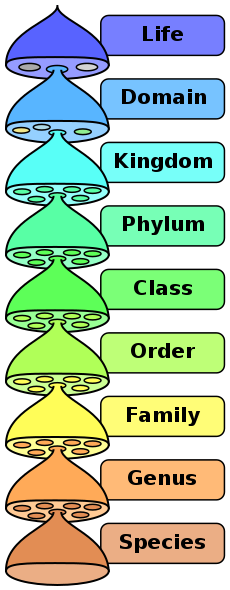
The next stop down this rabbit hole would be "species", then. Wikipedia says:

In biology, a species is often defined as the largest group of organisms in which any two individuals of the appropriate sexes or mating types can produce fertile offspring, typically by sexual reproduction.

You see, just by following some easily visible bread crumbs, you'll find out that saying elves can be considered a humoid species would be a very well grounded assumption. Not "race" (which is obviously politically AND historically loaded), but "species". Took me longer to write this than to find it out, which should be an indicator how readily available this information is.

There are even pictures about it:

[source]

"Traditionally" it is "Race" in D&D, though. Right?

The funny thing is: yes and no. As far as I can tell, when it first came up, they talked "demihuman races", which is all mixed up terminology. And yes, it is carried along for some time unquestioned. That said, they caught up to it relatively early, actually. Here's what you'll find in the AD&D 2E Player Handbook (first paragraph introducing the concept):

After creating your character's ability scores, you must select a player character race. This is not a race in the true sense of the word: caucasian, black, asian, etc. It is actually a fantasy species for your character -- human, elf, dwarf, gnome, half-elf, or halfling. Each race is different. Each possesses special powers and has different lists of classes to choose from.
That's interesting, isn't it? They are actually talking species and just CHOSE to call it race (maybe because it had been established as "races"?). They willingly tried to expand what "race" means instead of using the term "species". But they also CLEARLY categorize it in the sense of SPECIES (that is: biologically) as early as 1989!

My beloved HackMaster 4E actually makes the same statement (HM 4E PHB, p. 22):

Note that when we speak of 'race' in HackMaster, it has nothing to do with what we in contemporary society know of races, i. e. Eurasian or African. In HackMaster, race simply refers to the fantasy species of your character.

Wizards of the Coast, however, did not carry on that sentiment into the D&D 3E they published, which is also interesting, I think. There is, of course, a biological definition of "race" that is synonym to "subspecies" (see here), so in that sense it is not necessarily wrong to use the term in D&D (or any other game).

What made it problematic, it seems, is the claim that categorizing a species into subspecies is somehow "racist", which is (at least!) highly debatable. If, as history teaches us, a categorization like that is used to argue some sort of superiority for a subspecies, it is plain stupid, wrong and objectionable. And very dangerous. For obvious reasons. But that has nothing to do with the idea of categorization itself, which can be quite useful. Also for obvious reasons.

So what's the case we can make here? The hobbyists that created D&D used "demihuman races" as the distinction to categorize their "fantasy species". It created some adjacent terminology, and they never changed it across editions, although it is noteworthy that they cared to define it properly in the AD&D 2E (and the HackMaster 4E, which just revised 2E).

It is, in a sense, legacy terminology, but never "abused" to paint some sort of "hierarchy of subspecies" (as far as I'm aware of). Instead, it is merely terminology for a categorization that became necessary as the game grew and evolved, and was done with good intentions and taste throughout. Again, for obvious reasons, as they wanted people to like and use the options they got. Like in: all people interested in the game, with no reservations.

Anyway.

Now "mixed races" are banned ...

... for ideological and emotional reasons, as far as WotC are concerned. This is, at the very least, nothing but big mouthed pandering or ill adviced marketing and social media politics. It is not about bringing the game forward, as it should be, but about virtue signalling. I'll say that as unbiased as I can. Of course, it is their business and they can do what they want. But categorization is useful, as we have learned, and this move should be catgorized for what it is: done in ill will.

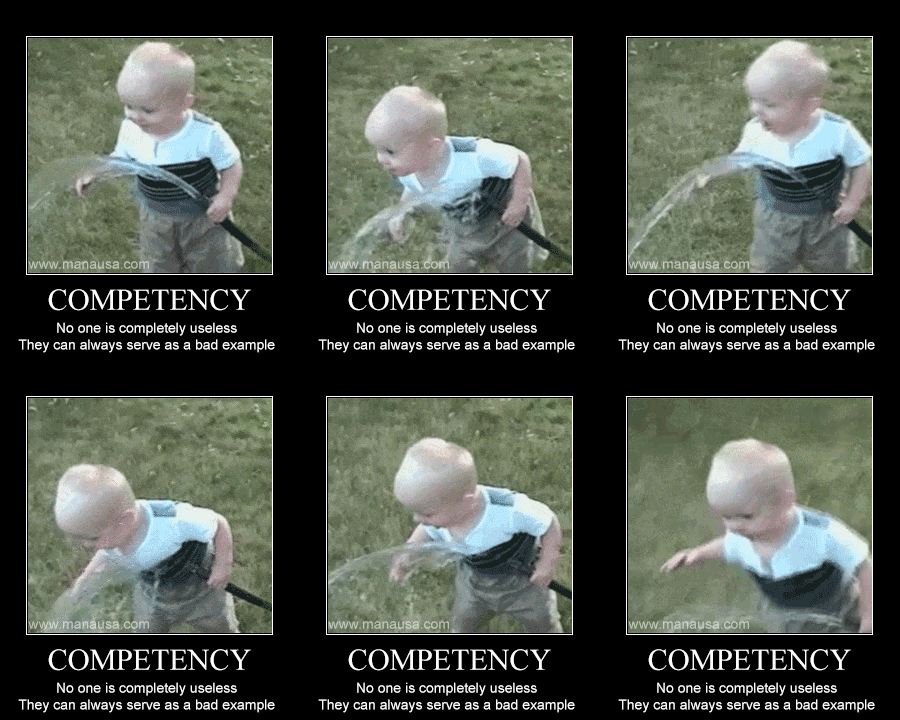
In a way it shows the same contempt WotC showed with their attempt to change the OGL. It shows the same lack of competency, too, imho.

[source]

Why do I think that, you ask? Because compromise would have been so easy, but wouldn't send "the message". If they'd been "Language is important, and since the term "race" is so loaded and convoluted these days, we decided to use the more precise term "species" instead so all of you can keep enjoying playing your half orcs and half elves!", or something along those lines (and to give but ONE obvious example!), it'd barely been worth news.

Instead, it would have helped bringing people together (would be my guess, anyway).

It's just not what they wanted to do. They wanted to put fuel into a divide that already went to far as it is. People should build bridges again and come together, not wallow in resentful hatred against some idolized opposition. If we are able to find and cultivate what unites us, we'll be able to overcome our differences.

Easy as that.

And you can't tell me that they did that stunt out of the good of their heart. That's just not where those ideas come from. War is not peace, slavery is not freedom, and ignorance is not strength, no matter how loud those people claim to have good intentions when supporting ideas like that.

And if you think that's a bit far fetched, to go from saying it is "racist to have mixed races in a game" to full blown 1984, I'd urge you to think again. They keep saying that the origins of the game are racist and misogynistic (among other things), despite all the good the game did. Despite all the science, even, that exists today, pointing out how it brings people together, how it helps personal growth, how it helps mentally. Tbh, all this posturing completely goes against common sense.

There is no healthy rationale behind it. There never is behind revisionism, which this is, because what they are saying is that chosing that term "race" to begin with was out of hatred by the original creators. Maybe they'd say it was "subconscious" or whatever, but it doesn't change that thinking like that is small minded, to say the least.

ANYWAY.

A horse is a horse, of course of course ...

I don't know if you are aware of this, but horses and donkeys, two distinctly different species, can have (infertile) offspring. If a male donkey mates with a female horse, that hybrid is called a mule (if it's the other wa around, that's called a "hinny", which is somehow cute, I think). Different species, some sort of outcome.

Zonkeys are a thing, too! [source]

 A little closer to home, the same is said for humans being able to reproduce with Neanderthals (leading to their extinction, is one theory). Which leads to another well established fact: we used to live with other humanoid species here on planet earth, and not that long ago, too. Not only Neanderthals, but it also had Denisovans and some smaller hominid groups. We interacted with them, and I believe some of our oldest stories are proof of those interactions (which is neither here nor there, but still interesting to note).

What I'm saying is, there is no reason to say this phenomenon of interspecies reproductional activity cannot exist or talked about. To be completely honest, I'd say, if we were to encounter aliens, people would find ways to fuck them before anything else. That's just who we are.

So if you don't like the term "race", use subspecies or species and be done with it. Nothing I wrote here is "newly established science" or something like that, it is no secret knowledge. The information is right there, publicly available. Why act as if a decision like that wouldn't need checking what can be gathered about it?

No need to make a stink.

Will this hurt the hobby? Fuck if I know. There are enough alternatives to D&D out there, published by companies that don't feel the need to act like WotC. Will it hurt the brand? More likely, if bullshit like this keeps mounting up. And that is a shame on multiple levels. For one, as I said above, this hobby of ours should be about uniting people with good intentions, but D&D is more than that, culturally speaking, and the little history it has should at least be looked at with the benefit of the doubt, if not heralded for the good it did.

Tainting that history by implying some sort of moral superiority and to gain, what?, social credit?, well, I think that's something reprehensible. Especially if it's done by people that have proven to be morally suspect, as WotC did on multiple occasions in the last couple of years (not just recently).

Final thoughts

Not sure how to end this ... I recently came to believe that there is too much anger all around. People dug in and aim to hold their positions. There's also a lot of negativity around, and I don't know how you guys feel about it, but I just can't take it anymore. So I'm pointing this out as bad behavior to encourage people to do better. Not that I believe that anyone addressed here will read this, or care about those things, for that matter.

No.

The point of the exercise is more along the lines of reminding anyone reading this that we worked hard in the last couple of decades to create a culture of exchange, understanding and personal growth. We have an obligation to check what can be assumed as useful interaction, and what should be considered disruptive or even harmful. We already know a lot about these things, we don't have to start at the beginning with every dilemma that presents itself.

As a matter of fact, why not try to be a bit more mindful in general? I know I struggled with this in the last couple of years, for sure, and I know it'd help me to find more peace.

Easter is traditionally the time for new beginnings, so with this I'll renew my efforts to be a positive force where I can. If you read all of this, I appreciate you. If you have any thoughts about my take here, you are welcome to share them.

[source]

Currently reading: Penetration by Ingo Swann (a Why Files recommendation, and so far a good read ...)

-----------------------------------------------

If you liked any of this, you could go and check out my offerings over on drivethru. The latest is part three of the blog anthology I'm working on. Part four is already in the works, and I aim to offer a PoD of the first three books as well. Soon ...

Friday, February 10, 2023

In Defense of AI Art (the drawing kind ...)

Calm down, no one is being attacked here. I come in peace. Just one thing up front: it is not theft. Now, hear me out! Whoever came up with that sure knows how to do propaganda marketing. At least that's where tactics like that come from. Please understand: "AI Art is Theft" as a catch phrase is what the literature calls "... [shifting] the focus of attention away from facts and information, and towards altering the context within which people act" (MINDSPACE document, UK government, p. 14). It means using shock and awe (for instance) to make you stop thinking about a topic and start acting in a certain way ... in this example, it negatively associates something with theft to elicit either guilt to avoid it or compassion to "fight" those "thieves". I don't like harmful shit like that and it makes me wary instantly.

Think, do the research, form an educated opinion, share it with others in open discourse. Repeat ... So I'm going to make my argument here, and you can read it or leave it. If you come to consider my points, I'd be happy to talk about it some more.

This post will be illustrated with results from InspiroBot. You brought this unto you. It also ended up being a bit rambling. Just a bit ... If I repeat a point I deem important, just nod and move on :)

Cui Bono?

That age-old question: who earns a pretty buck by having things go their way? Closely followed by: who benefits from halting this innovation for as long as possible? And (something you should ALWAYS ask yourself): who benefits from you not thinking about it? You get answers to those three questions, you get a good idea what's going on.

I'm going to say it up front: in my opinion, AI art does not infringe on meat space artists. Or to be more precise, not more than technology already does. That I can write these words here to share it globally instead of screaming them words against a cave wall cost at least one person a job: the guy I had to pay to walk to the next village to tell my story to the people there.

I know, I know, it is a pointed argument, but not without merit, I believe. Technology happens. Always did, does so more frequently now. Just imagine all the tools we already use. Do you know which of those already use some sort of AI to support an artist's work? Just type in "Adobe and AI" into a(n AI supported) search engine of your choice and get up to speed. They already do that with the visual arts and frame it as "tools to support creators".

And rightly so, but the uproar was about the implication where the machine learned to do what it does. Anyone exploring that for Adobe or Amazon or any of the big gorillas in the room? No, not that I know of. Midjourney and Stable Diffusion just painted a huge target on their back by being public about what happens, but it's been happening all along.

As a matter of fact, DeepDream by Google is already seven years old (went public 2015). You think that program did NOT learn from what it found online to look at? Someone suing google about it? Not that I'm aware of ... But there is more! How many apps on our phones already use AI to, for instance, alter pictures? Making you look older or adding a fancy filter to a picture? If AI was used, what do you think that AI learned from to work towards?

I could go on and on. We are already knee deep in AI, for years now, full well knowing where it leads to. HAS to lead to. If you are a (visual) artist and NOT aware of what's happening and what the trajectory of that development is, you are among few. It has been known, witnessed, demonstrated and talked about. So what's the fuzz all about now?

Be like that? [source]
What's more, technology like that is a great tool for ALL artists. For one, those pictures have to be generated. You have to get a feel for how to formulate prompts, and it will take several iterations before you'll get something you can work with. Emphasis on being "work with", since those pictures often still need some work before you can even think about putting them in publications (which is ADDITIONAL work). That's a lot of steps compared to "I tell an artist what I want, they show some samples, we talk about it and it is done".

It is also work an artist could earn money with, as they should be very capable to use their skill to pretty up prompt results.

For artists themselves, it also is a great opportunity. Midjourney is dirt cheap. Even if they just go for inspirations and elements, I imagine they could speed up their workflow tremendously with AI art at their disposal. Actually, that is already happening! Still making their own thing, but the AI takes some of the heavy lifting ... a tool, just as Adobe put it.

And then you have another important aspect of this whole thing: all of a sudden lots of small artists and publishers are able to compete with mainstream aesthetics. I kid you not, for a small publisher like myself tech like that, for as long as it lasts, is a godsend. Although lots of work, it helps me giving my products the look I imagined for them but couldn't pay for (and I already do a lot, drawing just isn't my strong suit at all).

That whole argument that the AI learning from existing artwork is "theft" is faulty to begin with, actually, as it rests on the idea that it reduces future incomes because it "copies their styles". Or learned by "looking" at pictures posted online in some form of public setting. As pointed out before, no one did that with apps or whatever, but that's not even were I'm going with this.

The point I'm making here, is, that the same happens when I get an inspiration for a layout I saw somewhere else. No one is earning a dime when I do layout and writing myself, even IF I'm inspired by someone else. Which can't be helped, of course, because we constantly look at the outputs of others. Just as the AI, but even that's not the point I'm making here. What I was aiming at was that if I can't pay an artist, I will find ways around that. The whole public domain is full of material a creative mind could make use of. 

(And yes, I know, I'm not an "artificial intelligence" but a "natural intelligence", so it is a bit different. Still, how much different should be a matter of debate in this context.)

It's also a lot more work than it sounds, but the opportunities and applications of the public domain (and open source in general) are (within their limitations) endless. There are fonts and pictures, millions of books and illustrations ... Everything used from the public domain has an active artist not earn money. Everything I can do myself has someone else not earn money. Is that all frowned upon now? No. But, obviously, the whole public domain and open source movement isn't very popular with people that are actually in a position to hurt them.

Keep that in mind.

Especially since all those AI art services under fire right now are deeply rooted in OpenAI, for instance (all using technology provided to the public via google, among other open sources). The point being, those services used publicly available technology to innovate to a point where they were able to create successful businesses with LOTS of growth and potential.

So established artists have some reason to grief, yes, but only because innovation changed their world (yet again!) and we have to adapt. That's stress, of course, but also a great opportunity for all that can make it work. So did printers not that long ago, for instance, when printing went digital. So did publishers when the whole DTP movement made Print on Demand such a success ...

I know you guys know that it happens all the time. What's different now? Nothing. It is the same players protecting their benefice. And who's that? Not the little artists trying to get by. Not even the big artists, as it has only benefits for them (imagine to be that good that your style is so recognizable, an artificial intelligence can produce work like that). Can't be them. And dead visual artists? Well, same for dead actors or writers ... new technology will revive them for our entertainment. It's inevitable.

As a matter of fact, IF AI learning could be traced to having learned from one specific artist, I doubt they would benefit more if it hadn't. In other words, if this is the future, you'd be better off if it's part of your legacy than if you are being scratched out of it, because this WILL shape our immediate cultural future.

But who really earns from using that technology?

Well ...

InspiroBot, reading minds again ... [source]
That comes pretty close to the answer of the first three questions right in the beginning. But there are more arguments to be made before we get there. Other than manipulation through psychological framing and nudging, there's another thing going on. If you check the Wikipedia page about Midjourney and the litigation connected to it, it'll lead you to a (rather level-headed, actually) article over at The Verge that basically makes all the points (see here).

You will find that it is THREE artists that are suing through a big law firm specialized in cases like that. And that they actually have a weak case, since their claim seems to be, for instance, that the AI stores those pictures, which it doesn't, and it has an open source/fair use angle plus an international aspect the court could not even begin to address.

We'll have to see how that turns out, BUT it is not a lot to begin with. And that's, to me at least, suspicious. We have seen a tendency in recent years to manipulate "the masses" via social media engineering into acting as Trojan corporate mouth pieces (of sorts), through psychological skullduggery explained, for instance, in that document I shared right in the beginning. We have learned that the "mainstream" media is complicit in this, to a huge extent (see the Twitter Files, for a really, really great example).

Not all voices online are equal. Some are bought or have a vested interest in following a certain agenda, some are more vulnerable to manipulation than others. Needn't go as far as arguing that kids, for instance, are one big group deserving more protection than we are giving them right now. There is VERY solid science about how to manipulate others into doing ... well, anything, really. Public, too! And yet, for some reason, we assume that social media is "just" an exchange of opinions? Even something where an event perceived as a widely acknowledged outrage might accumulate to something true?

No, it is used to earn money and influence. Or, the other way around, it's targeting your money and manipulating you.

So, I don't know about the intention of those three women going to war against AI art. It certainly helped them getting a profile. I also don't trust all the media attention this one got. Yes, it's all new and shiny an TROUBLED, but isn't it also pretty clear cut? What makes me skeptical the most is the perceived social media war drums, the cancel culture looking for new victims. It smells of social engineering. And who does that? Who earns the big bucks with technology? Who benefits from halting innovation forced by a couple of start-ups? Who does not want you to think about those things? Well, the conclusion is, in my opinion, the direct competition.
Not sure how true that one is :D [source]
DeviantArt makes a lot of noise, while working on their own version. Adobe, Amazon, Disney, everyone earning Big Money with media is looking for the money Midjourney, Stable Diffusion and GitHUB is not making because people get scared away or join the war path to fight those "thieves".

They also have the money, expertise and means to do so. Have been doing so for years, which is pretty evident by now ... so why assume they are not somehow involved? They are, or so I'd argue, the only ones benefiting from this NOT changing the media landscape as fast as it does.

Nowadays, in general, when I see an outrage like this online, my first impulse is to question it. It all became a huge battlefield of psychological warfare and propaganda in just a couple of years, and it is bad for all of us.

So who benefits? I tell you, it's not the little guy. We are, again, reduced to being pawns in a bigger game. Evidence for that is all around us, and it is a safe bet that it is the same machinations being at work here. If not that, than it is mimicking those processes, which is (arguably) just as bad, because:

It's the wrong attack vector ...

Here is the thing, given the huge potential of the technology we are discussing here, the whole discussion that is surrounding it is asking the wrong questions. Technological advancement is (at least) exponential until the innovations happen so fast, they might as well be happening all at once. At that point, the only arguments we as a society/culture will have about what's worth saving (or safeguarding) are those already anchored in our respective cultures/societies.

When that singular event, that singularity happens, the decision what happens next is out of our hands and only our legacy will be able protect us ... or damn us.

So at this point we know AI art will be perfect in a year or two, then films and books and comics, even computer games will be done by AI within, I'd say, the next 3 years. If that slow. The whole media complex: imploding.

That'll also mean that you can have AI programming utilities, it'll teach, it'll do medical procedures. It'll do, in the foreseeable future, ALL the work. We are at that point in time RIGHT NOW. The generation born into the world as I write this will see it in ruins or live to have no need to learn and build and care other than for prosperity. None of our institutions are prepared for that other than using force to conserve the (corrupted, it seems) established. Same goes for the so-called "elites". And the rest of the population seems properly primed and rigged to function under the old paradigms.

So this should be about the BIG QUESTIONS, right? Not some petty bullshit about "the AI looked at my picture" ... no, there are far bigger issues at hand. And yes, I do believe the noise about AI art to be smoke and mirrors. Another fake problem to keep the dirty masses disoriented, disorganized and at each others throat instead of taking a closer look.

As I said, there is, in my view, only one party with a huge interest in keeping it that way, and that would be the direct competition of AI art, and Big Money in general. Proof to the contrary, as far as I can see it, is fucking rare and whimsical at best. The implications are pretty clear: Big Money sees the opportunity to replace a (cheap but still too expensive) working force and just make more profit, with even fewer benefiting from it.

In a sense, they'll tighten and close the economic circle to keep anyone not being part of the inner circle already, out of it indefinitely. To that end, they buy and cheat their way through our institutions. Big Money ALREADY earns too much money to spend, printing new money every day like crazy. So much money, in fact, that a ridiculously small percentage of it is enough to buy EVERYONE earning a regular salary or less into submission with ease. 
There's truth in this ... [source]
The cultural seeds have been planted, greed is a powerful motivator and deeply ingrained in a western culture that got rid of almost all values able to protect a culture from abuse. Education is so steeped with propaganda and manipulation now, they are already in the middle of auditing our cultural heritage towards the prevailing ideology. We've seen this only speed up, when it started is obscured in history already.

And sure enough, it all connects to how technological innovation is speeding up as well, challenging the existing order of things.

And sure enough, we already see signs of this on a global scale.

Here's what's happening and why ...

Every small business that works with artwork will sooner or later use AI art indiscriminately. I'm already seeing this happening here in Germany. It is just a tool and used as such by anyone not caring enough, even, what it looks like (and it'll be only a question of time until it will be perfect).

Chat GPT isn't challenged like we see with AI art, but already censored towards conformity (Midjourney, too, has limitations as to what can be created, and I think there's room for debate about that, too). There is a huge danger, imo (Kim Iverson has a good video on the subject here). The decisions what's right or wrong aren't a process of culture anymore, they are decided by those at the dials, following ideas not everyone agrees to (or should agree to, for that matter). Maybe even following ideas we don't want to be stuck with in the long run? But especially ideas we should have overcome a long time ago already.

Make no mistake, big money is already using this to make more money, and will do so more openly within a year. Elon Musk's (who also had a hand in OpenAI, btw) biggest investment in the last 6 months was into AI tools. This is coming, and it is coming fast.

If Midjourney, Stable Diffusion and GitHUB get thwarted or even destroyed by this, it'll all still happen, with even less access and heavier control by Big Money. We can say that from experience now, it's the pattern they thrive on. Again, look at how Adobe is setting it up. The only bone of contention with Midjourney etc., was to have those tools available for everyone and for a reasonable price.

You think Microsoft or Google would go a less greedy route? Adobe for sure doesn't, and Big Business in general seems to be very fond of some kind of subscription scheme where you keep paying until you die, ideally increasingly so and with debt as well.

So spare me the fake outrage, and start being productive about this. We'll desperately need an informed public very soon. The French are already restless ...
Fair enough ... or is it? [source]
And that's all I shall say

There is a recurring pattern in history that huge medial innovations lead to huge upheavals. It has always been that way, and maybe it cannot be avoided to be that way again or that we live to see it, but I'd urge readers to readjust their targeting a little bit. AI art is not theft, we are being stolen from all the time, we are being manipulated to believe that we have reason to hate each other instead of questioning who made us point that finger.

It is quite enough of that, I'd say.

You don't have to believe me when I say that social media phenomena like this are, more often than not, systemic these days, but the evidence is out there for everybody to find. We have open corruption in the highest administrative bodies of our western culture and it goes unpunished, for fuck sake. On a daily basis. Social media is geared to escalate shit, people are geared to get riled up like that, and those in power will use their possibilities to make happen what they see fit. Because they can.

So, just take a step back and think before riding into the next social media craze, all guns blazing. It's not all that it's made out to be. And fair enough, you can disagree with what I was writing here. I believe I made a good case, but fair enough. Allow me the courtesy to disagree with your take, then, and we move along our own paths. Works for me. Just stay positive about it all. And if you are an artist struggling because of AI art, let me tell you it'll get worse for everyone soon you'll be all right.

Actually, if you are the creating type, I really believe you will be all right. There's always something to do, always something to create, and maybe this development will wake people up to the truth that it is part of human nature to create. Not for all, but for some of us. And we should cherish that as a society. But if all fails, you'll have that drive at least and it will bring you joy. So yeah, it'll be all right and I'm sorry for your troubles. May you find the strength to overcome those difficulties.

One last thing. I am in contact with artists, and the reactions had been always the same: intrigued shock. Something between "I can stop doing that now" and "Uuuh, it's so great, how can I use it to do some wicked shit?!". I imagine it is the same all around.

Other than that, I've said quite enough about this already and I'll close with a couple of quotes and concepts for you guys to think about. First of all, I'll share the "Seven Tells of Cognitive Bias" as per Scott Adams (of Dilbert fame). The guy is a bit full of himself, in a insecure kind of way, BUT he's spot on in this, imo, so I'll share it (a short yt video about it can be found here). If this comes up in a discussion, it is fair to assume that the tells indicate that the person using it has no real grasp of the argument (describing some Rhetological Fallacies, of course, but that's unpopular and complicated).

SEVEN TELLS FOR COGNITIVE BIAS

  1. Changes Topic (something like "You don't like X, so you can't understand Z!")
  2. Ad Hominem (if all fails, people will get personal)
  3. Mind Reading (saying something outrages, implying that you think that way)
  4. Word Salad (if it doesn't make sense and can't be made sense of, it's most likely just gibberish to avoid defeat)
  5. Uses Analogy Instead of Reason ()
  6. Insists it's "complicated" and can't be summarized (basically the "I'm not a doctor." argument, which is bs, of course)
  7. The "So ..." Tell (basically the Kathy Newman approach of misrepresenting your argument with something akin to "So you are saying [add misrepresentation]")

I'll close with a quote from a Terence McKenna interview I'm very fond of (his last recorded interview, they say, you can see it here). So fond, in fact, that I used it on the back of the RPG I published (ORWELL). It was as fitting on the back of that book as it is here:

"This is what it's like when a species prepares to depart for the stars. You don't depart for the stars under calm and orderly conditions. It's a fire in a madhouse. And that's what we have: The fire in the mad-house at the end of time." (T. M., 1998)

Here's an InspiroBot quote that came up, featuring a base element of ORWELL (the title being Leet Speak and all that), so it deserves a place here as well:

I liked that on for the Ø, obviously ... [source]

And with this, I'm done. I'll use the pictures I created in Midjourney for my publications, and I see no harm in that. I'll make a note of it, so people can decide for themselves if it matters to them. I have no way of influencing that decision. After all, it is just superficial garnishing and it should be about the content instead of petty bullshit. But yeah, limits of control and all that. I'd just as quick work with an artist (as I did in the past) or use public domain art or diy it, as best as I can.

Thank you for taking the time. Stay safe out there, friends, it'll be a bumpy ride.
Yeah, sounds about right ... an AI's dream [source]

Tuesday, May 31, 2022

Extraordinary Characters in Ordinary Situations VERSUS Ordinary Characters in Extraordinary Situations (right there is your RPG Schism!) Motivation Series Part 2

This is another piece in the prism that the Motivation Series turns out to be ... Not what I intended to write, but what came to me basically by accident: there seems to be a core divide between games that either make rpg challenges mundane by having powerful characters OR making everything challenging by having mundane characters in dangerous situations. Why is that? How does it work? And why aren't others talking about it? Let's see (and yes, this will eventually be about gaming, of course).

You want to start reading at the beginning? Here's Part 1

There's also an Intermission about how computer games shaped our expectations, and you can read that here.

What makes us laugh, divides us ...

So here  is what happened: Pratchett died (bear with me), and no one writes as funny as he did. At least no author I could get my hands on. Sir Peter Ustinov was just as funny, but didn't write as much and died even earlier (which doesn't help).

Now, people will tell you that humor is a matter of taste, and I will tell those people that taste is a matter of specific biological and psychological conditions which need to be understood to make any meaningful contribution to any art we attempt. Doesn't matter how abstract the grip is we get on the topic, we need to have SOME UNDERSTANDING about taste to interact with it. It's disingenious and lazy to try and stop a discussion with "that's just a matter of taste".

Another perspective on humor is that laughing is the spontanious (and possibly shocking) realization of a connection we haven't seen before. Why is it funny when somebody stumbles? Possibly because we didn't realize what movements a body is capable of to desperately keep balance? There is no such thing as "stumbling with grace", which leads to "people take themselves too serious to allow for stumbling". So you could say it's the spontanious insight that we are taking ourselves too serious that makes us laugh when we see others stumble.

... [source]
 Well, different stumblings might stipulate different laughter. A kid playing recklessly doesn't take itself too seriously, but if it stumbles recklessly, it might still make you laugh, maybe for the sheer honesty of it, maybe to signalize the kid that it's not problem to problem to stumble and fall. You just get up and move on.

Oh, and there's always the aspect that we laugh when nothing is really hurt but another person's dignity. If an old lady falls and is at risk to break a bone, you get there and help her and ask her if she's alright. That's not what I'm talking about.

There's also Jackass, so there is a spectrum on how much pain can still be funny ... But that's neither here nor there. What I wanted to show was that humor has reason and has a function in a culture. Or even in general among humans ... and we do know that animals can laugh, which is also very interesting. We instinctively know it is important. It is an easy connector in any conversation. If you can make people laugh earnestly, you know you will get along with them. Just like that.

However, to go full circle: while taste should never be the end of a discussion when talking about creating a specific kind of experience (as that's what we do: design talk), it's very much a marker of preferences that should be taken seriously in order to find out why they exist and how they are, lets say, activated. And Pratchett was a huge and popular marker in that regard. He was the GOAT, without a doubt. And no one seems to be able to crack his formula. His writing doesn't even translate well to other media (other than rpg, maybe, but definitely not for tv).

Always had great artwork, though ... [source]
Why is that, then?

I'd argue that ONE aspect of it is that he described very real people in very bizzare circumstances. Imagine being a photographer for a newspaper, but you are a vampire and using the flash will actually turn you to dust, so you have to take precautions ... Pratchett is full of ideas like that. Undead fighting for their rights in society, politicians dealing with trolls and dwarves and dragons, but those all behave like people you might encounter in daily life, too.

Fantasy and the (British?) 20th Century mindset juxtaposed like that is a huge part of where Pratchett's books draw humor from, often to slyly tell us something about the human condition we hadn't realized yet.

Some good reading [source]
It irked me a long time how he did it and it took me a long time to get there. Incidentally, it wasn't because I'd read one of his books and something clicked for me. No. I bought a book because the premise and the advertisement told me that it actually might be something "like" Pratchett. That book was The Stranger Times by C. K. McDonnell. It is no Pratchett, but it was an enjoyable enough read to actually recommend it. I couldn't put it away, and I had those laugh-out-loud moments I rarely get when reading. Some light Urban Fantasy and my kind of humor (can't say anything yet about the second book, however ...).

Still, didn't click for me right there. Made me think about the issue again, though.

What did the trick was reading another author after that who also was celebrated as very funny, although more in the manner of Monty Python. I dig me some Monty Python, the story sounded rad, so I took a chance (and probably made the mistake to read it directly after the Times). That book was Rober Rankin's Retromancer.

In all honesty, I didn't enjoy it as much as The Stranger Times, and I couldn't put my finger on why exactly that was. The premise is great. Guy wakes up in the Sixties, but it isn't the Sixties he knew. No. Here, it seems, the Nazis had won WW2 by bombing the US into nuclear winter. So that guy gets to rejoin his Master, a great wizard and guru, to set the timeline straight again. A bit of Monty Python, a bit of a Peter Sellers routine, full of great ideas and great little story vignettes.

Great writing, too. I'd have loved to see it as a movie. But as a book, it just didn't work for me. It was in direct comparison to that other book that it dawned on me: the characters in Retromancer are anything but mundane. They are, in many ways, larger than life. Not only "the guru's guru", but his sidekick, the narrator, as well. Not someone you relate to, but a character you know from movies. Superficial, in a sense, and with a "funny" perspective on things that colors the whole story.

A character like that (as in: extraordinary) going for breakfast (as in: doing something ordinary) will have the most extraordinary adventure doing so (goes for a good old english, gets a Bratwurst, or as his aunt puts it "the Führer of all sausages", which I actually found immensely funny). This character will buy some cigarettes, and you'll have the most beautiful little stories about smoking throughout the book. Ordinary things made extraordinary by the extraordinary character ... you get my drift.

There's a theme, even!

You could make the same distinction between the horror Stephen King is summoning versus the horror a Clive Barker will summon. King's characters are real or "mundane" in that we can empathize with them. Barker's are bizzare minds putting a bizzare lens on reality. Two very different qualities, but qualities with the same differentiating element: they either use the ordinary to explore the extraordinary or they use the extraordinary to explore the ordinary.

Same goes for computer games, I'm pretty sure. On the one side you have some open world games where characters start from zero and carve themselves a niche into the sandbox as they see fit and on the other side you have those ultra complex quick time event driven games that hold your hand for the story and most of the progression, but pushing the right buttons at the right time will have a character make some really crazy moves (Arkham Asylum, Metal Gear Rising).

Me, everytime ... damn qte! [source]
And within that spectrum you'll get everything from a S.T.A.L.K.E.R.-style fps with all the freedom to move you could imagine to some Gears of War-style tps on rails but with cinematic qualities. Many computer rpgs fall in between that spectrum as well. It's definitely not true for all computer games, though*.

Either way, it's a thing for sure, and once you are aware of it, you'll find it is a very strong theme in tabletop role-playing games as well. As a matter of fact, I'd go as far as saying that it is one of the distinguishing factors in role-playing games right now. And it is definitely leading to different design choices along the way. Not BETTER or MORE FUN, but DIFFERENT. As in: so different, people will most likely be into one OR the other (or at least more into one than the other).

And that's what this post is about: showing that there is a DISTINCT difference between those two modes of play and that they not necessarily (or easily) mix. It is not an evolution of gaming, it is manifesting a divide that always has been there.

Different styles altogether?

So far we have the outline of the distinguishing factors. On the one side you have rpgs that start with a couple of in some sense ordinary characters (usually a beginners of sorts) who face an extraordinary situation (classically, exploring some dangerous ruins with magic and monster abound). That's your basic early D&D, but most ttrpgs up until the nineties would follow that recipe more or less.

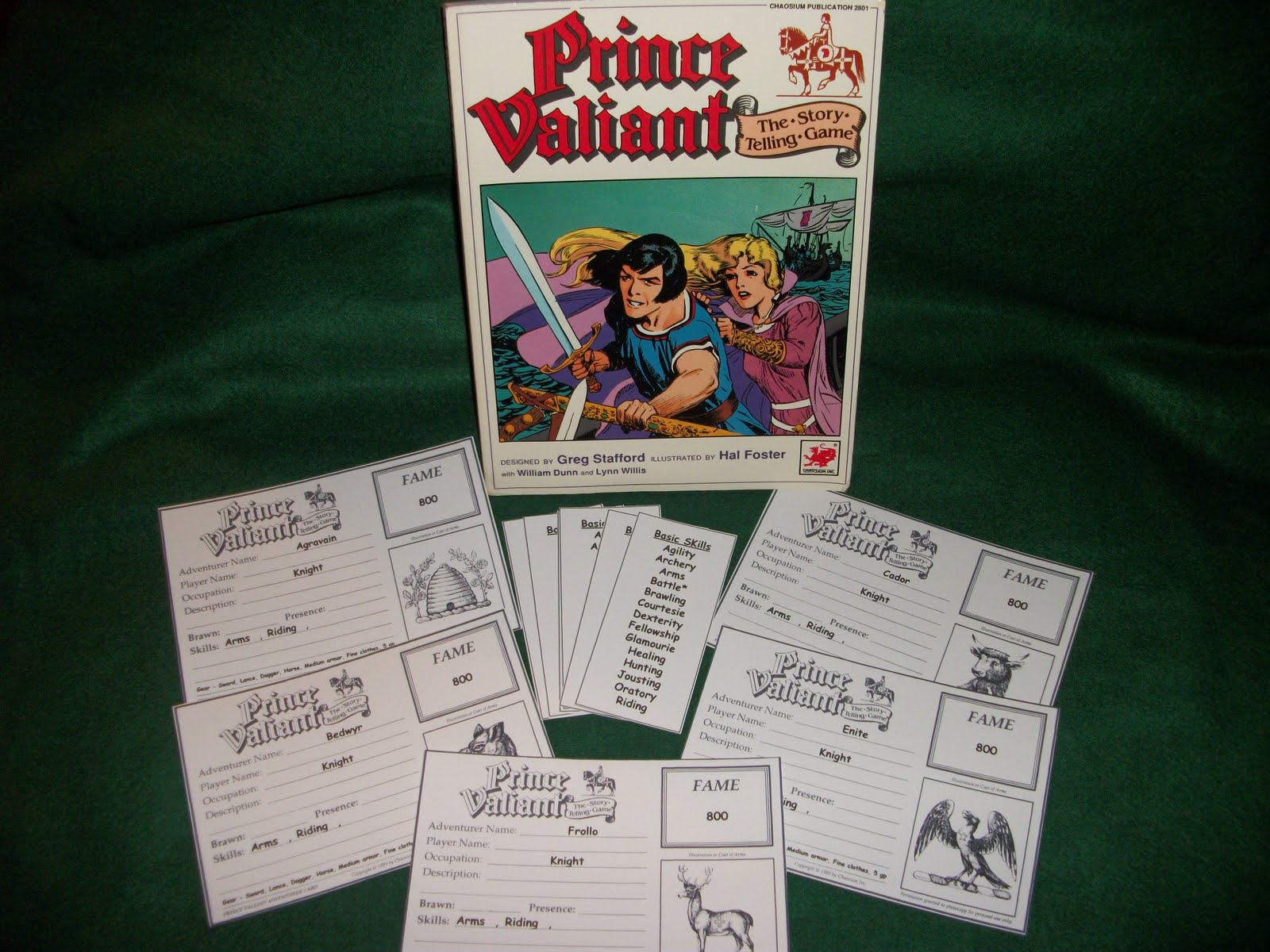
Prince Valiant: The Story-Telling Game was in 1989 an early precurser of that shift we are talking about here, but the big success in that regard was Vampire: The Masquerade. The tag line back then had been very apt, it was a game about playing THE MONSTER. All of a sudden you'd be way above humans in the foodchain, and in a contemporary setting, no less. Still small fries, all things considered, but powerful small fries.

Classic rpg fork [source]
 You could say it was the first time that the power curve in rpgs shifted from being on the system-side to being mostly on the side of the narrative. And that's significant in that once it is established that you can just narrate that you are the MOST POWERFUL CHARACTER OUT THERE (TM), although V:TM offered enough meat with its system that a somewhat prolonged campaign arc was possible.

Still, it turned out to be the starting point for a clear trajectory, with the PbtA games as one high watermark and the Black Hack games as another.

Interestingly enough, there seems to be a trend to glorify the original beginner characters from early D&D towards the extraordinary. My guess would be that it has something to do with loading the characters with some meaning they didn't have before, like PUNK, for instance. It's pretty much the Robert Rankin approach described above, where the lense through which the player/character see the world colors everything mundane in some special light.

There's also a massive manga and anime trend to have ordinary people become extraordinary because they end up in extraordinary circumstances (like a fantasy setting, but are actually very capable in that setting compared to the real world (where they might be nothing!). In other words, ordinary characters turned extraordinary because their extraordinary surroundings are just ordinary for them is a classical trope by now, which might explain the appeal in role-playing (which follows the same meta-knowledge metric: players knowing the rules fare better).

Blades in the Dark is a more recent powerful contender for the "extraordinary characters" category as well and The Spire RPG seems to be the newnew hot in that regard (giving players lots of narrative power, for instance). 

D&D 5e tries very hard to be that kind of game but obviously brings a lot of baggage to the table, which will make it a great example for how different those games actually are and how it's more like a spectrum on the user end of things. Because D&D was the original blueprint of all things rpg, it will have always had room for the story-telling gamers.

You can't, on the other hand, play ordinary characters in games that are designed for extraordinary characters only (unless you go for the comedic break of the ordinary character doing ordinary things among extraordinary characters). We tried, actually, in one of our groups once. Was a new group, didn't last, btw. I had offered to DM the WitchCraft rpg and I told the players that it is about powerful characters in an urban horror/fantasy setting.

All agreed and knew what was what, but as soon as character creation started, half the group wanted to play ordinary characters in a horror setting. WitchCraft doesn't work that way and that led to many discussions why there is no tension for the ordinary characters. They just didn't get that they were talking a different kind of game. As I said, didn't work out in the end, and it was more symptomatic that the game played out as it did. But it illustrates my point: original D&D could have been played that way (and there actually are urban fantasy b/x variants out there), WitchCraft was designed to NOT do that.

There's also the little fact that playing the first editions of D&D will grow a character from wimp to god and one could always just start with a more powerful character along that trajectory (Goblin Slayer would make for a D&D campaign like that).**

But who likes to play what and why?  

Different players altogether?

I might have to start with a disclaimer here. First of all, people will change between the "roles" in their life. A loving mother can be a bloodthirsty barbarian on her weekly gaming night. People play to relax. To be someone else or to be among friends or because the gaming immerses them. This is, in a sense, where we connect a bit with Part 1 of the Motivation Series, but only to (maybe) add another facet to it.

Here's the part I'm talking about (5 positive motivations for players to join your game):

  • DOING something meaningful (mainly socialicing with others for a collective experience ... leveling up & campaign play as milestones, those things)
  • LEARNING something meaningful (collecting experiences & testing approaches to reality)
  • COMPETING meaningfully (negotiation, tactics & strategy)
  • BEING someone meaningful (exploring who you are or aren't & why)
  • CREATING something meaningful (a game, an experience, a story)

I'd say that players going for "extraordinary characters" would, going by the 5 types of motivation proposed in Part 1, be mostly among the people motivated by BEING someone special and those aiming to CREATE an experience. COMPETING and LEARNING motivations would gravitate more towards that are challenging and offer some more skill oriented growth (instead of, say, personal growth). Those in it for DOING it as a social activity could go either way, so we'll have an even split among motivation types. Nice!

The new aspect here would be, then, that finding out what actually motivates people in joining your game is actually quite easy. You just ask them if they'd rather play (A) an extraordinary character doing ordinary things or (B) the other way around. There are three possible answers: A, B or "I could go either way, I'm in it to socialize with friends" (or something along those lines ...).

An "I don't know" shouldn't cut it, to be honest. Sure, talk it out, but if one of the three possible answers doesn't appear naturally relatively fast, it would hint (imo) towards a motivation that hasn't anything to do with gaming. Just something to be aware of, I guess.

Just saying ... [source]
One more piece of the puzzle ...

Still not where I wanted to be with this, BUT another important piece, imo, as we will need to talk about what different kinds of role-playing games are out there and why that matters immensely in terms of player motivation. What we got to explore in this post helps shining a light on some of the distinctions.

That said, being aware of the axis described above should be useful in itself as it should help you in finding an understanding about why we play the games we play and why some will work for you and some won't just because of some design choices that aim to please a ecrtain type of player.

By accident or consciously doesn't matter, if you think about it. Sometimes it's just a designer's raw preference that resonates with likeminded people. What does matter, however, is that is not "all the same".

I hope I was able to make my case here and that you guys enjoyed reading this. What do you think the implications are? Did it change your perception about your preferences? Thoughts and opinions are, as always, very welcome.

------------------------ 

If you enjoyed the above, you might like the blog anthology series I started publishing on drivethru. You can get it here and it definitely supports the blog to drop by for the pdf here.

AND I'm still hustling this one: You can check out a free preview of Ø2\\'3||, that rpg I wrote, right here (or go and check out the first reviews here). I'm (still, but only until end of June) doing a sale on the game proper ...

If you already checked it out, please know that I appreciate you :) It'll certainly help to keep the lights on here! I'd love to hear about that, too.

Just look at that beauty ...

 ------------------------

* I have to figure out how tactic, card and puzzle games figure into that, but I think they might just be something else entirely, leaning towards boardgames and such.

** Okay, here is yet another dimension to this: it is known that many D&D campaign fail when the characters becoem to powerful. Mostly that'd be because the DM didn't shift gears along the power curve and challenged the more powerful characters with something adequate. But in a sense it shows how players who like to play ordinary characters in extraordinary circumstances, actually don't like it when the game turns that around after a couple of levels. Anecdotal evidence, for sure, but nonetheless. It fits the pattern, doesn't it?


Sunday, March 20, 2022

How our motivations to play RPGs hints towards what we should play (and why that matters) Part 1

The blog is 10 years now and I have mostly been talking about gaming philosophy and design. The way I see it, I tried to explain (to me, if for no one else) what this hobby is. At times I tried to go a step further, I think, and aimed for some more substantial, more 'usable' content, building on the established insights. I would argue that writing and publishing games and modules was/is one way to do just that: applying what I had learned filling this blog with words. I feel I am at an impass right now, where what I did here should come to an end (of sorts) and my new focus should be on publishing ... And then I realized that I hadn't been giving this blog a chance to grow into its next stage: if I feel I'm done exploring, I should start doing something new instead of mapping. 

 Here is Part 1 of an attempt, as this will be a long one again ...

Preface: where to go, and from where?

With knowing what motivations keep players engaged and how that may relate to different kinds of role-playing games or styles of play, we should be able to make some conclusions about what players we should seek for certain games or what new games might work with existing groups.

That's the premise of this post.

To do this with any kind of benefit, we need to take a close look at what motivates people in general, which (naturally) heavily leans into the psychological. If you are a reader of this blog, you know I dabble in these topics. I am, however, at best somewhat well-read on those subjects (in general) and bring some extensive experience to the table, as far as role-playing games are concerned. I'm not a scientist. Not even an academic, actually (I'll spare you the Elon Musk quote I keep telling myself in that regard).

So, this will be what it will be. As usual. I'll quote sources for the bigger claims, but in general, as per what I wrote in the beginning, I've thought about this a long time and should be able to make my argument without bigger meta-texts.

To get a complete picture here, we also need a firm understanding of how many different types or role-playing games there are. Maybe even, how different styles of play with one game can draw different crowds. Although I'd have to say that, from a design standpoint, if you play a game other than within what the game offers, you are playing something else just claiming you are playing said game, which circles back to the original questions: what kinds of rpg exist and why are they different.

If we manage to get a grip on all that AND manage to work out some significant relations between the two categories, we got a stew going ...

[source]

What helped conceiving the idea for this post was a yt video about how personality affects what computer games we want to play. I thought the video somewhat lackluster in that it basically states that your preferences somewhat correlate with The Big Five ... Yeah, no shit Sherlock.

If you are more assertive, you like competing with others, if you are more creative, you like creating shit, if you are more neurotic you like more weird shit. And so on. Not necessarily ground breaking, unless you've never heard of The Big Five (find the video here).

The vlogger also claims that others did some profound research on the topic and shared a link to a survey (here) that'll give you some fancy label (Bard, Gardener, Architect, etc.) after you shared your preferences ... It's quite short, as far as surfeys go, and from what I could gather from others doing it, the results had been mixed or (very generally) accurate. But it ended in an "if you liked this, you might like this" kind of scheme and after thinking about it some more, I came to the conclusion that I don't trust their effort.

For one, the gaming industry at large is way more about how to make a player base dependant than about their motivations. They want you addicted to computer games, end of story ... and a very different set of psychology (addictive, dopamin producing gaming loops, that kind of design). Their approach is so different and sales related, that it really doesn't apply in what we are looking for (in other words, the motivation big corp is looking for is somewhat lesser in the hierarchy of needs, might even be unhealthy and subverting it in order to gain a buck).

Think about it: consumption is our weakest impulse, or say, our weakest state. If you are doing things, you'll consume less. Or even the other way around, once you stop consuming, you'll start being active one way or another.

Here's my takeaway from that video linked above (or another vlogger? can't remember). He (or someone else) said at one point that he has more computer game backlog than future, and that's ... concerning, isn't it? Especially considering that it won't stop a gamer from buying even more.

I mean, I'm no stranger to the problem. I own too many books, computer and role-playing games. Way more than I'm likely to have use for within my lifespan. Pretty sure I'll keep buying them and I'm writing some more, just to add to the pile. The difference is (or so I keep telling myself) that I actually work with the material ...

And I'm a collector! That's really important, right? Right?!

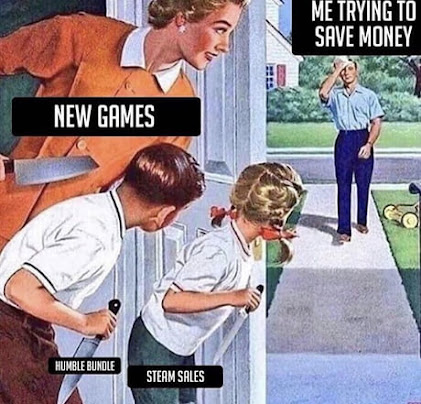
Still like coming home ... [source]

Anyway, I digress. Role-playing games originally came with the premise that all you'll ever need is that one game, which is completely not what you'd want to sell as a product, if you try to earn money with it. That premise still holds somewhat true (although it's constantly subverted and undermined), and playing role-playing games can have honest-to-god benefits for those engaging in them (as do computer games, btw).

It's the reason for their popularity, I'd wager, and it's our approach for mapping possible motivations to engage with the hobby.

We need to talk about what we are not talking about ...

Alright, as established in the preface, we aim to look at "healthy" motivations and how those are satisfied by playing certain kinds of role-playing games.

By way of exclusion, however, we should start by pointing out motivations that might apply but tend to be based on unhealthy impulses and are therefor to be avoided, or at least not supported.

Here's why one propably shouldn't play role-playing games:

  • out of BOREDOM
  • out of OBLIGATION
  • out of ADDICTION
  • as a form of CONSUMPTION
  • as an outlet for DISCONTENT
  • ...

Not sure if this list is exhaustive (it's close, I think), but the main theme here is that you shouldn't just play for reasons that have nothing to do with playing the game, so it should be able to bring the point home. External factors will always try to intrude a game one way or another. People have bad days or bad cases of ego or are in a slump for one reason or another. It happens. It's just, when it is the SOLE motivation to participate, it will create problems down the road.

Bored players might get bored by the game or engage in something else, obligations might change, addictions might interfere with the game (switching from, say, coming to drink and play, to just drinking and ignoring the game), the novelty necessary for consumption fades or the antics grounded in a persons general discontent starts hurting others (a good example here might be the attention whore that uses the game as a platform to present themselves, another one would be someone trying to live out some extreme desire that way).

Again, I could go on, but the point remains that all of those might motivate all players to one degree or another one time or another, but if it's the sole motivation (or ends up to be, as those things might change over time as well), it's no good for the game or those involved.

Since people with unhealthy motivations like that are usually not that aware of it, it's a group effort to work out solutions how to handle it. However, that might be fodder for another post*.

What we should talk about, now, are healthy motivations to play role-playing games.

5 is a good number ... 

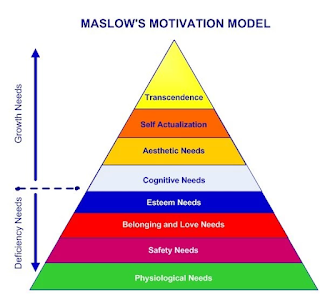
What could be considered "healthy" motivations? In general, it is obvious to assume that all of them will be somehow related to some form of personal growth. To go with Maslow again:

Ideally, you should be in the upper half** [source]

What we individually seek for growth would be related to the Big Five linked above, so this is about circumstances first, and then defined by preferences. Still, I'll be making an abstract leap here, not directly linking the motivations with The Big Five.

For one, all five are manifest in all of us, with the mean being in the average and the interesting extremes quite rare. We also can be in conflict with them (or our surroundings are in conflict with how they manifest in us) and they change with age. So while it is possible to get a snapshot of an individual's personality with a test, it is not necessarily a convenient approach to motivate said individual to play (correlation needn't be causation and all that).

Because that's the thing with growth: it is what we think we need to develop our personality in a direction, something we feel necessary. Not what we are (or the result of a test), but what we want to become. Hence, as far as motivations go, I'm thinking of them as offerings, as invitations to play. A bit like the unhealthy examples above are signs that show someone plays for reasons other than playing (looking closer at those 'bad' motivations, I'm pretty sure you'll find some form of deficiancy or even trauma that makes the motivation manifest ... that's just not necessary to determine if it helps the game or not).

So here are possible motivations for playing role-playing games (as far as I can see):

  • DOING something meaningful (mainly socialicing with others for a collective experience ... leveling up, campaign play, those things)
  • LEARNING something meaningful (collecting experiences & testing approaches to reality)
  • COMPETING meaningfully (negotiation, tactics & strategy)
  • BEING someone meaningful (exploring who you are or aren't & why)
  • CREATING something meaningful (a game, an experience, a story)

See? It's about what a DM/group/game can offer that potentially triggers intrinsic motivations to engage. I'd be willing to bet that there are people looking for all five and that there are groups with games that allow for the full spectrum (although quite rare!). However, more often than not people will only be interested in parts (those interested in BEING someone would maybe not have much fun with playing a more tactical game or with people coming with a COMPETING mindset, for instance).

They all intermingle, of course, but the main point here is that those motivations are so distinct and necessitate flow states so differing that it might need role-playing games with just as differing design approaches to keep players properly motivated.

But before we can tackle that, it needs a bit of an excursion about the science of "fun".

Motivation = Flow State = FUN

First of all, as soon as I start going down these roads, someone gets ready to point out that we are "just playing for the fun of it". As in: we don't have to think too hard about it, we know what it means to have fun. End of argument ... or is it?

Actually, what it is, is called a "rhetological fallacy". Several, to be a bit more precise here. For one, it is a Sweeping Generalisation to assume all fun has the same cause (playing=fun), but one could also argue that it also describes the fallacies of the Undistributed Middle (by basically saying fun=fun) and it is also, and I quote from the page: Cum Hoc Ergo Propter Hoc (Claiming two events that occur together must have a cause-and-effect relationship. (Correlation = cause)) or, to play is to have fun ... 

You see what I'm hinting at? Fun can be several things, is actually derived from several very different things, and can definitely had for the wrong reasons. Those "unhealthy" examples I wrote about earlier? There are people that will have FUN destroying your game or making someone else unhappy or pushing others aside to have the undivided attention of the group or ... I could go on.

I'd go as far as saying that you'd need to surround yourself with people that have the "same understanding" of what fun is, but how helpful is that? It directly leads to questions of "why are you playing" or "what games do you like", as if that was conclusive enough (it usually isn't, really). So going with motivations is a good bet, imo. It's easier to say what interests you enough to make a commitment.

How's that, though?

There is one approach to this that makes the most sense to me, and that'd be that we are looking for activities that help us experiencing something that is called a "flow state". It describes a phase of perception that is so dissolved in an activity, that we can "lose ourselves in it", or in other words, moments where our consciousness is reduced and we experience immersion.

Now, the conditions to reach a state like that can be summoned as follows:

[source]

What it says, is, that when your skill level is high and matches the challenge level, you can experience a flow state (which also implies continual growth, as you'll see). If your skill is higher than the challenge level, you are either in control, or, if the challenge level is really low, you are relaxed.

However, if you are not as skilled as you could be, a low challenge will result in boredom. Why boredom? My guess would be that "high" in that regard must mean a limitation you have reached and are aware of (as in "highest possible at the time", while medium means you are aware that you haven't reached said limit, and that would make a medium challenge "boring" as it only matches the state you already reached but will not grow your skill.

I think the rest explains itself easily (also I don't see medium skill to medium level explained here ...). Apathy describes a state where offer (the challenge) and motivation (a skill to use) don't match to the point of disinterest. Low skill level versus high challenge is way more intimidating than facing a medium challenge, but both are daunting. Medium skill versus high challenge level, finally, is arousing in that it describes the tension that the challenged is aware that their skill might not be enough, but they have a chance to still overcome.

Frustration, then (missing on the chart, but one wonders ...), would be when arousel violently turns into anxiety due to the forced insight that one's skill is way lower than expected. That's just me guessing here :D

Btw, notice how the word "fun" never enters the equation?

Anyway, ideally we move in the realm of medium to high challenges with medium to high skills. That'd at least guaranty a somewhat pleasant experience (none of the words in that spectrum imply a negative experience). If all involved are high level, a bit of low challenge to keep things relaxed might work as well, if the dose is kept low or there is a good reason for it (high level skill playing with low level skill, for instance).

One can easily see how players with a high skill level could help adjusting the difficulty level for those players with lower skills or how highly skilled Gamemasters would be able to establish the skill level of their players ...

For the wife ... [source]
That said, the flow state is where it's at. From experience I would say no flow state will last for an entire session. I'm not even sure that it would be something to seek, to be honest. But I know that it can happen several times in a game, sometimes even with all involved at the same time. And those are always the moments where you get better at "the game". 

At this point we have two of three aspects down that describe how motivation manifests. It needs something you want to get better at (the skill***) and a desirable emotional condition that can be achieved while you are getting better (the flow state). What we've not been talking about so far, would be how that connects with the five "good" motivations described above. Why have skills related to "gaming"?

Well, for one, the skills aren't "for gaming" necessarily, but should be generally applicable instead. Just like shown in the list above, playing role-playing games could allow for several areas of growth through playing that are connected, but also describe strong motivations on their own. Another good description of the mindset necessary for this kind of intrinsic motivation would be the japanese philosophy associated with Ikigai (basically about filling your life with meaningful activity).

So that third aspect is about having or cultivating a mindset for growth. Not "just" playing to play, but seeing (or at least assuming) that there is meaning to it. There's even some neurological science to this that shows how we can "hack" our brains to produce dopamine from "just" doing things: you basically learn to work towards a goal through stress with completion being the gratification ... you can strive just on that without extrinsic (often unhealthy!) factors.

You see, the science behind that is actually quite solid, even from yet another scientific angle. A good introduction into the topic can be had in this interview with Dr. Andrew Huberman (Huberman Labs) and I had written about it (in a somewhat different context) in this post.

There you have it, your recipe for "fun". As a last thing I'd mention that there is the concept of "group flow", since we are here talking about people playing a game in a group. Mass psychology has a couple of twists to it, as we act somewhat differently in a group than we would alone.

I decided not to go into it, since it is easily enough explained with what musicians, for instance, do and my argument would be that if the motivations align, it'll produce the desired effect following the same principles described above. For now I see no benefit in going down that specific rabbit hole beyond mentioning that there is something to that aspect as well.

That's already lots of words ...

The next post will be about looking how those 5 intrinsic motivations interact with each other as well as recognizing and utilizing different types of role-playing games. It should close with some words on what we could do with categories like that. Just not in this post. It is a lot to digest as it is, I guess (I thought about making this here two posts to begin with, but I couldn't decide where to make the cut, so here we are).

Only if we on the producing end take our hobby serious, we can make meaningful contributions to it. For that, we need to take a close look at what we have here, define it and go from there. Map it, then formulate ways to navigate it. I think intrinsic motivations are the way to go, in all dimensions of this (me writing this, you reading this, we playing this ...). I hope I was able to contribute to that a bit.

As I said in the beginning: I've done a lot of mapping here over the years and it started to feel as if I'd seen enough to believe I've seen it all. Which I haven't obviously, but there is a point where you need to use a higher resolution to get somewhere new. I'm still feeling my way towards that.

So what do you guys think? What's your take on how the five motivations I pointed out interact? I have an approach for that in mind (a quite surprising one, I hope, but working very well), and it should be interesting to explore it ... but I'm, naturally, curious to see what people think as well!

Also, what benefits do you guys see in this approach, if at all? Better marketing? Better designs? Would it help asserting the quality of role-playing games out there? Could it be used to usher in a new appreciation for the hobby? What are your thoughts?

Different flow state. Ha! [source]

------------------------ 

Tooting my own horn a bit: You can check out a free preview of Ø2\\'3||  right here (or go and check out the first reviews here). I'm still doing a sale on the game proper ...

If you already checked it out, please know that I appreciate you :) It'll certainly help to keep the lights on here! I'd love to hear about that, too.

Just look at that beauty ...

 ------------------------

*Well, that sounded a bit more dramatic than it needed to. I had all those players. the girlfriend playing out of obligation, the party guy who thought this was just another form of party (and played along until he one time brought way too much beer to the game and started to get drunk on his own as everyone else was there to play). I had the player who just came to be passively entertained (as if he was seeing a play, I guess ... he was always surprised when I asked him if he wanted to do something). I had the players that started out of boredom and moved on quickly after that and I even had the players will some unhealthy impulses they tried to vent in the game ... None of them stayed, and it almost always ended with some drama, but in my experience it's all just trial and error and a solid group can take a curveball or two like that. Still, knowing is half the battle, right?

**There is a possible therapeutic dimension to playing role-playing games. It can help with self-actualisation, socialisation and so on and so forth. Trauma, even. That's just a completely different ball-park and I'd wager that you do not just need to be a great Gamemaster to pull that off, but you'd also need some form of certified training to even go there. Maybe (and that's a big maybe) a solid rpg group can give a kid a feeling of belonging and self esteem has even a good possibility of manifesting, I think. But if it needs therapy, you shouldn't assume you could be the cure JUST by playing a game. You'd have to bring more to the table than that. That said, I might add that it is a great educational tool and role-playing has been used successfully in therapy.

***I could easily off script here and lose myself in how this is a great argument for why it not only needs "player skill", but how it is unavoidable, a necessity even. I won't. Or rather, I did that already in another post (here), defining player skill as:  

So what is player skill? As a consequence of the argument I'm making here, it is using player communication with system and DM to inform a narrative beneficially towards the goals all participants formulated in the game they are playing by narrowing down the narrative options to a manageable scale.

Read the post for details :)