Showing posts with label Dungeons. Show all posts

Saturday, October 2, 2021

The Monkey Business Ruin Generator in Action (Part 1: Basic Results & 1st Area)

So a good friend of mine recently informed me that the Ruin Generator I provided in Monkey Business (that OSR module I wrote) had no merit at all. The results were too vanilla and for the time you'd spend using it, nothing of value would be produced. He admitted, though, that this judgement was superficial and only based on his read-through, not on actually testing it. Fair enough. I value his observations a great deal, so I should pay attention. If my description of it wasn't enough to inspire him to use it, I'd go as far as agreeing that I failed to make him use it. That doesn't mean, however, that the tool doesn't have merit, it means I failed to make my case properly. This series of post will try to rectify that (this is going to be a big one, so I decided to go with two parts or more here).

Presumptions 1: Can Complex Environments be Randomized?

DMs using the tools provided will create a huge jungle sandbox from scratch, including factions, villages, treasure and ruins as well as having an idea how those interact. It is a tall order and people seem to mostly find it all usefull. Treasure got some heat, but I make my case about that in the post linked above ... in short, I believe the treasure generator gives a DM a shitload of information to build on while IMPROVISING treasure on the fly, even creating quest items (among of lots of other things). Test it in specific gaming situations (it needs the context of the game to build on) then tell me it doesn't work and, more importantly, why.

Anyway. The Ruin Generator got no love at all and was deemed to baroque to be even used. I mean, it definitely is high concept and not using it will have you missing out (imo), but not hinder you from using the module at all. It is just (and here's why I even bothered to write it) that a DM will create 19 hex fields with each containing an average of 3 ruins, some of them small (not so much work), some of them huge (that'd be modules in themselves, actually).

You don't have to have all of them prepared (players will only explore one hex at a time ...), but you'd be well advised to have the hex prepared the characters are in and the adjacent hexes as well. Starting at the border of the hex map would mean you'd have some concepts for round about 12 ruins ready enough for the characters to explore on a whim. Looky here (from the module):

Open in new tab for details ...

Now, either way you prepare for that will be lots of work, because that's just what it is. You sure can have some maps handy or some other product or even some random online generator to help you through this, but you will not get around preparing all of that. At the least you'll have to adjust what you get to your game.

The problem is, obviously, the level of detail players will expect when exploring ruins or a dungeon. It can barely be handwaved (if at all) and it'll have lots of moving pieces in the air as the players gather information about structure and inhabitants and how to work that to their benefit.

My design goal for the ruin generator had been to have a system easy enough to complete in a couple of steps, but with complex enough results to allow for depth and variety while summoning all the little tropes one could encounter in such an environment in the order they would be encountered.

That last part ("the order in which they are encounteres") turned out to be the crucial part, as it mirrors the hierarchy of information from "most general" to "most detailed" when the narrative starts zooming in on something that warrants more detail. Having the information build up that way a DM will have at all times a superficial pattern on hand to expand on as well as some detailed hot spots to work with as the characters explore.

That is, admittedly, a tall order. But if pulled off properly, it'd be a mighty tool for a DM to get all of those ruins prepared within some reasonable time frame (imo). If a DM has fun doing so (because we are nerds like that), it'd be even better. It'd be the DM playing AND creating at the same time (like, you know, How To Host A Dungeon, for instance). If nothing else, DMs using this tool will spend time creating something themselves instead of learning to use something someone else wrote (well, it's kind of both ... you know what I mean).

Naturally, one could critizice now that you don't buy a module to do something yourself that should be provided instead. However, that argument does not stand with all the sandbox creation tools I have encountered so far. It is always assumed that the DM interprets and builds on the pattern any such tool would provide. Why should this be different with ruins or treasure created that way?

It isn't different at all, imo. The DM creates. Ideally a module will provide a great frame to make what they create shine and maybe even give it some direction. But DMs will create or they end up being the mouth piece for something someone else created, and where's the fun in that?

Anyway, I digress. Sorry. I believe that a certain amount of complexity for such a tool as described above is warranted, even necessary to get results worth anything (considering said complexity). Still not saying I managed to create such a tool, but I hope I was able to explain where I'm coming from in this and how I went about it.

Show, don't tell, man!

Alright, lets get rolling. I'll just go ahead and use the module as intended so you guys get an idea what's happening. Our hex-field is a 52, that'd be "rolling plains with some jungle". The Resource Level is a bit lower here (-1), so we get to roll 2d6 for ruins here ... a 7. That means we have one medium sized ruin hiding here as well as two overgrown remains (a piece of road, a pillar, something like that). As for factions, this hex also contains a hidden Gorilla Base (with 2 orangutans, 3 chimpanzee ninjas and 9 goblins stationed here) and two hidden drug stashes, 2 Cannibal Villages, some mushroom artwork (5 times, spread across hex) and some artifact and weird effects from the Alien presence as well as some (4) areas showing signs of radiation.

First, the Cannibal Village (just going with the dice here) actually is within the ruins. They currently have lots of wounded due to some sort of war and people are afraid of something (quest is indicated!), but are poorly equipped. They have a shaman who's faking his magic abilities (which is somehow connected to the people being afraid) and have a crazy chieftain (reason for the wounded and the poor equipment, although they live within the ruins).

The second Cannibal Village fights with some sickness but has the population happy as something nice had just happened (I'd go with them finding a cure or remedy). They are quite primitive and have only basic farming and rudimentary tools available, but their fighters are capable veterans and have a level 3 Shaman that is in contact with the spirits. Their chieftain, however, is quite incompetent.

There are no conflicts in the area, but the next time the gorillas will expand here, it'll mean to go to open war with the cannibals, so tension is high.

That's the stage as far as we'll need it for this example (we'll ignore the surrounding hexes and the vistas they'd add to this as well as the results about what the villages would exactly look like). This is what's going on in the 790 square kilometers of this hex (an area about two-thirds as big as Los Angeles) ... everything is in a distance equivalent to couple of hours travel across those plains. 

What ruin over yonder?

This is for the results!
Now for the Medium Ruin. First roll is 1d100+50 to see how big we'll go ... that'd be 115 points for building this. The result of our first Ruin Section is 9 (d12), 20 (d20), 5 (d8), 10 (d10) and 2 (d6) (a total of 46). First sign of those ruins is a big overgrown Stone Arc (adds includes Inside Area). It should be in a jungle area this hex is featuring, visible between the green growth.

The Theme for those Ancient Ruins is "Time Loop Destruction" and it'll feature some Residual Magic of sorts. There are also some harmless ghosts here and a zombie problem as well as Kobolds. One Jungle Treasure can be found here.

TREASURE 1: 17 (d20), 2 (d20), 1 (d12), 6 (d8) - This is one dose of a rare drug made from vermin and worth 208 gp.   

Our 115 are reduced by the value of that first roll (46) to a 69.

For the second Ruin Section (an Inside area) the results are 3 (d12), 5 (d6), 7 (d10), 20 (d20) and 7 (d8) (a total of 42). This is a former Green House. The entrance to it is hidden, Stone Faces are heavily featured in this area, it is quite swampy and here are some crude and natural traps. Here are two factions present: Kobolds and Troglodytes, but it also has a Dragon! So a dragon has its lair in a tower here ... Furthermore adventurers might find 4 Jungle Treasures and access to clean water here (additionally to what the Factions and the beasties carry, that is).

TREASURE 1: 4 (d20), 15 (d20), 2 (d12), 5 (d8) - This is some ancient weapon made out of iron and worth 130 gp.

TREASURE 2: 1 (d20), 12 (d20), 8 (d12), 7 (d8) - This is some alien wear made out a strange leather with usability 8 (high) and worth 56 gp.

TREASURE 3: 6 (d20), 10 (d20), 4 (d12), 1 (d8) - This is some crested container made out of wood with a usability of 4 and worth 21 gp.

TREASURE 4: 2 (d20), 1 (d20), 5 (d12), 7 (d8) - This is 5 doses of some alien alcohol made out of herd animals and worth 30 gp.

Our remaining 69 are reduced by the value of that second roll (42) to a 27.

On to the next area. The results are 15 (d20), 4 (d6), 4 (d12), 5 (d10) and 2 (d8) (a total of 30). First Impression here is a "Mountain Side", which should translate to something like a cliff of sorts with the features "hiding" in the jungle atop the cliff. I'd go as far as saying this is a wonderful stone wall featuring a mountain scene and hiding some stairs that lead to the top. The high result here also adds one Inside and one Feature Area to this.

Main Theme here is "Roots"and the Complication is "Uneven Footing", both adding to the hidden aspect of this area. Some harmless monkeys reside here and there's one Jungle Treasure hidden here as well. I'd put the cannibals here in relative distance to the Kobolds and the Zombies (and the Dragon, for that matter).

TREASURE 1: 3 (d20), 16 (d20), 11 (d12), 1 (d8) - This is an ancient artwork made from salt and worth 62 gp.

Our remaining 27 are reduced now below 0, but there are still two areas to be resolved (an Inside and a Feature). After that the ruins are complete (for now).

For our Inside in this area we get 6 (d10), 5 (d6), 5 (d12), 1 (d8) and 5 (d20). This is a Boneyard (a huge hall, at that) with the Stone Faces returning as a Theme, more harmless ghosts and some termites. Three Jungle Treasures can be found here. The Cannibals are aware of this area, but mostly avoid it because of the ghosts.

TREASURE 1: 13 (d20), 13 (d20), 3 (d12), 6 (d8) - This is some mysterious knowledge conserved on iron sheets with a usability of 3 (low) and worth 70 gp.

TREASURE 2: 15 (d20), 1 (d20), 9 (d12), 7 (d8) - This is 9 doses of some primitive alcohol made out of herd animals (blood?) and worth 32 gp.

TREASURE 3: 4 (d20), 8 (d20), 1 (d12), 1 (d8) - This is some big ancient accessory made out of bone with a usability of 1 (very low) and worth 14 gp. 

The Feature is connected to the Inside and for that we get 3 (d8), 13 (d20), 3 (d12), 1 (d6) and 2 (d10). An Ancient Gallery with some hidden spaces can be found here. The main Theme is "Bridges" and these ancient halls still have some magic working here. The complication here is that it's crawling with insects, mostly Termites, it seems. One Jungle Treasure can be found here.

TREASURE 1: 17 (d20), 13 (d20), 2 (d12), 2 (d8) - This is some rare knowledge written on some vermin based medium with a usability of 2 (low) and worth 272 gp.

That's it for the random results and what they sum up to. All of this is somewhat basic, so far. What we haven't done yet is interpreting how the dice used for those results connect with each other and what that looks like. A map, so to say (see below).

And all that for what?

I had scribbled on the side how all of this comes together, roughly. This will need some fleshing out in places as well as produce some very specific necessities for the ruins here (mostly due to residual magic and a dragon).

What I will do now is putting in some extra effort, since this is a blog and not a DM notebook. If I were doing this for my home game, I'd just make a sketch, put down some notes and be done with it, which would be much faster. Since this is also a proof of concept, I'll go the distance and show how the provided information helps creating a very individual and fitting location for Monkey Business.

It goes without saying that this has a very high variation due to basic variables like location alone. Have this location high in the mountains and it will look totally different as well as offering different challenges (different hidden areas, different ways to get from A to B, different populations, ...).

Other than that, there might be many different reasons to explore those ruins derived from how the adventure is going. Those cannibals have a problem that needs solving. The dragon could be a problem in the area or even a possible ally versus the gorillas ... or it's all just treasure hunting (again, that dragon will have a hoard!).

You won't get the same result twice, so there is that as well. In the end, if you do 12 ruins like that, even without fleshing them out properly (there are cheat sheets to keep the information straight and with that it should be easy to even improvise a ruin), they all will be distinguishably different with lots of variety for exploration and enough information established to keep the players busy for some time.

And now for the first Area ... this is me as the DM now, building on the established. The map for what is presented here looks like this (preliminary and to be expanded on, of course, but this is what you get):

Just a sketch, but all the pieces are there!

The Hidden Everdying Galleries of Karrik-Thazzar

These ruins of a long lost civilization once flaunted its greatest achievements and victories for its people to indulge in. It featured a magical gallery where the rooms connected via magical bridges, a boneyard where the remains of overcome foes could be admired in artful displays and a green house showcasing the most beautiful and magical blossoms throughout the realm.

It fell, as all things do eventually. Now only the ghosts and ruins left behind give careful observers a hint of the serene beauty this place once held.

This location contains five major areas, some of them hidden, as well as two factions to interact with (Cannibals & Dragon Crew). It's low in treasure and in traps.

The whole complex is hidden under heavy plant growth and the easiest access to the ruins is through a overgrown but still well visible artificial and ornate stone arc.

Encounters as per rules for exploration (in this case using Labyrinth Lord and the module itself).

Random Encounter Table (1d12)

1-2     Ghosts 

3-5     Signs of Dragon Presence

6-7     Sight of Dragon in Distance

8-9     Kobolds on Patrol

10      Troglodytes having Fun   

11     Cannibals, but lost

12      Dragon Close-By

Add (1d4-1) 1 Random Jungle Encounter, as per the module (results 12 & 8):

There are some stoned lower monkeys somewhere in the location (where the DM thinks it appropriate ... I decided for Area 1 Site 3).

AREA 1

Basic mixture of jungle and ruins. Sites are connected via paths that allow easy traversion. Cutting through the jungle between sites is (mostly) possible, but tiring and time consuming in comparison. Sites are between 30 and 50 meters apart, visibility of surroundings is noted if applicable.

There is some Magic Residue in this Area with a "Time Loop" as a theme. Let's have some fun with this one: once per character (not enough magic to trigger this more than once per character!) death in this area creates a loop where the character is sent one combat round back in time instead. First time this happens, the character has to make a successful check to not be surprised and just die again (because, duh!). Second time around they know what's happening and can take the knowledge about their surroundings and the fight into account to avoid their death. Each time they willingly die to learn from the experience, they either get +1 to attacks or -1 to AC until death is avoided (as for the DM: that last and deadly last attack will stay the same, of course ... no additional rolls needed!).

If they die more than 10 times, a succesful Save versus Death Rays becomes necessary to stay sane. Unsuccessful save implicates fear against [mode of death] and means that each time a character is confronted with similar situations (same weapon, same monster, whatever applies) they have to make a Save versus Paralysation to not freeze in place instead of acting.

Please encourage players to come up with creative alternatives to allow their survival. Characters willingly facing death in this Area after surviving their first loop, will just die as per the rules of the game you are using.

Area 1 Site 1: A once glorious Arc

The top of this arc is well visible when the jungle containing those ruins is approached from the plins due south. Even when entering the jungle during daylight, the top of the arc will function as an easily visible guide to the location.

On site, this turns out to be a roughly 40 meters high, 60 meters wide, 20 meters deep triumphal arc. Very ornate heavy stone blocks that mostly feature edged but expressive stone faces.

Features:

  • An eery whisper is omnipresent here. It sounds like the distnat buzz of a town.
  • The remains of a cobblestone street lead downhill towards WWN (Area 1 Site 2).
  • The surrounding jungle is littered with big overgrown stones, but no complete structures are visible.
  • Everything but the arch seems thrashed.
  • Climbing the arch will reveal two more close-by features: a half-sunken building with a tower due NE and a massive cliff artificially cut to appear like a mountain panorama due west (Area 3 Site 1). The panorama can be recognized and located in the distance after a succesfull INT check (and might lead to other locations, if the DM so desires).

Area 1 Site 2: Kobolds & Decaying Ghost Shadows

This has been a plaza of sorts, located at the foot of a artificially altered, 30 meters high cliff bordering it due W. The cobblestones here resisted some of the roots reclaiming this area, resulting in a bit of a clearing. Still, it's full of big debris and growth, making this the perfect camp for the kobolds residing here. They are the preliminary guard for the Dragon living in Area 2 Site 5.

Features:

  • The residual magic remaining in this place makes things even more irritating: glimpses of the past of this location flitter ghostly over the remains, making the whole area very restless with ghostly people and buildings telling of the downfall of this place, if one cares enough to observe the phenomenon for a long enough time (at least 4 days before it loops back to the beginning).
  • The Kobolds are well hidden here, allowing for an ambush 4 in 6 times.
  • An optical illusion hides a staircase up that cliff (leading to Area 3 Site 1).
  • Rests of one cobblestreet leads up SEE to the arch, one leads up NEE (to Area 1 Site 3)

12 Kobolds, 1d4 HD (4, 4, 4, 4, 4, 3, 3, 2, 2, 1, 1, 1), AC 7, C, 1 Attack, D 1d4 or Weapon-1, Saves 0 level Human, Morale 6, Hoard Class I

Area 1 Site 3: Hidden Durst Jamboree

This clearing borders above a swampy area due N (some 20 meters down from the clearing). It has only big debris marking the area, like overgrown partial walls and half broken passage ways. Some stoned monkeys have set up camp here (the Random Jungle Encounter set up above ... it fits here quite well becaus of the Treasure hidden here). There's a shabby tent, some carpets, wooden boxes and dirty cushions. There's also a table set up with six monkeys playing poker and five more commenting on it (in Common Tongue, of course). It's a lively scene and they are unafraid and relaxed (the Dragon allows their presence, thinks them entertaining). The monkeys are not associated with the Hidden Gorilla Camp in the area (just customers ... those monkeys are too flimsy for military duty).

Features:

  • From here the half sunken building due N (Area 2) is well visible.
  • The monkeys will allow characters joining the poker game, but they cheat and are careless about it. Still will take the gold, though. They are easily threatened and intimated, however, and will make concessions if pushed hard enough.
  • One shady monkey will offer the character some Durst (see Monkey Business p. 42 & 43), but has no idea what the dose is actually worth (or what the drug does ... he'll sell it hard, though). He'll claim 100 gp, but can be haggled down to 60 gp.
  • One path leads down due W into swampy territory (to Area 1 Site 4), one leads down due WWS (to Area 1 Site 2)

[using the Monkey Generator provided in the module, adding the stats myself:]

11 White Howler Monkeys with flat wide faces and naked prehensile tails (black skin), 1d4+2 HD (6, 6, 6, 5, 5, 5, 5, 5, 4, 4, 3), AC 4, C, 1 Attack, D 1d6-1 or Weapon, Saves 2 level Human, Morale 4, Hoard Class IV

Area 1 Site 4: A damp place, but sunny

This little clearing is bordering on a swampy area with a half sunken building due NNE surrounded by lots of water patches between the dense jungle as a main feature (Area 2). Other than that, there's not much else to be seen on a first glance. There's no such thing as an empty space, though. It's quite nice here, actually. And no ghosts at all. Coming to rest here, one can admire the beauty of nature integrating what's left of this once thriving place. Thick roots, rustling green, ornate stones and sunlight glittering on water ...

However, spending more than half an hour here will trigger an encounter as described above.

Features:

  • Taking the time to enjoy the scenery will heal 1d3 HP.
  • There are two hidden paths leading away from this location. Finding will take 10+1d20 minutes each (unless characters very actively look in the right places, going by the description the DM provides).
  • One leads underwater NE and into the building adjacent to this site (into Area 2 Site 1, sidenote: the building can be entered by climbing as well, see entry Area 2) and can be discovered by looking into the clear water between this site and the building (which will reveal a stone doorway). Characters will have to dive through it into the building (simple CON check will suffice, though).
  • The other leads through an ascending tunnel due N (to Area 1 Site 5). The Stone doorway leading into the tunnel is hidden behind some rubble (covering the lower third) and heavy undergrowth. This is former service tunnel used by slaves and it is very well intact, even features some graffiti mocking the long dead masters of those long dead slaves (texts will need read magic to be deciphered, the pictures of profanities speak for themselves).
  • There is one obvious path leading up and due E (to Area 1 Site 3).

Area 1 Site 5: Foul Kitchen Service

The building that stood here is long gone and only some foundation and debris are left to frame this site. The service tunnel this site is entered by opens into what has been a kitchen (which could be found out if someone where to study the remaining foundations). This is not a clearing, but somehow bushes did not overwhelm this part of the ruins. The jungle only gets thick right behind the remaining stones marking where the building stood. The Dragon Crew is not aware of this area, which would make it a nice place to hang out. However ...

Features:

  • Main remaining feature in this place is an open well with a 2m diameter. The water deep down is black and muddy. On opposing sides of this well, somewhat hidden below earth and grass, it has two skeletons. The rests of their clothing indicate that they had been soldiers of some kind. They seem to have stood guard here.
  • Only the night reveals the tragedy that befell this place, albeit only incomplete. The scenery will come to life ghostly, showing the two soldiers forcing what seems to be the household into the well, with all the tears and drama one would imagine. Women trying to protect their children, people trying to climb out of the well only to be cut down. The soldiers do their job relentlessly, but with tears streaming down their stoic faces. 20 people die in that well. The Soldiers commit suicide after the deed and die where their skeletons are found.
  • Those 20 souls forced into the well are Zombies now that will climb out as soon as they sense the living above. It'll take them two rounds to get out of the well, and even though characters being aware of what's coming will be able to shoot some of them down before they get out, most sure will make it. And they will follow those adventurers mercilessly unless destroyed.
  • Service tunnel leads out of there due S (to Area 1 Site 4).

20 Zombies, 2d8 HD (adults: 15, 13, 12, 12, 11, 11, 10, 9, 9, 9, 8, 8, 8, 7 children: 7, 7, 7, 5, 4, 3), AC 8, C, 1 Attack, D 1d8 or Weapon, Saves F1, Morale 12, Hoard None 

That's enough for now ...

I think it's already a lot, actually. The rest will follow as I get down to it. As I said above, just going with the notes and sketches is way less work intensive, especially if the DM is somewhat familiar with the tool and uses the provided Cheat Sheets.

Okay, I have to admit this was more fun than I thought it would be :P Reminded me why I enjoyed writing MB to begin with. However, as I stated above: if you actually use the tool, you'll get lots to play with and it does allow for a deeper exploration of the setting while allowing room for what the module established. This is an, I'd say, average result (you can get a crystal skull, ffs, and more quests that connect this with the hex ... a lot can happen).

In realted news, since the PoD version of this is overdue and a revision is warranted (it is my first, and I love it for that, but it can be better!), I'll aim for a Kickstarter of the Revision in 2022. So stay tuned! You want a teaser? You'll get a teaser :)

Sexy, no? More 2022 ...
The module itself already does a lot, of course, so make sure to check that out if haven't already! It is PWYW, so you can get it for free, give it a try and show some love afterwards, if you are so inclined. This beast of a module received 3 five star ratings since the reviews had dropped. From people I do not know, I might add (and still love for their commitment!), so this actually is received quite well.

------------------------ 

If you are thirsty for more,  you can check out a free preview of the Ø2\\'3|| (that rpg I published) right here (or go and check out the first reviews here). We will do a sale in October when the banner goes live. Stay tuned for that ...

If you are in Europe, I'd put this on hold for a bit (wishlist it, or something). OBS still prints in the UK and since that isn't Europe anymore, tolls are mandated. No one needs those extra costs. They are working on the problem, and I'll do a happy sale as soon as they switch printers.

If you already checked it out, please know that I appreciate you :) It'll certainly help to keep the lights on here!

Just look at that beauty ...


Tuesday, August 3, 2021

My OnePageDungeon Contest entry: Opik's Magnificiently Damning Door Bravery

I ended up having the time and energy to throw something together for the OnePageDungeon 2021! It's a full page, and trust me, every millimeter was fought for. Naturally, I sent it in on the last possible day (with a couple of hours to go and I wasn't the last, but still, cutting it short). I'll try and talk a bit about it here (sharing it as well, of course, as that seems to be the custom), but this might end up being my shortest post in a long while ...

Opik's Magnificiently Damning Door Bravery

It's the nature of the beast that I'd rather share the page itself before saying anything about it, as it should all be on the page, really, not needing any context. If you know the blog, you know I'm quite verbose. I think that's alright for the medium, but other formats need other types of writing or a layouter cutting corners. Guess what I did. Ha!

Anyway, here we go (open in new window for detail):

What can I say beyond that? For one, I actually aimed to have three puzzles in there instead of two. Good thing I only had a vague idea what that third module could have been and time was the deciding factor to just go with what I had. Thankfully so, since I barely had room to do those two modules justice (close call, but I managed ... I think). Still, maybe something to expand on?

As per the guidelines, this is system neutral, and that turned out to be a challenge as well. How to scale something like that in a way that is easily adapted to every imaginable system without ending up being arbitrary was something that needed lots of consideration. I tried :)

Oh yes, but doing the dungeon modules was the hardest part, btw. Who'd have thought? Lining up some squares is easy enough, for sure, but making them presentable from scratch was harder than I thought (I looked into online variants, but even there some work would have been necessary). I aimed for 'playful' in the end, I guess.

Anyway, I hope this will give a couple of people some joy. I sure had fun writing it and putting it on the page (using inkscape has a very meditative quality, for me at least). Not sure if this has a chance for anything but being in the publication in the end, but I'm happy with the result and hope I'll get another chance next year.

So, what do you guys think? Useful? Too much? Fun?! I'd be happy to hear your thoughts on it!

------------

In other news, I will keep the discount on Ø2\\'3|| (that rpg I published) up until tomorrow and you can check out a free preview of the book right here (or go and check out the first reviews here). This will be with the general populace for a little while now, but we will do some sales in the future, of course.

If you need more convincing, maybe this post might get you there. If you already checked it out, please know that I appreciate you :) It'll certainly help to keep the lights on here ...


Sunday, July 10, 2016

TPK

You know what those letters mean: they all died. I'm talking our last game of Lost Songs of the Nibelungs here. Players took it like champs and we talked more about it than necessary. Nonetheless, the discussion after the game was left, as you would have it with half a bottle of vine in the brain, incomplete. Or so I think. And there is always something to learn from the ill fate of characters. So a post it is ...

This will scratch several topics I already wrote about all over the blog and connect to some extent to this post about sandbox gaming and my last post about improvisation and preparation.

This is how I roll

Let's start with a few sentences about how I DM my games. I think it's important to understand where my decisions come from to evaluate them properly.

First things first, it's all random. Down the road I fill it with internal logic where I need to and randomize the rest. The setting is the historical Dark Ages around 550 AC and with a touch of magic. The sandbox the players get to explore is fictional (there are no proper topographical maps of the time anyway, btw) and also random (using this system). Their tribe, at the center of that random map, is also fictional and I allow some customizing regarding appearance and culture (tattoos, burials, and so on).

Character creation is a mix of random results and player customization. I have no story to speak of at the beginning of a campaign/game, just some random seeds (mostly what fascinates/intrigues me at the moment), random tables, background information (many of that as a random result of the setting creation with as much actual history as I can summon and what the narrative already produced) and dice. The rest is interaction with the players, rolling the dice and improvisation.

In this the players are free to do with their characters what they want. A career in the Arena? Not a problem. Becoming drug barons? Show me how to do it ... I propose and react, they do.

I'd like to stress that I'm very laid back about all of this, mostly working with internal logic of a setting or situation. I have no dog in this fight, as they say. Being a neutral party like that should have the great advantage for players to solve problems with as much ingenuity as they can gather and not just by knowing the rules. Everything can be done if it's within the realm of possibility.

It also means that wrong player decisions might bear dire consequences for the characters.

I admit, I will soften a blow somewhat if I get the opportunity. But a blow it will be nonetheless. Nowadays I even roll in the open most of the time and without a DM screen.

That being said, I'd like to add that I'm only human and I make mistakes. So that is in the mix, too :)

Finally, this is play-testing. To some extent this means putting the system under stress to see if and where it might break and that means players might end up in situations the system can't handle some way or another. Not saying it happened here, but it could have and everybody was aware of that.

What happened before

The quest of our heroes started in the (totally fictional) Roman city Ovicuria with a mourning mother (a sad prostitute one of the characters met in a tavern) and her missing child. The group decided it was a proper quest for the heroes they aspire to become, so they promised to reunite the family. They did a lot of questioning and listening before they found out that the mayor of the city, a self-proclaimed Caesar, is somehow involved with stealing babies for some demonic rituals involving orgies somewhere under the palace in the center of town.

Part of every Roman cityscape [source]
Their questioning already aroused some suspicion from several parties and they got followed by humans and phantoms (both spotted by the group, so they knew). But the opportunity arose to infiltrate the catacombs during an uprising against the evil Caesar (was a result of this here random table) and while said Caesar was having one of his rituals below the palace. So down into the catacombs it was. They found a secured entrance easy enough, guarded by two of those sinister legionaries they keep seeing patrolling the streets.

It'd been a short and brutal fight. Although those guys were really tough, they went down. And this was the moment the group found out that those guys could regenerate. Cutting them open revealed that they had strange purple worms residing in their hearts. Cutting them out and killing them killed the legionary, too.

But all that took a lot of time and this being an exit provoked a situation where they encounter some traffic. And so it was, two noble Romans with their escort, another pair of legionaries, showed up. They fought them, but one of the nobles got away and it didn't take long for that guy to raise the alarm. The group cut their losses and off they were.

It had been a wild chase through the city and the group had been lucky that the riots spread into their direction (again, a random roll). They found an abandoned house to lay low for a few days and heal. In the night they heard (and some of them saw) a huge demon flying over the burning town. At that point they had some idea what they are up against.

Something like this: A blood demon by albino-z [source]
There is one more incident I need to report before I write about that final and fatal game night. One of the characters had been out of luck with his stress saves and his character was a bit shaken. That was why they decided on a full nights rest. Another character had a light sleep that first night and woke up, thinking some of the rioters tried to force their entry. Not being a fighter, he decided to wake up the shaken character with a kick to the kidneys and the claim that they are about to get attacked.

They all being under lots of pressure, I demanded another stress save from the character with the boot in his kidneys and he fails dramatically. A botch, if I recall correctly, with the character ending up in a corner whimpering and shaking. A real nervous break down for an attack that never happened, as the doors held and the rioters moved on.

A fatal last descent 

Orientation: They came from south, there on the
right, A is where they ended up.
Time was definitely a problem, so they took as much rest as they dared and prepared for their next foray into the catacombs. With the riots just being crushed and their first attack from that direction being as effective as it has been (four dead legionaries and one witch down), the palace guards decided to be extra careful about it. They had sentries early in the catacombs, mainly runners. The group gets spotted then and there. Another fight, two legionaries join the fray. All enemies die, but some characters get wounded, too.

Still, all is well and they press onward. The door those soldiers had been guarding is the next obstacle, but not that big a problem. The group enters the palace dungeon. There are some statues, some doors with magic warding (probably tombs, they conclude) and an opulent entrance to what seems the dungeon proper. Since they have a mission (rescuing the baby) they store that information for later and move on.

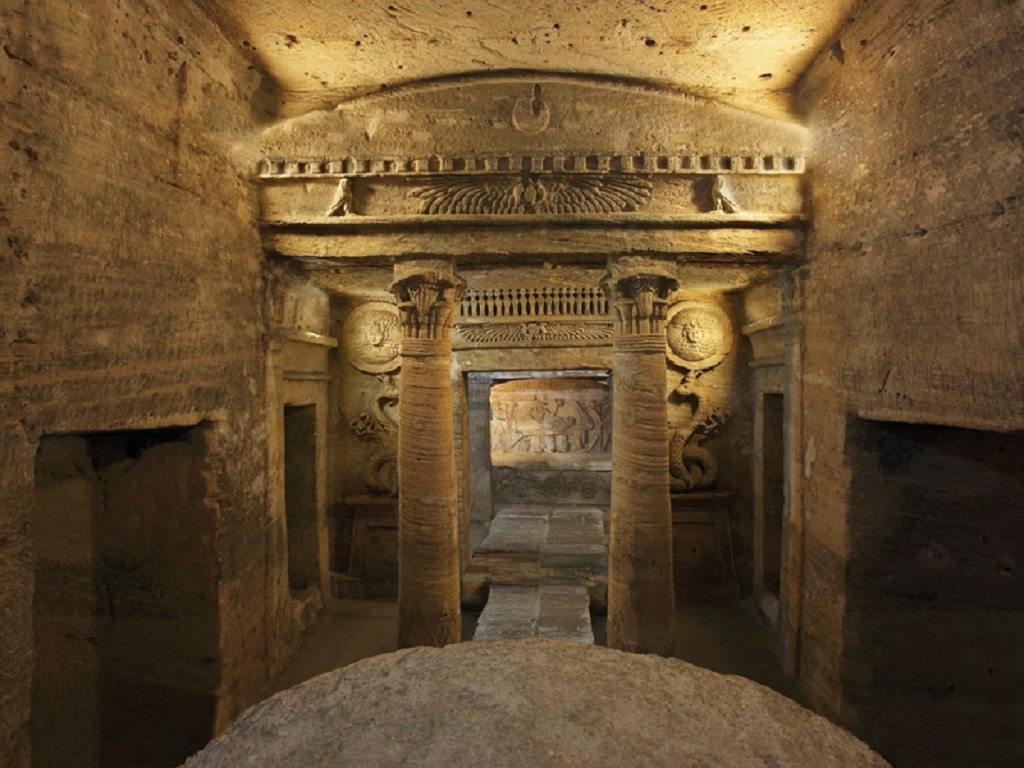
The entrance: They had something Egyptian going on down there, too [source]
Two choices, left or right. Left gets the popular vote first and they follow that broad hall way a bit until the get to a crossroads of sorts, with a smaller corridor going off to the right and the hallway going on ahead. On the left the see a ghostly legionary kneeling in front of the wall between two columns. That seems dangerous so they head back and into the other direction.

The never ending watch: Well, I really came prepared ...
[source ... no idea where I got that]
Right it is now, still on that main hallway. It's when they start hearing the screams of tormented souls that things start going south. It threatens their nerves and that allows for a (normal) stress save. Failing this would make characters nervous, nothing more. But the one player with the nervous break down just the other day, well, he fails and with his nerves already being shot, he is not able to move on as the shadows themselves threaten him.

They put him into an alcove and he hides behind his shield, the white in his eyes way to visible as he tries to penetrate the darkness around him in fear and finally decides to move back to those statues before the entrance and between the tombs. He has no luck there, as a creature is imprisoned in one of those tombs, between bones and dust. It is an oracle from another world and the dice decide that he encounters her. I interpret this as him hearing her otherworldly voice singing. He rolls his save for sanity and ... botches. One epileptic seizure later is is out of the game for good. His body just couldn't take it.
The otherworldly oracle by
the great Bastien L. Deharme [source]
One down, three to go ...

The character being unconscious means he can't hear the patrol passing the entrance, moving towards his friends.

Meanwhile the others came to another junction with some legionaries guarding another opulent exit to the right and another corridor opposite of them. Or so the group assumes. Deciding on a course of action, they decide to trick those legionaries into turning away from them with a sling shot and attack them from behind. Tension being high, I decide the legionaries don't move towards the noise, but move back into the corridor they are guarding instead, closing the gate.

That crossroad, the lights leading into A on the map [source unknown]
One of them gets hit with an arrow as a going away present before the two are out of sight, but the noise of the bow in the hallway and the gate closing alerts the patrol coming in from behind the group and they engage.

Having no time, they decide to make a run for it and instead of running ahead, the group aims for the corridor they assume to the right (see the map, at that point the players had figured out that this entrance might correspond with the other one opposite of the ghostly legionary on the other side). So they ran and they had no time to check that entrance or see anything other than that it was actually there. They saw the two stone faces at the entrance, but they couldn't see the shimmering veil between them. A trap ...

A trap [source]
The first ran through and there was a flash of light, but he had cast some magic protection and he managed to pass unharmed. The second character rolls for a full stop and makes it, but the character behind her is not that lucky and she stumbles between the faces, barely avoiding running into the character before her.

That one gets badly burned and she's barely conscious when the horrible, now unfiltered screams, the irregular proportions and the eerie light of the area they just entered gives her the rest and she loses consciousness before she loses her mind (two failed saves later, so to say).

Two down, two still moving forward

With the legionaries approaching and two characters already being in the other side, the third character decides to go for it, too. A spectacular save later, she passes the stone masks unharmed. The legionaries don't follow them and they realize they have entered a labyrinth of sorts. After having the second unconscious character stored somewhere in a dead end, the remaining two characters head towards the screams.

What they find is disturbing: people, pinned to the walls and knotted into unholy symbols, forcing their souls into infinite torment. The proper thing to do is to free those souls, so they cut their throats and silence them. As the last soul dies with a thankful sigh, one character starts to hear children crying and they find an air slit leading downwards. They immediately start looking for a secret door. The silence also alarms one of the residents of the labyrinth and she comes looking, but the characters find the secret door in the last moment and barely avoid detection.

They find themselves atop a narrow circular staircase. The noise of crying babies is way louder here and the make their way downstairs. But this secret laboratory in the heart of the inner sanctum of the palace dungeon is protected by a bone maelstrom that makes the unwary lose their balance and fall into it, grinding them to death. The first character falls and loses consciousness, but the second is able to catch her before he himself fails his save and falls towards his doom ...

Another trap [source]
Death scenes

They infiltrated a highly protected and well guarded area and although none of them died, they did all lose consciousness one way or another. So they got caught and all of them found horrible deaths. One ended up at the wall where he just hours before freed those tormented souls, two got sacrificed in a blood ritual and the last one, the guy that had the seizure, well he got gutted by the oracle for one of her readings.

At this point, I really was left with no choice at all.

Discussion

The players took it really well. They had been happy with the campaign and Lost Songs as a system so far. We'll make new characters and explore other directions. They also get the xp their characters earned from that sessions, so chances are they won't start at level zero. So that's something.

A few points came up, though, and I'd like to address them. There is a point in the system where failure starts a cascade of effects that will harm a character way more before the body gives up and denies consciousness. That needs to change. It wouldn't have changed a thing here in the end, but if the characters somehow managed to get out of there, they'd have more damage to heal than is reasonable.

Instead there is a threshold of pain now, where if the disadvantage on a roll is higher than the save, the save fails automatically instead without doing any further harm than the effect (losing consciousness, that is).

One other point of critique had been that I reveal too much in my narrative and descriptive parts as I give interpretations for the characters. I do that mostly because I believe if games are longer apart as a few weeks, details get lost on the players and the game suffers a bit because of it (the opposing argument was that what the players don't know anymore has no place in the game). I also like to talk a lot. There, I said it.

Joking aside, I'm not sure I want to tune that down in the future and I think it's worse if the characters end up in a situation where I have to say "Well, that's bad luck. You have been warned about this three games ago ... you know, two months ago, talking to that swamp witch?" (or some such thing) because that just doesn't sit well with me. I have to think about it some more, but it directly leads to the last point (and the one I definitely do not agree with).

Where we didn't agree

That final point was that I, as a DM, have to balance encounters for the group so a TPK doesn't happen. That I won't do. It is a sandbox game and the course of action the characters chose brought them where they ended up. I didn't enforce any of that and kept is as fair as possible. The dungeon was set up before the game so their decisions mattered and their observations had value, stuff like that.

Interestingly enough, the case of the missing children was a direct result of the randomized setting creation. Something dark stirred there and affected something combat related. I decided early on that the legionaries where connected (actually long before that campaign started) and the missing babies were connected with tat, too (they bred the legionaries out of them ...). So it was very likely that they encountered people with missing babies (still was a random result, though).

But they saw the warning signs and decided that what they did is what their characters would do because they are inexperienced Germanic warriors from the country. I don't agree. Or not completely. It would have been totally legit to consult a holy man before taking on that palace dungeon. Gathering more information would have been possible. They already got some allies in town.

I admit that time was a pressing matter and that the challenge was hard. But it was impossible if you just run into it unprepared or careless (or both). And I don't bend narrative or setting just because some players miscalculated or can't remember important details (see above). But there is also no need to for highly trained and well tuned tactical group machine to make it happen.

For me at least it's about finding that sweet spot between what a character should do (or be) from the "playing a game" perspective and how that could be explained in the narrative (the storyteller perspective). So if you as a player thinks that his character should check for traps and move silently, but he is an oaf from the country and wouldn't do that, it's for the player to find a way to make it work. And there always is a way. 

What happens next?

I don't know. I really hope we get to play more together, because I had loads of fun with those guys. And although I don't necessarily say their character decisions had been, well, wise there in the end, I definitely say that they made for a great story and I'm looking forward to continue in that tradition :)

Lost Songs of the Nibelungs is a demanding game, both on DM and on the players. You get a very detailed picture how your character feels and if you ignore that, it might result in dire consequences. Sandboxing i demanding, too. Morrowind is still my high standard here. Do what you want, make it work. It sure means investing into it and it means you might fail by chance. But if you play along, it can be very rewarding. On the one hand I'm very happy with that, on the other hand I hope it isn't too much. Either way, the game keeps growing.

Damn, that's a long text again. Couldn't help it. Still left things unsaid, too (I think). There is, for instance, something to be said how filling the narrative with information might be a good way for the players to dam the randomness to a point where you make success almost impossible with established facts. Taming the narrative, of sorts. But that is for another post and you can read it here.

Next week I'll finish the Dragon's Cough scenario here on the blog and after that ... I don't know, maybe another review?

Thoughts and comments are, as always, very welcome.


Thursday, June 16, 2016

How dragons are the flagship monsters of (early) D&D (using the Rules Cyclopedia)

I was writing a short scenario for the blog (which will be up next) and while I fleshed out the encounter, it occurred to me why dragons are so important as showcases what D&D was meant to be. Or could be in the hands of a capable DM. Anyway I took a closer look at the dragon in the D&D Rules Cyclopedia (big surprise there). Here meander my thoughts on the matter.

Why is it called "Dungeons & Dragons"?

I sometimes wonder how Gygax and Arneson came to call their game "Dungeons & Dragons". It is, if you think about it, an odd choice. Genius in its elusiveness and spurning the imagination more than many other similar word combinations I can think of*, but odd nonetheless. Sure, dungeons had become big with the early play testing groups in the 70s and it was kind of an obvious choice. But it must have sounded very weird to those not familiar with the background, since "dungeons" as they had been used in the game, had been no where close to what popular culture endorsed at the time. Even at it's fringes.

That's mostly due to the fact that the "dungeon crawl", as it is experienced in role playing games, is something genuinely unique to that very medium (or at least was at the time). You just don't have it in books, comics, tv shows or movies back then and computer games weren't even a thing at the time (and would use D&D for inspiration later on). Today it's still pretty rare in anything but computer and role playing games. And with reason. The thrill of exploration comes from doing it, not from tagging along.
[source]
And why is it "Dragons" and not "Demons" or, I don't know, "Daggers" (assuming the alliteration was a must-have in the decision process ...)? Well, this is me guessing, because I have no idea what exactly went down there (tempted to google it, too, but where would be the fun in that?). Might be the easier one, though. Dragons had always been a thing in literature. Heroes fight dragons and if you read the word, you have a mental picture what it's all about or where it's headed.

There is another dimension to the whole thing. Dungeons are very dangerous locations full with treasure and promise. So that's something to explore. Dragons are famous for being intelligent, mean and unbelievably rich, they are some of the most dangerous monsters out there. So that's a challenge to overcome and get famous by (well, and stinking rich, of course).

Both words describe goals and  to reach those goals means having an adventure. I think there is something to the idea that they describe goals to aspire to: you want to get to the dungeon to explore it and you want to get strong enough to beat a dragon. The way is the goal. Doing it, not being there.

Following that argument, you'll end up asking if D&D actually delivers in both regards. For dungeons it's quite simple (I'd say) as the whole game in it's early editions is rigged towards exploration as a team of adventurers with the goal to get more powerful and treasure directly connected to that (treasure = xp). The sum of the available classes are able to overcome level appropriate challenges in a dungeon environment (finding traps and secret passages, orientation, fit for combat action and magic challenges, plus healing support to complete the package). The rest is player skill, which is just as important to invoke a sense of danger and exploration.

About right, right? [source]
Dragons are a little bit more tricky, as they are on the monster side of the game and that's the Dungeon Masters (sic!) area of expertise.

Let's start with monsters in the Rules Cyclopedia ...

I'm talking Rules Cyclopedia here and this changed focus somewhat over the different editions. But the D&D Rules Cyclopedia was understood as complete in one book, so the information that is in it is assumed to be essential to the experience of playing D&D (1e). In that it's not only a collection of rules, but also a collection of exceptions and examples. I think this is where it gets interesting. The D&D RC is a tool box and it's important to realize this when talking about monster entries.

Here is a word on short monster entries: they do nothing for a DM but giving him numbers he could have come up with just as easy all by himself. Even having all the general information that is available about a specific monster, it will always lack the most important part and that is how an individual version of that general monster entry fits into a campaign world.

The specific is where the work is, so to say. Not even the number of hitpoints per monster, but cultural background (cloths and equipment, behavior), territory, allies and enemies. All those beautiful things that bring the game to life and make it still hard for computer games to beat their analogue ancestors in terms of depth and flexibility.

Some of that can be randomized, like with monster reaction rolls in D&D to see how the monster interacts with the adventurers or random encounters that show how probable it is to encounter a monster in a certain area at a certain time (day/night, etc.). Depending on the possible variety of how a specific an entry could take specific form in the game, the book will be either very vague or very specific about it and gives general and/or individual guidelines what directions a DM could go with it.

Goblins, for instance, are held relatively vague. They live in caverns (infravision, don't like daylight), stealing what they need is their modus operandi and they really don't like dwarves. Might have a king with bodyguards, might have a spellcaster. Not even a quarter of a page in the RC (see p. 180), but lots of possibilities (as per pages 214 to 218). Make them bigger, smaller or make them smarter, combine them with other monsters, give them special attacks or a culture ...

The list of possibilities goes on and goblins are famous for the huge amount of variety in publications and home brews. I mean, who doesn't like a mean little monsters that breeds like bunnies, die even faster and are intelligent enough to fulfill the basic requirements needed to adapt to every environment and weak enough to make them the perfect minions.

And then there are the more specific monsters, the dragon being the one with the biggest focus in the book. There is, after all, even a saving throw named after it, ffs**!

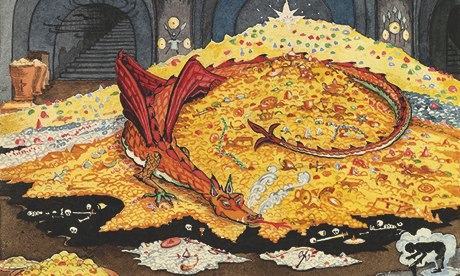
Smaug by Tolkien [source]
Dragons are showcases of what can be done in D&D?

Yes, I think so. There are 5 pages dedicated to dragons in the RC with lots of information to make any one encounter with  dragon something very special and dangerous. There's still enough variety that just by using the information on those 5 pages, no dragon will be like the other and there's always the option to change it even beyond that.

But that's not the point. It's more about the fact that each dragon is an individual and powerful enough to matter even as a NPC enough to have a full set of stats and background. Dragons matter in a game. It's nothing you encounter randomly, it's something that announces itself. Big time. Or it knows you are there while you don't know a thing about it being in control (it happens to be on random encounter lists, by the way, but a 15 HD monster doesn't drop out of the sky most of the time, so if it comes up, a DM is adviced to handle it with care ...).

Thought through it means that each dragon in a campaign world will have a huge territory, it will have contacts and minions and it will actively seek to keep all that or even expand. It is prepared and that means its lair will be trapped and protected. It'll also have spies in strategic positions and will be warned if someone is out for its hide. It'll furthermore have a very significant position in the power balance of a region, even if those living there are not aware of that fact. Shifting such a power balance, on the other hand, will have repercussions that will be felt by all ...

Anyway, what you get is far more interesting than what you have to add. You get combat tactics, several different physical attacks like crushing, tail attacks, hovering or wing attacks from a mean flying creature that is smart and might also be able to talk and cast spells. Add rules to subdue dragons, different power levels, alignments and colors ... It's as detailed as they get and when you actually sit down and plan an encounter like that, you'll see that what the D&D Rules Cyclopedia can do.
Yeah, I know that trap ... [more often than not NSFW source]
And that's why I think it's the showcase monster in the book. Not only because it's in the title but because the diversity in tactics, strategy and combat options with all their little special rules in combination with posing a versatile opponent in the mental department gives a DM a great idea how flexible the rules are and that fights don't necessarily follow the you-hit-me-I-hit-you routine the game usually is reduced to.

We are encouraged to make this happen at the table. Why not have the goblins cut off a characters ears when he's down instead of going for the next opponent? Why not allow a signature move for a orc tribe if a 19 to 20 comes up? Don't think in categories of weapons, think in effects. I had a fat goblin once fight using a big fish as a club. Make them attack the knees. No damage, but you need to make a save to stay upright ... Stuff like that.

Little details like that will make encounters unique and the dragon shows the way how to do it.

And what now?

I'll have an encounter with a dragon ready for the blog next weekend. I can say it will happen, because it's almost done :P It is an interesting experience to prepare an encounter like that and I think every DM should do this at least once. It's one of those monsters that are around anyway and if done early in a campaign, they can grow alongside of it, like the characters do.

Maybe that's something that should be done with every major threat in a campaign world and I was just to lazy to do it until now. In that case all of this might be old news to all of you. But if nothing else, it makes a point for details in monster entries and individual monster creations for every campaign.

It's not about the numbers, not even about the special abilities a monster has, it's all about the individual (non-player) character you produce when it appears in your setting ... Ah well, let me show you what I mean in that next post :) Here are Part 1 and Part 2 of the adventure scenario "The Dragon's Cough".


* The only really sweet combination of words I'm aware of would be Shotgun Shogun and that's entirely +Mark Van Vlack's fault, who brought it up and should do something about it ...

** It is interesting, in that regard, that the Saving Throws vs. Wands and vs. Dragon Breath are (optionally) both modified with Dexterity, which not only makes DEX the only ability score affecting two saving throws, it also makes the only remarkable difference between the two, in terms of what happens to a character that he needs to save against it, is  the change of the difficulty in the threat the character is facing. Funny also, that it's only for halflings and dwarves significantly harder to save versus Dragon Breath :) Man, that's a post on it's own, the more I think about it ... 

Tuesday, December 29, 2015

I will release a dungeon crawl early next year ...

My last post this year is ... an announcement and a teaser! I wrote fun-house dungeon crawler over Christmas and because I don't like to be set on anything but what happens at the table, I randomized the whole thing using the 2d10 idea you might (or might not) know from here, even included a Drop Die Table for good measure, ending up with one sweet roll for 6 results (from room size to contents, with random encounters, doors, features and former purpose). Here is a teaser of the structure:

Open in new tab for more detail ... Inkscape helped me do it!
I don't know if this will amount to a megadungeon, but there are potentially over 320 rooms in this thing (that's the average).

I won't give you the whole thing, though, only the random tools to build it and the backstory to make it work. It will be system agnostic and (most likely) not more than 10 pages. It is written, it is tested, I just need to clean it's nose and put it out there. Which should be one of the first things I post in the new year.

This will be free and weird.

In a way it's a summary of what I started to do this year and intent to finish next year. Remains to wish you all a nice and smooth transition into the coming year. I hope 2016 will be as awesome as 2015 turned out to be so far and wish you all the best!

Jens


Sunday, January 18, 2015

Actual Epées & Sorcellerie Play-Report Pt. 1 (Random Shenanigans! Goblins! Odd Petty Gods!)

E&S is a french retro-clone that works solely by using a solid (and beautiful) 2d6 mechanic. If you've never heard of it, you certainly missed out. It's free and short and brim full of ideas, so just do yourself a favor and check it out already! I also wrote a review about the game back in February, if you need some more convincing ...


The first opportunity to play E&S was this year in April when we went to the girlfriend's family during the Easter holidays. I believe I was a bit shaky with my DMing back then (I hadn't DMed on a regular basis for about a year at that time*), but everyone seemed to have a good time (didn't write a play report, though).

Anyway, when we decided to spend the Christmas holidays there, too, I was asked to DM once more. Now with more players (the people who'd had a good time the first time, had convinced others to join the party), so we ended up being 7 people. Two of them complete newbies and two more that might as well be called newbies, since the only game they'd ever attended was the one we had back in April.

I was better prepared this time (at least I believed to be better prepared, which is just as well) and really felt the urge to DM some fantasy role playing. My game of choice was, again, Epées & Sorcellerie, since most of the people attending already had at least some experience with it.

This is a collection of my memories of what occurred that day. Mostly for future reference, but also to talk a bit about how I DM a game (random and improvisation). Part one will be mostly the set-up and the first encounter. Part two will conclude the session and I'll write a bit about what worked and what not

The chances for everyone from the first session still having their character sheets had been thin to begin with, but still, I wanted to build on the setting and the story that had already been established and hoped that at least one player still had something for me to work with. One was all I needed ...

Recent Events in Barony Schwarzaarlen

The map I used for barony Schwarzaarlen was the one I talked a bit about in November 2014:

The post is here.
Character creation took about 90 minutes. That's not the games fault, though, but due to the fact that 5 new characters needed to get done and I had a lot of explaining to do. When starting a setting new to the players, I usually assume that they had some reason to be in the area. Them all being level 1 made things quite easy, as they all just had finished their training and thus needed to be locals (as travelling would have most likely ended in earning xp ...).

I also take the time to tell the players a lot about local politics and rumors (list contains rumors from both sessions):

  • The local baron, Welbur ven Stretten, was away on military expedition to get rid of the giant spiders that recently had caused some trouble at farms in the south.
  • Rumor has it that the problem with the spiders was because of another military expedition a few months before that, where the baron got rid of some lizard tribes who lived in the southern swamps.
  • With the lizards gone, Zaraziell the Weird (mighty wizard and resident of the infamous Flickering Tower (yellow circle with the "C" on the map) decided to travel into the swamps to the Ruins of Takor (an ancient city. hexagon-8 on the map) for some research, something he'd thought to be too much work up until now because the tribes had been somewhat protective about it.
  • There were rumors of Ogres living in the east and some goblins living in the north.
  • There were stories about The Road Under the Mountain, a series of ancient tunnels with the legend that there might be a shortcut through the mountains. A dangerous endeavor, but sure worth some gold for those who find such a passage.
  • With all the Big Players being busy, the town Deverrin (red circle with the "A" on the map) was in desperate need for some local trouble shooters to get things done. One such group (characters of that first session) had been sent to check out why the big cider delivery for some upcoming festivities was late (the town had been preparing for a fair to celebrate the apple harvest at the time).
  • As it turned out, that delivery had been late because of a (very) drunken Ogre being on a rampage on Widow Oldinges farm (producer of the famous Cider Goldspritz, biggest farm in the area, people call her godmother, but only behind her back ...). The young heroes had helped killing that beast and ventured on to find out where it had come from and why, as ogres normally don't come that close to the town (end of that first session).
  • The second session starts two weeks later with the new characters finding out that the fate of that first group is uncertain, as only one of them had returned (the only surviving character sheet back at the table ...), but injured and with no recollection of what had happened after that first group had left widow Oldinges farm (she'd only remembered some ruins, an entrance leading under the earth, the screams of her dying comrades and the general area where it went down ...).
  • Some fairy creatures had been implicated with the ogre rampage, so the elves in the north took an interest in finding out what had went down and sent a young priest of Kalantos, the God of Axe Executions (random result of the Original Petty Gods roster, p. 60) and his bodyguard (two new characters) to find out.
  • The survivor of that first group had made a public request for volunteers to join her for a second expedition.

With this knowledge the new group formed (adding another elf, a wizard and a dwarf) and started their journey up north.

Preparing the Randomness

I had the map shown above, the E&S rules, some random encounter tables for the different areas, the names of important personalities living in the valley, the local landmarks (they traveled basically following known landmarks, like the mountains surrounding the valley, etc.), also the fantastic Original Petty Gods pdf (finished and hosted by Gorgonmilk, not to be confused with the connected, but still developing and eagerly awaited Expanded Petty Gods project over at Save vs. Dragon) and a list with random names for every occasion.

I also had with me (but didn't need) the "Dungeon Dressing" Tables from the Ruins of Undermountain and the OSR dungeon crawl Under Xylarthen's Tower by +Jeff Rients of Jeff's Gameblog fame.

That is all. The rest needed to be improvised ...

Tribal goblins and some strange ruins ...

So the group traveled north and the first day of travel didn't bring any random encounters and they managed to venture deep into the forest before they needed a place to spend the night. The night turned out to be a bit more exciting, though, as during the second watch 4 Goblins infiltrated the camp undetected and almost managed to get away with kidnapping one of the characters (set up of their camp allowed for the attempt and the character didn't wake up ...).

A short fight dispatches three goblins, but the fourth got away and weaseled his way back into the forest (being on his home-turf and all). The group decided to break camp in the middle of the night as their position was obviously compromised. And sure enough, 20 minutes later drums started echoing through the forest and wolves answered their call.

A wild chase ensued with the group fleeing through the forest and the howls of their hunters drawing closer and closer (random results: it was a clear night with the moon half full in early spring, so even the only human in group had a good chance of seeing where he ran; the goblins had reacted quite pissed, as per the reaction table, size of the tribe as per E&S, which amounts to around 100 ...).

One character gets the idea that climbing a tree to get some orientation could help them finding somewhere to hide and is lucky enough to discover the tip of what looks like a ruined tower somewhat (3d6 x 10 in m =) 150 Meters away from the groups current position. The enemy is pretty close at that point and 4 characters decide to make a run for that tower, two remain where they are and hide in the trees.

The four who had made a run for the tower, saw it belonged to the ruins of what once must have been a church (a graveyard surrounded it) and three of them (the elves) decided to go for the nearest trees instead (elves are almost invisible when hiding in forest). The dwarf decided to enter the chapel.

With the party effectively split into 3 groups I had to improvise big time to get some tension. I began with describing a group of three dozen goblins, eight of them on mean looking wolves, passing the tree the two left behind characters had hidden in. One of those dire wolves passed a perception check and stayed back and 8 goblins decided to tag along. The rest headed for the ruins ...

Into the weird territory of improvising and using random results

What followed was the utterly strange result of trusting the dice, a smelly but friendly petty god, some strange rituals, a random trap dungeon with a giant frog and the need to improvise a complex puzzle at 1 o'clock in the morning (after 5 hours of play, no less).

So stay tuned for part 2!


* Blogging is a nice exercise to keep it theoretical and explore the hobby and the game further, but it doesn't help when 3 strangers need convincing that role playing games are a worthwhile past time ...