Showing posts with label Community Projects. Show all posts

Sunday, March 5, 2023

REVIEW: Of Dice And Men

Let's try a new thing. It will be a variety of "I read a book and talk about it", the difference being: I'm not doing it alone. My good friend Eric Diaz over at his (fantastic and fantastically productive) blog Methods & Madmen will read the same book and we will cross-post and talk about it. We've decided four books to start with (two of which offered by Eric, two by yours truly), all connected to the hobby one way or another. We talk about it, and see how it goes. The first one will be "Of Dice And Men" by David M. Ewalt, a book I wanted to read (and like) and now can't make my mind up about ... 

[source]
Character Sheet (what are we looking at?)

The "revised and updated" softcover version Of Dice And Men (ODAM, 2013) I perused clocks in at 285 pages, 32 of which are afterword, notes, acknowledgements and an index. Formally this book is done well, good formatting with no serious hickups in the editing (one word he kept repeating rubbed me wrong around the third time it was used, but that's all that comes to mind right now). Just from handling it, it's a nice book, pleasant to read, even.

Another positive observation up front: Ewalt consistently writes "role-playing games", with the "-" (the hyphen) connecting "role" and "playing" ("role-playing" is a verb, therefore the hyphen is correct). It is a conscious choice, because when quoting other sources, he uses their writing, which can be (and often is) different. I applaud that.

Somehow I care about this more than about if "gamemaster" is possible or not. If "storyteller" is possible, "gamemaster" sure as hell should be as well ... interestingly enough, Wikipedia's respective entries go by "role-playing game" and "gamemaster", so I feel vindicated.

Anyway, moving on, stated mission of this book is to offer "an enticing blend of history, journalism, narrative, and memoir", which is a tall order for 253 pages, but not impossible.

David M. Ewalt was an editor and wrote Advertisement for Forbes magazine, it seems, so there is nothing to gather about the guy's opinions whatsoever ... Not hating here, it's a plus in my book that he keeps a low profile, although writing advertisement is a stance in itself, right? His bubble is, according to his homepage, The Wall Street Journal, Reuters and Forbes. His job now is editor over at Gizmodo, again also writing advertisements ...

Good money, for sure, but it takes a special mindset to work in circles like that, and it shows in the book. At least it explains a lot how he constantly feels the need to denigrate his fellow gamer nerds (a group of gamers is a "stink" now, is it?) while telling everyone how great the role-playing is he's involved in is, implying his approach is more artsy (or whatever you'd say to "safe face" in front of an audience that'll judge you for the company you share but think you shouldn't).

Unfortunately that's a strong theme in the whole book and we will have to revisit it throughout, I'm afraid.

So this already is a mixed bag. I'll be honest and in-depth about my findings (and feel the need to state this because I feel it won't be a nice review in the end). Is this really "the story of D&D and the people that play it"? Let's find out!

In-Game Analysis (how does it play out?)

I will go through this roughly and from the beginning. Re-reading the introduction for things I could say about that already has me more critical about the text as reading it casually did. So keep that in mind. It nicely connects with the impression the book left with me, but we'll see if I'm able to connect those dots ...

The introduction it is, then. It seems to be the part of the book where the author aims to establish himself in the hierarchy of gamers as the "DM" of this book. As the moderator and the authority, if you will. It begs the question if the author just felt it necessary to build a defense against some hostile grognards, or if he just addresses the necessity of it.

I completely understand the urge, especially if one is used to write stuff published online. In a book, however, it appears to be a bit too defensive. I will not be very detailed about the structure of the rest of the book, but this introduction checks so many boxes already, a closer look at it helps to form and understanding how the book is written.

The introduction is titled "I am not a wizard" and starts with addressing the "hardcore fantasy role-playing gamers in the audience". The mainstream audience can just skip it and start reading. The text then switching to chum up to those "hardcore gamers" alluding that the "muggles" are gone now and we can talk business.

That's just a couple of sentences after claiming he isn't a wizard, so it is already a strange move to use a Harry Potter quote. But that's not even what bothered me (although I'm thinking now he meant not a "Wizard from that coast"?). It is the term "muggles" I object to, as it is abrasive while ALSO painting a less favorable picture of what he implies "hardcore gamers" think of the dirty masses.

It is divisive and I don't like that at all, especially when considering that no one reading that first paragraph would just skip it, so those "muggles" will read at least as far as to read being classified like that. It's not even cute, it's just cringe (if I'm generous).

[source]
 Moving on. Next, authority needs to be established. It reads like he wants to be the big man among equals, pointing out that he mostly uses 3e, because that's what he likes and plays, so if people think they need to criticize that, they can go and shove it up their asses (that's actually what he says ... if you don't believe me, just go and read that part on amazon).

Again, the only reason to be aggressive about this is that he expects some sort of backlash in that regard OR wants to establish hierarchy with a reader he thinks needs subjugating, because just stating that 3e is what he's playing now and what he likes would have been plenty enough.

Now imagine what someone would think reading that, who doesn't identify as "hardcore gamer" ... they'd have to think this sort of chest bumping must be necessary for some reason, which directly feeds into negative stereotypes already established. I'm so tired of shit like that.

Ewalt goes on and talks about how his session reports will at times not follow the rules of the game they played, but might take creative license in that regard to make it work in the book. First of all: obviously, duh. Secondly, that's not even how the session report sections are written to begin with, so why bring it up?

Feels like the "I'm the author here, and that's my skill, so shut up"-kind of way to, furthermore, establish authority over what he seems to perceive as a hostile reader? Again, painting what picture?

In closing he writes:
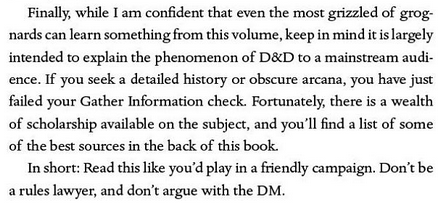
ODAM, p. 2

You read that as I do? Now he's protecting the "mainstream audience" from those evil grognards while snubbing the gamers as having "failed" in reading this properly.

But did they? The book claims to be "the history", not "a history", not "a short history", it's definitive. Nothing in the marketing actually gives any hint of this book being anything else but what it claims to be.

Anyway, he's (again) hinting the reader to go somewhere else. The last sentence, then, aims to cement his authority and advises to play it nice. It's funny, but if someone about participating in a game came at me as aggressive and divisive as that, I'd laugh them in the face if they ended it with "be nice to each other, this is a friendly campaign". Textbook passive-aggressive behavior, I'd say, and I don't care for it one bit.

This could (should?) have been done way more amicably. Easily. As it is, it starts the book off on the wrong foot, and every time he puts himself in relation to those (perceived) hostile readers, you'll see little stabs like that. Here's just a small selection:

  • says (as mentioned in the beginning) that others refer to a group of role-playing gamers as a "stink" (p. 56)*
  • explains how he's anxious to tell others since people have negative associations with the game, to a point where girlfriends leave (p. 75)
  • says gamers are a welcoming bunch, but then goes on to make an example how abusive gamers can be, alluding to something called "Arrogant Nerd syndrome", which isn't even a thing** (the story of Jonathan starts at p. 84) 
  • actually, this is worse than "just" showing how "abusive" gamers can be, it's inverting who's the victim here by saying that gaming should be a "safe haven" for nerds, but ostracizing them is understandable, because they can be, after all, difficult people ... and that's a shitty move***
  • he also dedicates three chapters talking about aspects of the hobby he doesn't like: traditional war-gaming, traditional role-playing and LARP, and I don't think he's giving them a fair shake just because it's not his thing ... more shitting on fringe aspects of the hobby

Let's leave it at that (see the footnotes for the venting). As I said above, it's written well enough, but what's showcased here is also evident in the whole book. Little stories and hints that seem innocent if encountered alone, but accumulate to something where the sum of the parts is uglier than the single encounters. A stink. Ha!

[Source]

Honest to god, I started reading this book to my wife, who's not a nerd at all, and she did not care for the tone of the book. I'm saying, it's not just me and it is important, imo, to highlight this aspect of the book before going into other aspects of it.

So what else is there to talk about? The history sections are excellent, from the very beginning of the idea of cooperative play in history, via early war gaming roots to the first conception of the rules that would become D&D and how that went viral in the seventies. All of that framed by Ewalt's gaming experience and intersected with gaming reports from when he started playing again (a D&D 3e campaign in a vampire apocalypse setting).

Mixed into that we get some D&D quotes, learn about some of the great minds of the hobby, now and then. Anecdotes, quotes from interviews ... Good show, and he runs strong with that until page 172, when Gary Gygax dies. After that, the book loses steam considerably, most of all because the history part of it is basically neglected. We learn how TSR fared after Gygax' departure, and how all of that ended in TSR being sold to Hasbro, but it's basically bullet points of names and dates.

It's just not where the development of D&D ended, or the cultural influence of it. It's just where the writer stops doing what he did well in the first three quarters of the book. We get more of the session reports and quotes and anecdotes, but even there Ewalt'll shift focus and introduce new stories. It doesn't always work, and that last third drags on until the author describes his pilgrimage to the origins of D&D and helps us see through his eyes what all the famous locations are now, which was a nice touch.

Beyond that, we get lots of fan-boying and shilling for WotC and the development of the D&D 5e, which I didn't care for. So, yeah, that's basically what you'll find in the book, without going that much into detail.

Awarding Experience Points (is it any good?)

A book can read well, but transport horrible ideas. Or better yet: it can hide terrible ideas behind a casual tone and a good reading flow. Not that ODAM is in any way, shape or form offensive, but it is "politically correct" while being uncritically vague and even favorable towards WotC and their business practices to a degree where boring just ends up being a vehicle for, well, advertisement or at least craving endorsement.

And sure enough, there are plenty of examples in the text where WotC is being presented favorably ALTHOUGH there is something to be said about the business practices of Hasbro and WotC in 2013 when this was published (the OSR was thriving back then for good reasons).

If not written in favor, that part of the history of the game is actually not present at all, instead we get a reference to another book for checking out the decline of TSR and nothing but praise for WotC "rescuing" D&D and moving on with the brand. No word on the counterculture movement and success of the OSR and the revival of the old editions ... Especially since he's obviously aware of "old gamers" and "edition wars" (as it is evident in the introduction).

And you don't have to be a "fan" to recognize this, but you have to mention it to cast a complete picture. WotC felt pressured to go back to those old roots because people turned away from 4e in troves.

At least Ewalt is honest about being an "ally" of the company and quite happy to support their drafting of 5e. He wants to be in on that action and is happy to be recognized as a "fan" by WotC. Even gets an invite, or so he writes.

All of that is problematic, in my view, as it goes against journalistic integrity to be biased like that, and "journalism" was claimed to be part of this "enticing blend". No xp for advertisement or networking framed as "journalism", I'm afraid (0/5).

[source]

History next. Those passages I enjoyed a great deal. It's well researched and cleverly put together. Lots of interesting trivia. The early years of the hobby sure as hell make for a great story, the good writing puts it to the next level.

But there is a huge stylistic shift after roughly 170 pages. The whole interplay between talking the home campaign (the narrative/memoir part) and the history of the game falls flat. The history part all of a sudden gets rushed and the home campaign gets neglected as well. With what is left, we go as fringe as talking about LARPs while important transition points in the hobby get ignored entirely or just mentioned very briefly.

The last 80 pages are full of odd choices like that, and I get the impression that the author didn't have the stamina to go it all the way (which would have ended in a far superior book, imo).

See, you can make fringe excursions if the main text has enough meat to carry a little extra context. This is well illustrated in chapter three, when Ewalt's talking about legacy war gaming (although I did not care much for the retelling of those battles). But when all the interesting bits fall flat (for instance, how the game developed beyond Gary's involvement), we are left with a boring mess of praise for Big Corp, at least three different session reports and an overall text that goes nowhere until it ends with a pilgrimage to something that isn't there anymore.

I have to admit, the end works for me. The whole idea of the tying the book together like that is nice, and my guess would be that it came up pretty early in the writing of the book. However, there are at least 150 pages missing, and that's a shame. Still, what's there is great (4/5).

Gygax, making history again ... [source]
Memoir and Narrative, now, are interwoven to form the skeleton the history is presented on. I liked bits of that, didn't like others. As with the whole book, it is all crafted by a skilled writer, but I still felt it lacking at times, especially when Ewalt tries to be non chalant about not liking his fellow gamers (the stink, it's an addiction, all being welcome means there are abusive people ... but I'm repeating myself) or blatantly paints an uncritical picture of those currently owning the game (WotC).

That said, I did like the idea of structuring the whole book that way (not the negative parts, but the private aspect of it). It works well until it falls short 172 pages into the book. And when he not tries to paint himself as "the gamer that isn't a gamer anymore but then falls prey to the addictive elements of it again and now plays a far more sophisticated version of the game", it is quite the engaging read.

Even the session report sections work most of the time. Again, until they don't because they have to carry the book in the last third while adding several additional new narratives.

Using this memoir/narrative angle, the book mostly manages to paint a picture of what the game can be and what its elements are in almost all dimensions (the roots, the social dynamics, how it plays, ...), and that's good, although not fully realized and with the caveats already mentioned (3/5 each).

Nice ass, though! [source]

In closing ...

When all is said and done, this is not "the" but "a story of D&D and the people who play it". The historic part is interesting and I wish there would have been more of that and not just the pre-history and the first 20 years or so. Our cultural dialogue with D&D is not over yet, as the latest WotC fuck-up about the license of the game gave ample evidence to gawk at.

Writing a 250 pages book (with only a third of that actually being about the history, if you take away the memoir/narrative parts!) and claiming there'd be no room to explore the history of D&D after Gygax left TSR just to avoid shedding a light on some "problematic" truths regarding Big Businesses Ewalt likes to associate with, is just bad style.

So how should we end this? Is it a good book in my opinion? Yes and no. There are so many shortcomings, masked by a well crafted book that reads well enough to actually work, that it comes down to a meager 2.5/5 (tendency towards the 2, after taking as close a look as I did just now).

The history part that is done, is done well and I enjoyed reading those passages. Learned something about the early history of the hobby, too. The rest was engaging enough for the first two thirds of the book and the last chapter.

What left a sour taste in my mouth was the blatant adulation for WotC and the constant (somewhat underhanded) misrepresentation of most the people that actually play those games as undesirable company. Add to that the missing history of the game after Gygax left TSR and a weak last third with a somewhat strong ending that would have needed a bigger book to work properly.

If that sounds like something you could stomach, you can sure go and get that book.

Let's see what Eric's saying about it (we coordinated publishing, but didn't read each others take ... what fun!): follow me there.

This has always been true ... [source]

* He just came up with it, btw., or at least I couldn't find an easy reference for it. People call their spouse "stink" or relatives, but not a group of nerds, as he implicates. At least not as wide spread as he'd make "us" (assuming a main stream reader? pleasing the WSJ buddies?) believe the term is.

** Try and google that, the only proper hits are referring back to his book, one making the (great!) point that he neglects talking autism in gaming while instead re-enforcing negative stereotypes again. Same pattern as with the "stink", all to make role-players look bad (or make it seem that they are perceived in a bad light). I think it's projection, but that's just my two cents.

*** I'll segue a bit into this in a footnote because I feel it's important: people are not socially awkward because they are assholes or abusive, it's because they are made feeling unwelcome and pressed into the fringes. And what happens in the fringes? Subcultures, which D&D is one of. Or was, it seems, given its popularity today. Anyway, point being, I associated with another subculture back in school, in Germany: the punks. And those had been REALLY socially awkward. For the same reasons. To now go and act as if those phenomena are just direct results of ones conduct instead of symptoms of something far more difficult to tackle (social dynamics of bullying and hierarchies and whatnot), is insincere. At best. "My people" have been excluded and ridiculed for a long time now, what Ewalt does implicates he's more like the people that didn't get along with nerds to begin with ... I wrote about this some time ago in detail, see Nerd Pride and Pop Culture going Full Circle.

Tuesday, August 3, 2021

My OnePageDungeon Contest entry: Opik's Magnificiently Damning Door Bravery

I ended up having the time and energy to throw something together for the OnePageDungeon 2021! It's a full page, and trust me, every millimeter was fought for. Naturally, I sent it in on the last possible day (with a couple of hours to go and I wasn't the last, but still, cutting it short). I'll try and talk a bit about it here (sharing it as well, of course, as that seems to be the custom), but this might end up being my shortest post in a long while ...

Opik's Magnificiently Damning Door Bravery

It's the nature of the beast that I'd rather share the page itself before saying anything about it, as it should all be on the page, really, not needing any context. If you know the blog, you know I'm quite verbose. I think that's alright for the medium, but other formats need other types of writing or a layouter cutting corners. Guess what I did. Ha!

Anyway, here we go (open in new window for detail):

What can I say beyond that? For one, I actually aimed to have three puzzles in there instead of two. Good thing I only had a vague idea what that third module could have been and time was the deciding factor to just go with what I had. Thankfully so, since I barely had room to do those two modules justice (close call, but I managed ... I think). Still, maybe something to expand on?

As per the guidelines, this is system neutral, and that turned out to be a challenge as well. How to scale something like that in a way that is easily adapted to every imaginable system without ending up being arbitrary was something that needed lots of consideration. I tried :)

Oh yes, but doing the dungeon modules was the hardest part, btw. Who'd have thought? Lining up some squares is easy enough, for sure, but making them presentable from scratch was harder than I thought (I looked into online variants, but even there some work would have been necessary). I aimed for 'playful' in the end, I guess.

Anyway, I hope this will give a couple of people some joy. I sure had fun writing it and putting it on the page (using inkscape has a very meditative quality, for me at least). Not sure if this has a chance for anything but being in the publication in the end, but I'm happy with the result and hope I'll get another chance next year.

So, what do you guys think? Useful? Too much? Fun?! I'd be happy to hear your thoughts on it!

------------

In other news, I will keep the discount on Ø2\\'3|| (that rpg I published) up until tomorrow and you can check out a free preview of the book right here (or go and check out the first reviews here). This will be with the general populace for a little while now, but we will do some sales in the future, of course.

If you need more convincing, maybe this post might get you there. If you already checked it out, please know that I appreciate you :) It'll certainly help to keep the lights on here ...


Thursday, May 25, 2017

Discussing "Story vs. Rules" again, are we?

I'll join a good band wagon when I see one and I believe this is a good one. Regular readers will be aware that I love to talk about story and narratives and how the rules can inform and manipulate our gaming experience. This is a bit like what a bull must experience when he sees something red. But in a good way ... Here are my 2 cents.

Whose talking?

So we are having four opinion pieces out there talking about "story vs. rules" again:
  • +Douglas Cole over at Gaming Ballistic ("From that perspective, that’s what I think game rules do. They set up genre and task expectations. They (hopefully) reinforce world design, and constrain choices and action to those that would be appropriate for the game being played.", I really liked that one)
  • +Bannister Nicholas over at Dungeon World Dev ("So if Fun trumps Story.. doesn't that mean that guiding the game, to be more fun, is another form or railroading? What if the natural progression of the 'story' is to become a classic tragedy? If the GM obeys the fun rule, it forces a comedy, from what could have been an awesome tragedy, to something in the middle, and no-body wins.", I like that he compares this to railroading ...)
  • +Vb Wyrde over at Elthos RPG ("One of the principal roles of the GM is to balance the two during the course of each game. Sometimes the Story gains the upper hand, and the GM adjudicates things along Story lines, maybe fudging a die roll, or placing a monster somewhere other than directly behind the next turn of the corridor. Sometimes the Game predominates the GM focuses on the rules, battle map tactics, and the exact factors involved to accurately derive the necessary die rolls needed for success.", loved the diagram, too)

All offer valuable thoughts and insights, they started a discussion and gathered, all said and told, around 60 comments, with even more people reading it and taking something away. That's good stuff and entertaining.

But it is also well explored territory, of course. So there is, for instance, also a podcast over at The Escapist from 2015 ("More and more role playing games are driven by story instead of simulation ...", from what I've seen, this is all kinds of not my thing, but it is there) or this fun little essay from 2008 ("We have defined a software architecture that allows the implementation of our approach of the interactive storytelling: the player controls the narrative, but not the game. The game defines an interactive environment in which the player can, by his actions and decisions produce a storytelling under the supervision of the controller.", quoting a shit-load of interesting titles in that direction!).

The list goes on an on. Once you do a little research (and I scratched just the surface here), you get really fast really deep into the subject. And going by that essay I quoted last, I'd say especially the video games industry is way ahead in taking their research seriously. They are pushing it, actually financing people doing the leg work and all that while we sit in our own little echo chambers, asking the same questions again and again as soon as the first echo has faded away ...

Anyway, different topic. You get my drift. What I'm saying is, we can check out the work others have done in similar areas before we write our pieces (theories about writing, video game design and so on are all over the place), apply them and get more, I don't know, elaborate answers? Because while all of the quoted above are in their own way somehow right, I couldn't help but be reminded of the story about the blind men describing an elephant. Everyone describes a part of it, none the whole beast.

Here is my piece of the elephant ...

Once you start dabbling in game design or campaign building or writing about role playing games in one form or another, you are confronted with all the problems outlined above, so I, too, thought about this time and time again.

The essence of it is, we define our world by the stories we experience and tell each other. It's as simple as that: everything is story. Story is the elephant, if you will. The rules how stories work are as old as mankind and we have thought about how those stories work for about just as long. Conclusively, all that is true for stories in general, will be true for the stories we tell in role playing games. I imagine it to look something like this:

Also true for role playing games ...
The CHARACTERS are the center piece and everything resolves around them as ENCOUNTERS in the established WORLD (could be the DM in the moment of play, the world described in a novel or tv series or the world as you see it, to name a couple of examples, narrative would be another good word for it). A WORLD could be defined now by (at least) 4 corner stones:

  • STRUCTURE: or patterns. Structure lets you recognize and work with established patterns in a world. Is it a comedy or a tragedy? Is it magic or technology? English or French? All those patterns will shape everything around them and, in the end, the story.
  • THEMES: or labels. It's the selection you chose to describe your surroundings. Easy example would be the description of a game by the winning side compared to that by the losing side ("best referee ever!" vs. "cheating bastard of a referee!"). Fake news is another good example of labeling to influence a story.
  • RULES: or consistency. It's the rules we play by. Could be laws, could be D&D or a social contract, could be grammar ... They are always there to one degree or another and shape how we behave or judge behavior, for instance.
  • GOALS: or motivation. This is what propels the action. You want world domination? That's what you work towards. You are lonely? There you go, you'd want to meet someone. You want xp? Do what you have to do to get them and advance in levels ...
ALL THAT cumulates to STORY, every time, again and again. Depending on the story you tell, the parameters might shift and change in prominence, but they are always in effect. So if you are in the story about a couple of friends meeting to play a game of D&D it will have different parameters than the story the characters of those friends will encounter in the campaign they are playing. While the motivation in the first story might be, for instance, to have FUN, the story in the campaign and what the characters experience might just as well be a tragedy. Those things can happen simultaneously, even without conflicting with each other.

Nothing of this is new, you know, ...

... but the implications for role playing games are not very well established, it seems. So, yeah, you could say that "Fun trumps Story trumps Rules", but it'd be comparing apples and oranges with a chimpanzee. Even if examined in a specific context like role playing games, you'll end up with a huge variety in parameters (some may call it "taste") and it still doesn't explain what actually is happening in the collaborative story-telling we do for fun. Why do we experience a flow when we play and how do we facilitate something like this? How do we get the whole group on the same page for the stories we want to experience? Or how shape the different parameters like rules and themes and structures in our games? To what effect?

There is no right or wrong because there is way more than two layers to begin with. A rule in a game, for instance, has several layers like that, starting from how it is formulated right to how the individual interprets and uses it, but also how it effects the game itself and how it manifests. If you are up for a little experiment, try and change the word on a D&D character sheet from Charisma to Fate. Or at least announce to your group that you aim to do that and see what happens. You just do a small shift in meaning, but you'll be surprised about the effect (I was). Or try to use the French terminology for D&D instead of the English one.

Rules shape games like that and on many levels. THACO got lots of hate because the rules hadn't been explained properly (according to some). Ascending Armor Class is superior to descending why again? It isn't, it's a matter of agreement to explain and experience the game a certain way. I believe understanding that or finding an understanding what either does in a game is far more important than discussing taste or what is "fun". But I'm digressing again.

Are we having fun again? [source]
More stuff to read (bonus round)!

This particular topic is one I wrote and read a lot about in the last couple of years, so if you are interested to read more about this, I'm more than happy to give pointers. Here are some of the posts I wrote about story and related topics, most of them lead to other posts, essays, articles, books and what-not written by other people. Have fun:

Narrative Distinction and the DM (a series, starting September 2015)

Thoughts on Stories in Open Worlds (April 2016)

Narrative Flow vs. Player Skill (July 2016)

The Random Narrative Generator (lots of theory and an example, September 2016)

The Secrets of Escapism (a series, starting December 2016)

There might be more, but it's plenty as it is so I'll leave it at that. The illustration displayed above is something I had on my mind for a couple of months now and based on some of the thoughts formulated in those posts linked here.

Anyway, my two cents. Thanks to the guys linked above for inspiring me to write this post. It's all good reading and they get their points across, got others thinking and discussing. Good show. I hope my entry adds to that.

Have a nice picture of blind men tackling an elephant as a parting gift:

[source]

Saturday, March 25, 2017

12 Things I Wish I Would Had Known Before Running My First Game

Well, +Ripper X started it on his blog over here. It's a fun idea for a post (thanks, Ripper!), so I thought I'd take the opportunity to post a little something myself like that for you guys to ponder on this weekend: what's the things you'd like to have known for your first game(s)? Comment them, post them, share the love wisdom! Here's my (very personal) take on the question:
  • People are strange. Or in other words: no campaign construct, regardless how elaborate, will survive enemy player contact.
  • Let the players talk and take them serious. DM makes the pitch, players run with it. Or: you give the motor, they give the fuel and you'll never run out of fuel for the game if you let them talk. It also gives you room to plan ahead!
  • About those pitches: always let your agenda have agendas. Think moves ahead in your game, like you are supposed to in chess.
  • Never pitch the problem itself, let it manifest. Letting the players realize the problem is half the way of getting them to solve it. Give it all room and time to unfold.
  • One of the first things that will happen, is that you describe a little strange fact on the side and the players will jump on it as if it's the first crucial clue in the mystery that is life itself (42 ... just saying). It'll happen. Don't be annoyed, run with it, push it even, quote it later if you can.
  • As a matter of fact (and it deserves a point on its own), little strange things make a narrative tick, be it some strange NPC behavior, a weird character idea a player has, some unexplained magical effect or just a random, puzzling thing the players find on the dungeon floor or hear or smell or feel ... have some of that ready if you can (and chose them according to the atmosphere you want at the table).
  • Keep the players on their toes. It might be one of the most difficult things to do in the beginning, but never (ever!) let them have no problem to solve. Throw something strange at them if things get idle ... see above. A good way to keep the ball rolling is adding little problems to problems that are already in play.
  • About being idle. Be ready to get your game derailed as soon as players don't feel engaged anymore. There is no evil intent behind it, the freedom to do anything you want is just scary like that.
  • Randomize everything. You'll never be more concrete in your ideas than you are after letting go of the illusion of control. DM tools are there to help you and free you.
  • We have a tendency towards harmony (I have, anyway) and I think it can be kind of hard to give disharmony room in the game. Not on a social level, but in the narrative. What I'm trying to say is, don't jump on the obvious and satisfying solution that emerges in a session but think about the implications first and let the players be the force to establish (short term) harmony with their decisions.
  • Don't care about your non-player characters, make the players care instead.
  • And finally: NEVER let discussions (about rules or politics or any other topic not relevant to playing the game in the moment they occur) bring the game to a halt. Resist the urge to join the fray and put a stop to it as firm as you can and rule what needs to be ruled to solve the thing on the spot. Then move on. You should always give those issues room to get discussed after the game or during pizza break or whatever, though (unless it's a poisonous topic, then kill it right where it sprouts).

I aimed for 12. Maybe I'd come up with more if I'd think harder about it. And it seems that the things I missed are mostly about the skills we need to be aware of to "work the crowd". Anyway, friends and neighbors, please feel free to comment and share your thoughts about it. And if you have a blog (or any other means to contribute!), please do so ... make it a community thing :)

Now +matt jackson followed up with a nice piece on his blog (bandwagon!).

And +Eric Diaz is with us now with this great collection of advice on his blog (rollin', rollin', rollin' ...)

Thursday, November 10, 2016

The Ultimate Game (Blog Challenge!)

Yeah, this blog is still running 😀 Done with the Weltschmerz, too (for now). I'm just stressed between exams and all over the place. Still with lots of gaming in my head, but not so much in my fingers right now ... Anyway, +Adam Dickstein wrote a November Blog Challenge over at the Barking Alien and it's actually posing a question I've been asking myself every now and then. Here it is in his own words:
"I'm wondering if I've already run my greatest campaign, or is my greatest campaign yet to come? Would I know it if I saw it? What would it consist of?"
and 
"So, what would my Ultimate Campaign look like? What would yours look like?"

Not an easy question (being a challenge and all) and I'm not sure what my answer would look like, say, 10 years from now. But I'll give it a shot anyway. Let's see where this leads.

Genre/Setting

Pseudo-historic, gritty and epic, low on fantasy and low on magic (but with both present).

Or something like that ... Oh damn, DM ADD? Again?! [source]
Approach

A sandbox campaign with several stages:

It begins somewhat 550 AC, somewhere in Europe, the Roman Empire is down and the Germanic tribes start to take roots, forming the roots for what would be kings and noble families in the Middle Ages. And that's what the characters will do. They'll explore the lands their parents claimed for fame and glory. Adventurers in the beginning, leaders after that and legends in the end. The players build here the foundation for the next game ...

... it gets a bit vague after that, but I imagine it would be great fun to see how the descendants of those legends fared through history. The High Middle Ages come to mind, something like "Knights & Sorcery". It'd be the same sandbox, but centuries later and with new threats and horrors (and maybe some old coming back?). Territorial disputes, epic battles, the crusades ... old magic and monsters, the fay court still strong, but fighting a losing battle against Christianity. Stuff like that.

And once those characters got old and that part of the campaign cycle comes to an end, it'd jump to the 17th century, early 18th century. Cloak & Dagger, gunpowder, 30 years war, again with the descendants and in the same sandbox (expanding, growing and changing over time, I believe). Might have pirates, too.

I know it's crazy in scope and way too big. But we have that Dark Ages game going already and there is hope. I also have a plan ...

Pace

Pace is a problem. I like it when things have the time they need to unfold and I like to give players the time they need to get wherever they are heading. The only pressure I like to have in the game is the narrative. But that might be a luxury from my youth, where we met every Friday to game for hours and hours .. a luxury I don't have nowadays. So ideally I'd be able to have 2 games a month and some Play by Mail in between to keep it focused on the juicy bits during our face to face gaming.

Players/PCs

I like to have players that invest in the game and the story (well, who doesn't?). It's also necessary to play on a regular basis for people to get accustomed to each other, ideally becoming a group of friends over the course of a campaign (or at least a good team). It's good to just gather and have fun from the get-go, but for me there is a layer where the players start getting good at a game (player skill?) and go beyond beer & pretzels. This is where I want to get again.

Early stages of group formation ... [source]
Characters ... well, as mentioned above, I'd like to instill a sense of history for a couple of strong, individual characters and there descendants. One character per player and it's more about scars than about dying (if they get old enough, that is).

System

If you've been around this blog, you know my answer must be "highly customized and DIY". That's the "plan" I was talking about above: if I write it, I get to test and play it. That's often worth a campaign or two and usually gets more experienced players interested. Another aspect is that if I want to explore a specific idea or concept, I'll make it an adventure module and offer play-tests for that, too. Sounds easy, turns out to be quite challenging but also rewarding and intense.

So that Dark Ages game I talked about above? That'll be Lost Songs of the Nibelungs, of course. It'll be done and ready next year (I think). The first supplement after that would be about the Domain game when the characters hit level 10 in Lost Songs (title: Lost Kings of the Nibelungs) and after that it's epic (like "Beowulf"-epic) level adventures (title: Lost Legends of the Nibelungs).

Once the core rules are done, I'm thinking about exploring other epochs, just like described above. I hope it'll keep being that easy to find players interested in playing and testing those games, because as long as that's the case, I will also end up playing them!

Maybe it happened already?

And that's it. I already had the pleasure of DMing three great campaigns in my 24 years of gaming. I never managed to top my first campaign, though, and it might be that I already had my Ultimate Campaign. It might be that I'll never manage to have something like that again.

But who knows? For now I'll keep trucking. Writing Lost Songs is a great experience and it might not come as a surprise that I never felt that close to any other set of rules. Writing your own game is something I'd recommend to every DM out there.

To grow with a set of rules like that, to see it develop in play-testing and as the campaign unfolds, to see it all through, I think that's my Ultimate Game right now ...

And now I must get back to learning. I have a tough month ahead. If I get the chance, I'll take the time for another post or two this month.


Sunday, May 22, 2016

D&D Rules Cyclopedia light - for one-shots and/or new players

I agreed this year to participate as a DM for the Free RPG Day in Leipzig. The idea was to introduce newbies to role playing games. I was free to chose whatever I like to DM and I should aim for an hour and a half of play per session. It had been an interesting task to tackle and here is what I did.

1. Cooking down the Rules Cyclopedia

I somewhat know my way around the D&D RC and offering D&D was a no-brainer, being a big fan of the OSR and all. It also has all you need (and more) in one book, so that's helpful. With only one hour and a half of genuine play time per session, I'd have to ask myself what I really need at the table to give new players a hint of what D&D is about.

I wanted character creation in there, especially the 3d6 in order and there isn't a way around using ability scores, so that's the first thing to have. Next roll would be hit points and in an ideal world we'd be done with the rolling after that. But if you think about hit points, you'd have to think about classes and to be honest, using them was way too much effort. So the first thing that got cut was classes. It's 1d6 hp (+ Con-bonus, if there is any) and you are good to go.

By default the characters are citizens with some militia training, so they got saves and to-hit matrix of level one fighters, altered by bonuses, if they got them. And that's it. Ability scores with bonuses, the classic 5 saves, hit points and armor class. That's all I took from the RC.

2. House ruling the rest

I've DMed the Rules Cyclopedia for some time and tinkered with it quite a bit. One of the first changes I introduced was changing Charisma to Luck (like DCC does). Damn, this goes way back on the blog, so here you have my reasoning and some of the fire I got for it. Anyway, here Luck is just one of the attributes. If you think about it, every situation you used Charisma in could in its result just as well be explained as being lucky. It's a matter of perspective and I like that one more.

The second big change is another house rule I've presented in 2011 here on the blog: a variant of an Arduin Table concerning Character Aspects. Here's the complete thing (and here is the original post):

 Character Aspects (1d20)

1-2    Thin (-1 to Strength)
3-4    Choleric (-1 to Wisdom, +1 to Constitution)
5-6    Melancholic (+1 to Intelligence)
7-8    Nimble (+1 to Dexterity)
9-12   Normal
13-14  Serene (+1 to Wisdom)
15-16  Vivid (+1 to Luck/Charisma)
17-18  Brawny (+1 to Strength)
19-20  Fat (+1 Constitution, -1 Dexterity)

So right now it's:
  • 3d6 in order, re-roll one, switch two stats if you want
  • roll on the character aspects table
  • note all that down, note bonuses and saves
  • roll 1d6 hp (+ Con bonus, if you have it) and note it down, a 1 may be re-rolled
  • note base AC of 10

All it needed after that was some flavor, so everyone got to choose one occupation and one special ability the character has. Add name and what he looks like and you got a character. Even with a table full of newbies, 15 Minutes character creation, tops.

They were totally free to choose that special ability and whatever they choose was subject to a roll of sorts, so it might not work, but they should choose things that'd give them an advantage others normally wouldn't have. Worked like a charm. When testing for it I'd let them roll d20 + ability score + level versus 20 ...

... which brings me to another house rule of mine: high results are always good, low results are always bad. So tasks are always ability score + d20 (+ skills, if you have them) vs. a difficulty, saves are always target number or higher and attacks are always d20 + bonuses (if you have them) vs. enemy ac. Easy to explain, easy to handle.

Everything you could use as armor reduces your AC by 1 to 3 when you wear it. Could be a pot, could be a shield or some very heavy boots, even a wide cloak might give you some protection (obscuring the body and all that). Normal weapons do 1d6 (+ appropriate bonus, if you have it), small weapons do 2d6, taking the lower result, big weapons do 2d6, taking the higher result.

And now you are ready to play ...

I made an A6 character sheet for the players to use. It is in German, but you should be able to figure it out. As a matter of fact, if I've done this right, the visual presentation of the thing alone should be self explanatory. See for yourselves:

All you need to know with some room for notes on sweet little A6*
3. An argument for the original 5 saves and other commentary

Man, I do love those original 5 saves so much. Cooked down like that their purpose becomes quite obvious, I think. You have active rolls as tasks and they are descriptive with the ability scores. It's basically what you use to get it done. Then you have your passive rolls as the saves and they are descriptive about what you save against. They are what's happening to you.

Tell me what you want, but this totally makes sense to me. I wouldn't change a thing.

So what did I use as a scenario? It came down to that good old "You wake up in the dungeon"-schtick. No equipment to speak of (I allowed Luck rolls if they thought they might have something with them) and they only knew that they got drugged during a towns fair and brought ... somewhere underground.

They know each other and they have roughly an hour real time to get out of there before someone realizes they got out and it's Game Over. 25 Minutes and I got a game going with 5 new and fleshed out characters and a back story to play along with. The rest is player decisions, random encounters and reaction rolls.

As a map I found a big and somewhat complex dungeon, assigned 12 locations in it and rolled a d12 just before I described where they woke up (used this great map by Dyson Logos). I had the Rules Cyclopedia for the heavy lifting and the Dungeon Alphabet as a back up, a blank map to draw on and some miniatures.

In the end I mainly used what I had on my DM screen, the RC for the monsters and the board with the miniatures to illustrate what was going on. The rest was improvised and as random as possible. Didn't know where they'd wake up, didn't know what they'd encounter or the best way to get out there and great fun was had.

I pulled no punches and made clear that it's all very random and that the decisions they'll make might come with dire consequences. It's about player skill. The thing is, even with weak characters, if you make clear that the challenges presented are as much for the players as for the characters, people are good with. They see the character as an extension of themselves and not as a special snowflake.

Well, it was D&D in all it's glory. One more thing, by the way, since the D&D Rules Cyclopedia is a little bit out of print right now, I suggested Labyrinth Lord as a substitute. I'm actually willing to argue my case here, but either way, with what little I used from the RC it really doesn't make a difference.

How did it go?

Three most likely died and two were left with very slim chances of survival. Everyone had lots of fun, going by the laughter. And we ended up playing almost three hours before I called it a day, because when we first got to a point where I could have ended it, no one was there to replace the group and we kept going instead.

All of the players had played role playing games before, but none of them had played D&D in any version yet. So at least it held some novelty for them. But I'd really loved to have a complete newbie at the table or two. Just wasn't to be.

Anyway, another thing I took away from that session is that tension is everything with short games and/or one shots. Pick a player, give him something to think, go to the next one and when you come full circle, that first player better had an idea what he wants to do ... or it gets worse and he gets a bit more time to think. Keep them engaged, react to their input and spin it forward. Make their decisions count somehow.

And you will always have group dynamics. If you play with people you don't know and that don't know each other, you'll ideally have them on the edge of their seats the whole time, as people under pressure (even in a game) are really grateful for the help of others and if it's other players instead of the DM, you'll have a positive group dynamic even among strangers ...

I go on and on. Sorry about that. Point here is, D&D can be cooked down to it's bare bones and still work pretty well. I'd have done a little more for a longer game, but not much. A campaign wouldn't start much different, actually. If I'd have a group of people completely new to the hobby, I'd start right there. System mastery is key, nurture player skill and team work, go from there.

Should I do an English version of that character sheet? Maybe with some rules on the back?


The post about combat in The Grind, for those interested, should be the next after this one ...

* I used inkscape for the composition. The pictures all have public domain origins. The elements are isolated and changed (at least vectorized and cleaned). Not 100 % happy with sword and shield there, but it's what I could do in the time I had.

Saturday, February 6, 2016

The Devil's Dare (Dungeon's and Drunkards: Deleted Scenes)

So this is a little something I wrote some time back for my part of the Dungeon & Drunkards community project and it didn't make the cut for some reason or another. Now, reading it again, I started thinking it could be fun to allow it in a friendly game of D&D, maybe if beer is already a heavy motivator for the game anyway. I kept it for an occasion where I hit a dry spell on the blog. There are several other posts in line to get done (some I went as far as announcing them even), but I'm way behind right now (or: as usual) and thought this made a nice filler ...

The Devil’s Dare (a house rule for being dangerously drunk): This might produce all kinds of involuntary actions, but might also result in characters just boasting what they’d really like to do before they end up lying in the gutter puking their guts out. This is intentional. Players should lose some control over their character’s actions if they decide to go on a binge and there should be a good possibility to get into trouble, too. A DM should start this as a harmless enough drinking game of daring and go from there, escalating it as much as possible. To make this work, all parties involved have to agree that the characters already are a bit plastered and are willing to do stupid things ...

It's all about bad ideas ... but with beer! [source]
So here goes. Every time in an adventure when the characters decide to get drunk, they may dare each other into stupid actions (it works fine to start an adventure, too). This is a mix of many of the ideas in the original post (linked above), inspired by movies like Hangover or Project X and a players' gambit as they (somewhat) decide how drunk they want to be to attempt the dare. The payoff (xp) gets higher the more drunk they decide to be, but comes with a chance to pass out before it even started. 

A failed save vs. poison -2 initiates the daring and decides which characters get in the mood. At this point the characters already have some buzz going (-2 to attributes/attacks/ saves/damage, +2 to AC and HP)*. The characters that made their save suggest the dare, those that failed agree to it. If all failed their save, the DM is to suggest the direction of a dare. In both cases start with rolling 1D6 to suggest something:

  • (1) dangerous
  • (2) embarrassing
  • (3) illegal (by law or religion)
  • (4) story/rumor-related
  • (5) destructive
  • (6) reckless
If a player won’t have the dare for his character, another save is allowed, but with a -3 this time (being a bit more drunk and all that, they never stopped drinking ...). Failing this second roll will result in adding another complication to the roll (roll another 1D6 on the table above). There’s no upper limit to the number of saves, but it’s getting the character more and more drunk and adds a suggestion every time and every fail with a -4 or more will send the character under the table. A passed out character might be carried along for the fun and might even gain back some consciousness to participate, drink on or run for his life ...

Multiply every xp gained with the penalty the characters got. A player may decide to get more drunk and still get through with the dare, but has to make a save for every penalty of -4 or higher to not pass out on the way there. A penalty of -x always goes with -x to attributes/ attacks/saves/damage, +x to AC and HP. So yeah, if a character manages to kill a dragon being stupid drunk (say, -4) he gets four times as much xp as he'd get sober. And if he passes out, he gets funny pictures tattooed on his face or burned to a crisp (dragons not being known for their humor and all that).

If all of them manage to pass out, they’ll wake up with no idea where they are or what they've done (DM’s discretion).


I hope +Charles Akins approves. This is (as written above) wildly untested, but every role player or DM worth his salt should be able to make something out of this. People should be harsh, relentless and creative about what they suggest for the other players to do. Make it tough, make it illegal or make it embarrassing, but remember it's all about having fun. Doesn't hurt to be clear about those rules at the beginning of a game.

Other than that, tell me what you think or, if you went as far as testing it, how it went. 


*Following a concept described in that post linked above (and now here, too) and based on the rules for being stunned from the D&D Rules Cyclopedia (page 150), but assuming that it involves a gradual process, starting at -1 for a slight buzz and stopping wherever a character decides to pass out, with getting sober being the reversed same process. For more detail read the RC or/and the original post about alcohol in the editions of D&D ... 

Friday, December 18, 2015

HackMaster! - A Love Letter (for 4e, my only true love)

I owe this one, as I announced I'd write it (really sorry about the delay here, +Charles Akins) and I want it out there, at best still with 2015 on the name tag. I also want to write this bad, as I really, really love HackMaster (4e, the one and only). And I want to spread this love like ... well, I won't go into detail HOW MUCH I want to spread it ... Okay, that derailed fast. Let's talk games and dice!

Humor and AD&D (or: Who cares about 3e?)

HackMaster 4e and D&D 3e were published around the same time. Mainly because the D&D 3e wanted to get as much distance between itself and AD&D as possible, so giving the AD&D rules to a third party publisher who already was making fun of AD&D for years must have seemed like a good move to the Wizards near that Coast (whatever). Little did they know ...

But from the beginning. When AD&D had been at the peak of it's existence, already on it's way into decadent decline, the small publisher Kenzer & Co. started publishing* the infamous and genius Knights of the Dinner Table comics (that title alone is priceless ...):

A classic KotDT strip [I dare you, read the whole story here]
The Knights played a game called HackMaster, which had been nothing but a thinly veiled, and very satirical nod towards AD&D in all its voluptuous baroqueness and its players in all their weird and manic glory. Everybody knew one or more of the protagonists from his own gaming circles. I had two of them as players. I swear. It was (and still is) great fun to read those comics.

Anyway, imagine said publisher now getting a card blanche to cannibalize the complete and significantly large canon of the now left for dead AD&D 2e for that HackMaster game they had been writing about for years already. Incredible, you say? Unheard of, I'd answer! They did it, of course**.

So 2001, one year after D&D 3e had hit the shelves, HackMaster 4e made its first entrance into the real world: the first genuine retro-clone of a D&D game***. Curtain, applause:

I know, it has seen some use, but isn't it gorgeous? [pic by me]

Now, 14 years later and 7 years after the Coastwizards took their licence back, the game is almost lost in obscurity. But it made waves back then. Lots of waves: a complete revision of AD&D 1st and 2nd editions, mixing Oriental Adventures, Unearthed Arcana and Skills & Powers into one coherent system and ending up having over 40 supplements and modules, among them 8 Monster Manuals, a Spelljammer variant (aka Hackjammer) and rewrites of classic adventure modules like The Temple of Elemental Evil (aka The Temple of Existential Evil) or Ravenloft (aka Robinloft). All compatible with AD&D, of course. That's like AD&D 2.5 right there. And they had so much fun doing it, too. So. Much. Fun.

Feast your eyes, my friends! [pic by me]
It had been fantastic for those late to the party, like me. I never had that big an interest into AD&D and when I started having one, 3e had pushed it all into the dark corners of the local game stores. But HackMaster 4e was a high concentration dose of AD&D awesomeness and for once I had been at the right place at the right time.

Well, by now you already got an idea why all that could be considered as funny. I most certainly found it hilarious and it was one of the main reasons for me to get, read and play as much of that game as possible. Anyway, there is a reason being cautious to state it actually is funny, as so many people really didn't get it.

I can remember talking and reading about that game as it was still a somewhat new kid on the block. One of the most common misconceptions about HackMaster 4e had been (and maybe always will be) that it is making fun of AD&D. Mostly without reading it or just reading parts of it. And let me tell you, that's just stupid. Not only untrue, but plain stupid, because (and let me be very clear here):
You won't find a more affectionate treatment of the game and what it meant to play it than HackMaster 4e.
I mean, if you read it and don't like it because of the humor, more power to you. It's all a matter of taste, of course. The game might be brilliant under the Monty Python routine, but who cares, right? Well, the game had been a success despite the naysayers and party poopers and it really is brilliant under that Monty Python routine. That Robinloft module pictured above? A cranked up version of the original. And that means: all the content of the original with new maps, new illustrations and better writing. This is not a joke, but seriously hours of game play, just as the original.

By the way, if you were wondering how HackMaster is already in its fourth edition, it needs to be said that it really isn't. But one can see this as a nod to AD&D as the source, the fictional history HM has from the comics featuring it and the (at this point already) shamefully obvious trend to have a new edition on a regular basis for no good reason. Because that is how they roll. And really, who needs a 3rd edition when you can have the fourth, more advanced edition right away?! Windows 10, anyone?

AD&D on Steroids (The Rules)

If you think the origin story of this game is awesome and praiseworthy on its own (like I do), you just let me tell about the system a bit and blow you away for good. This is, in my humble opinion, AD&D at its best. I know, I know, many loathed the shitload of options available for AD&D, like the Unearthed Arcana, for instance. But I doubt there are many out there who took the time to find out what would happen if ALL THOSE OPTIONS actually made it into the game. And it's magnificent to behold.
Man? Woman? AD&D 2.5?! [source]
But before I dive into this like a duck into a big pile of gp, let me rephrase this for more impact: nothing in HackMaster 4e is per se new, 99 % of the rules they used already existed for AD&D****. It's just the first time anybody went as far as putting all the pieces together! I believe an AD&D aficionado could spent months just finding out what they did and where they took it from. It could be a series of posts spanning over years if you include the modules they took and how they changed them and if they did so for the better. It's that huge.

So many words and still nothing about the rules. Let's change that. We skip character generation for now and start with the game itself. Well, with the highlights, that is, like, what is the "hack" in HackMaster. It doesn't disappoint. Characters and monsters all get a 20 hit points kicker to begin with, so there is a lot of meat to hack (only very small creatures get just 10 hp more ...). One would think that it'll result in level 1 characters lasting way too long and that is true, so there are several rules in place to make it interesting and potentially deadly fast:

  • Dice can and will explode. You rolled a maximum for damage? You just earned a re-roll of the same die -1. Did it again? Same re-roll. Crossbows are even more brutal, allowing a re-roll not only with the highest, but the second highest result, too. A heavy crossbow, for example, does 3d4 damage against large creatures. That's just brutal.
  • Trauma Damage (Threshold of Pain check) is another fine rule (and somewhat connected to the exploding dice mechanic and only possible because of the kicker). If you get as much damage as half your max hp in one round, chances are you will end up being confused by the pain, fall into shock or unconscious and might finally even die because of it. A lot of "ifs", so a character's fate isn't directly sealed, but it adds some very interesting dynamics to fights, as one would imagine.
  • Fatigue is another fun aspect of the game. Combatants will have less fatigue than hp and if they are gone it's not a very good idea to keep fighting, indifferent to the amount of hp a character might have left at that point.
  • Morale Checks are still in place, so if three goblins are down in the first round, screaming and holding their entrails, the other 20 might (and probably should) reconsider their course of action ...
  • Critical hits and critical fumbles are not only very detailed (15 pages of charts and text in the GMG) and gory, but also potentially very final.
  • The honor system adds a good deal to combat, as it not only allows a character to burn honor for dice he can use in a fight, but also gives the option to avoid death entirely for one time for 90 % of the character's honor. This will a huge impact on how the character will be treated by non player characters, for xp and several other unpleasant side effects, but he will be alive. Regaining honor is hard and you'll need a certain amount to make it happen to begin with, but people did use it in my games. It has merit.

Excessive fighting will also reduce resources, of course. Weapons become dull or break, armor will get reduced to shreds and so on and so forth. It's all fine tuned and it works like a machine. A fricking huge monster truck of a machine compared to D&D, but that shouldn't come as a surprise (that's AD&D for you, baby) and it certainly is loads of fun to HACK! in HackMaster.

It doesn't stop there, of course. Spells will not only feature all the spells you'd know from your AD&D splat books, they also added all the spells you'd know from the comics (Sidewinder-Fireballs!) and some that are probably new (I'm not sure, they still might be somewhere in AD&D), like the Seventh Level spell Anger Deity, where the caster insults a gawd, his dog and his mother to get an immediate reaction out of him (a caster might have reasons to cast such a spell, I really believe he does) or the First Level spell Phantasmal Fireball, dealing 1d6 damage per caster level if those affected by the spell fail the save and really believe they burn to death just now (loved that spell as a player, allowed it as a DM, but stopped having enemies appear in large groupings because of it ...).

There is so much to love right there and that's maybe 2 % of what HackMaster 4e did with AD&D and added for the fun of it. The Player's Handbook alone runs precisely 400 pages with double column texts in font size 9 (or 8, not sure, but it's very small) for the rules, comes 150 charts and tables and only a few illustrations, as you'd expect. "350.000 words of wisdom", as they put it.

There is an appendix about how to prime and treat your dice, with cleansing rules like the "fame-rub" if lucky dice turn bad (including pictures), another appendix about the HackMaster Association (with tournaments, listed Dungeon Masters and all that jazz) and coupons for the players to earn in the game. To name but a few things. And then there is ...

... the Character Generation!

I'll really stop after this, but HackMaster excels here beyond awesome. It takes time to create a character, but it's a genuine mini-game itself, with family drama and early character death (if done right), so I want to give you all a closer look into that whole gig.

Take a close look (open in new tab for details) at the introduction of all the races you can play in the game (HM PHB, p. 26 - 27):

That's HackMaster in a nutshell, really. Glorious! [pic by me]
So much to see here: Drow, Grel, Half-Ogres, Pixie Fairies, Gnomelings and Gnome Titans, Kung Fu moves, dwarven woman with a beard, a chain mail bikini ... It's all very educational and really a fun primer.

Take your time. I'll wait here.

13 playable races, 17 classes, among them Knight Errants, Berserkers, Battle Mages, Blood Mages and Assassins, with even more options in the official Class guides, like The Griftmaster's Guide to Life's Wildest Dreams (The fast Track to Riches and Infamy):

Who wouldn't like to play a thief after
looking at that cover? [pic by me]
Upbringing, social status, siblings, career, it's all there and a point buy system to boot and make it all so much more flexible, with Quirks and Flaws for the taking to get even more points to buy skills, raise ability scores to meet class criteria or Talents to loose them again just as fast. We had a short sighted (and color blind, I think) Knight Errant in our group, that needed the group to shout directions when he charged something, we had the meanest halfling thief in the history of our games, scars and attitude all inclusive and a Nose Ring of Viscid Globs to make him even more dangerous ...

Characters never turned out to be boring. Never. And skills are worth another sentence or two, because there are not only lots of them, they also can be useful and/or funny as hell. Digging hasty graves, vandalism, sneaking around, basic and advanced looting, all with little rules and benefits to sweeten the deal. Or Groin Punches, Round House Groin Kicks, Eye Gauges and Wuss Slaps as combat procedures (for obvious reasons).

Had a player once in a con game that went all in that performed the Manu Weasel Dance (aka "showing yer ass dance") in front of a live audience to insult some samurai and gain some more bonuses (here is the whole story). Or the players dismissed to bury a henchman in a shallow grave for wild dogs to feast on and the poor soul came back to haunt them. So many possibilities, so many good times.

All good things come to an end

I could go on and on. We had such a good time with HackMaster, it's almost uncanny for such a brutally complex game. And missed out on so much more, in fact. Magic items like The Feet of Vecna or the Chain-Mail Bikini of Eye Gouging among the pearls one could discover. Or we never finished The Temple of Existential Evil campaign (but we had an epic show down in the famous Moat-house during a con game). And I still miss some books for my collection, mainly modules like Little Keep on the Borderlands. Sometimes I want to take it all out of the book shelf and start a new campaign with it ...

That's a campaign waiting to happen ... [pic by me]

... but it can be very demanding, to be honest. Our main reason to play something else in the end, was that things got really complicated and some players wanted to take it easy for once. So we did that and never came back. It can be a lot of work and it took me ages to understand the honor system, for instance. And sometimes it's just a bit too much over the top, even for my tastes:

Funny? Yes. Lots of information? Of course.
But also a pain in the ass to use ... [pic by me]
I regret it sometimes. HackMaster had a huge and lasting influence on how I game. 50 % on the optional rules here on this blog had been attempts to transfer some of the HackMaster aesthetics over to the D&D Rules Cyclopedia. It's a great game, with so much to discover and a good read above it all. And it was close to complete before they pulled the plug on it. There had been talk about a HackRight supplement right at the end and I'd loved to see that happen. But it was not to be.

Anyway, there still is a lot of game to have, if you can get it (which is seriously difficult nowadays). If you like AD&D (or liked in back in the day) and liked what you've seen here or the Knights of the Dinner Table comics, than you will love HackMaster 4e like I do. It's also as Old School as one can get. So old school, actually, that it pre-dates the OSR :)

I hope you had as much fun reading this as I had writing it. I know it is a lot of text, but I already got the feeling that I didn't do the game any justice. There is so much more ... but I'll stop here anyway and end the post with my favorite illustration in the HackMaster GameMaster's Guide:

HM GMG, p. 323 [pic by me]
Final note: this story isn't over yet. Some day I will DM this game again ...

_________________________________________

Also on the internet: this post is part of a series of love letters across the blog-o-sphere that had been started by Charles Akins over at Dyvers and already ended some time ago. I wrote another piece back then about the Rules Cyclopedia and several other, far more talented bloggers than me, wrote about the rpgs they love and why. +Marty Walser, for instance, not only has a great post in that series about the Paranoia RPG over at the RagingOwlbear blog, but also a (as far as I'm aware) complete run down of all the other entries. Check it out, if you haven't already. It's some good stuff! 

* Okay, the publication history is a bit more complex than that and Kenzer & Co. entered for publishing with the 4th issue in 1996. But who cares, really?

** Again, it hadn't been that easy. Maybe it started that way, but it got more and more complicated for Kenzer & Co. to keep HackMaster out there. Maybe they had been to successful in keeping a game alive that D&D 3e couldn't replace. Anyway, it ended in tears, as it does so often with those things. But that's not what this post is about, so ...

*** And that's totally true!

**** A rough estimation on my side. Don't hold it against me. As far as I know, they took it all and added almost nothing.