Showing posts with label Bookshelf. Show all posts

Sunday, March 5, 2023

REVIEW: Of Dice And Men

Let's try a new thing. It will be a variety of "I read a book and talk about it", the difference being: I'm not doing it alone. My good friend Eric Diaz over at his (fantastic and fantastically productive) blog Methods & Madmen will read the same book and we will cross-post and talk about it. We've decided four books to start with (two of which offered by Eric, two by yours truly), all connected to the hobby one way or another. We talk about it, and see how it goes. The first one will be "Of Dice And Men" by David M. Ewalt, a book I wanted to read (and like) and now can't make my mind up about ... 

[source]
Character Sheet (what are we looking at?)

The "revised and updated" softcover version Of Dice And Men (ODAM, 2013) I perused clocks in at 285 pages, 32 of which are afterword, notes, acknowledgements and an index. Formally this book is done well, good formatting with no serious hickups in the editing (one word he kept repeating rubbed me wrong around the third time it was used, but that's all that comes to mind right now). Just from handling it, it's a nice book, pleasant to read, even.

Another positive observation up front: Ewalt consistently writes "role-playing games", with the "-" (the hyphen) connecting "role" and "playing" ("role-playing" is a verb, therefore the hyphen is correct). It is a conscious choice, because when quoting other sources, he uses their writing, which can be (and often is) different. I applaud that.

Somehow I care about this more than about if "gamemaster" is possible or not. If "storyteller" is possible, "gamemaster" sure as hell should be as well ... interestingly enough, Wikipedia's respective entries go by "role-playing game" and "gamemaster", so I feel vindicated.

Anyway, moving on, stated mission of this book is to offer "an enticing blend of history, journalism, narrative, and memoir", which is a tall order for 253 pages, but not impossible.

David M. Ewalt was an editor and wrote Advertisement for Forbes magazine, it seems, so there is nothing to gather about the guy's opinions whatsoever ... Not hating here, it's a plus in my book that he keeps a low profile, although writing advertisement is a stance in itself, right? His bubble is, according to his homepage, The Wall Street Journal, Reuters and Forbes. His job now is editor over at Gizmodo, again also writing advertisements ...

Good money, for sure, but it takes a special mindset to work in circles like that, and it shows in the book. At least it explains a lot how he constantly feels the need to denigrate his fellow gamer nerds (a group of gamers is a "stink" now, is it?) while telling everyone how great the role-playing is he's involved in is, implying his approach is more artsy (or whatever you'd say to "safe face" in front of an audience that'll judge you for the company you share but think you shouldn't).

Unfortunately that's a strong theme in the whole book and we will have to revisit it throughout, I'm afraid.

So this already is a mixed bag. I'll be honest and in-depth about my findings (and feel the need to state this because I feel it won't be a nice review in the end). Is this really "the story of D&D and the people that play it"? Let's find out!

In-Game Analysis (how does it play out?)

I will go through this roughly and from the beginning. Re-reading the introduction for things I could say about that already has me more critical about the text as reading it casually did. So keep that in mind. It nicely connects with the impression the book left with me, but we'll see if I'm able to connect those dots ...

The introduction it is, then. It seems to be the part of the book where the author aims to establish himself in the hierarchy of gamers as the "DM" of this book. As the moderator and the authority, if you will. It begs the question if the author just felt it necessary to build a defense against some hostile grognards, or if he just addresses the necessity of it.

I completely understand the urge, especially if one is used to write stuff published online. In a book, however, it appears to be a bit too defensive. I will not be very detailed about the structure of the rest of the book, but this introduction checks so many boxes already, a closer look at it helps to form and understanding how the book is written.

The introduction is titled "I am not a wizard" and starts with addressing the "hardcore fantasy role-playing gamers in the audience". The mainstream audience can just skip it and start reading. The text then switching to chum up to those "hardcore gamers" alluding that the "muggles" are gone now and we can talk business.

That's just a couple of sentences after claiming he isn't a wizard, so it is already a strange move to use a Harry Potter quote. But that's not even what bothered me (although I'm thinking now he meant not a "Wizard from that coast"?). It is the term "muggles" I object to, as it is abrasive while ALSO painting a less favorable picture of what he implies "hardcore gamers" think of the dirty masses.

It is divisive and I don't like that at all, especially when considering that no one reading that first paragraph would just skip it, so those "muggles" will read at least as far as to read being classified like that. It's not even cute, it's just cringe (if I'm generous).

[source]
 Moving on. Next, authority needs to be established. It reads like he wants to be the big man among equals, pointing out that he mostly uses 3e, because that's what he likes and plays, so if people think they need to criticize that, they can go and shove it up their asses (that's actually what he says ... if you don't believe me, just go and read that part on amazon).

Again, the only reason to be aggressive about this is that he expects some sort of backlash in that regard OR wants to establish hierarchy with a reader he thinks needs subjugating, because just stating that 3e is what he's playing now and what he likes would have been plenty enough.

Now imagine what someone would think reading that, who doesn't identify as "hardcore gamer" ... they'd have to think this sort of chest bumping must be necessary for some reason, which directly feeds into negative stereotypes already established. I'm so tired of shit like that.

Ewalt goes on and talks about how his session reports will at times not follow the rules of the game they played, but might take creative license in that regard to make it work in the book. First of all: obviously, duh. Secondly, that's not even how the session report sections are written to begin with, so why bring it up?

Feels like the "I'm the author here, and that's my skill, so shut up"-kind of way to, furthermore, establish authority over what he seems to perceive as a hostile reader? Again, painting what picture?

In closing he writes:
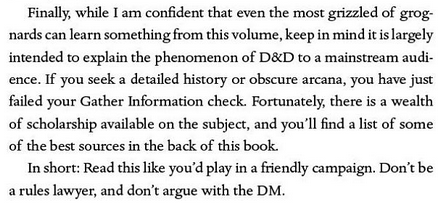
ODAM, p. 2

You read that as I do? Now he's protecting the "mainstream audience" from those evil grognards while snubbing the gamers as having "failed" in reading this properly.

But did they? The book claims to be "the history", not "a history", not "a short history", it's definitive. Nothing in the marketing actually gives any hint of this book being anything else but what it claims to be.

Anyway, he's (again) hinting the reader to go somewhere else. The last sentence, then, aims to cement his authority and advises to play it nice. It's funny, but if someone about participating in a game came at me as aggressive and divisive as that, I'd laugh them in the face if they ended it with "be nice to each other, this is a friendly campaign". Textbook passive-aggressive behavior, I'd say, and I don't care for it one bit.

This could (should?) have been done way more amicably. Easily. As it is, it starts the book off on the wrong foot, and every time he puts himself in relation to those (perceived) hostile readers, you'll see little stabs like that. Here's just a small selection:

  • says (as mentioned in the beginning) that others refer to a group of role-playing gamers as a "stink" (p. 56)*
  • explains how he's anxious to tell others since people have negative associations with the game, to a point where girlfriends leave (p. 75)
  • says gamers are a welcoming bunch, but then goes on to make an example how abusive gamers can be, alluding to something called "Arrogant Nerd syndrome", which isn't even a thing** (the story of Jonathan starts at p. 84) 
  • actually, this is worse than "just" showing how "abusive" gamers can be, it's inverting who's the victim here by saying that gaming should be a "safe haven" for nerds, but ostracizing them is understandable, because they can be, after all, difficult people ... and that's a shitty move***
  • he also dedicates three chapters talking about aspects of the hobby he doesn't like: traditional war-gaming, traditional role-playing and LARP, and I don't think he's giving them a fair shake just because it's not his thing ... more shitting on fringe aspects of the hobby

Let's leave it at that (see the footnotes for the venting). As I said above, it's written well enough, but what's showcased here is also evident in the whole book. Little stories and hints that seem innocent if encountered alone, but accumulate to something where the sum of the parts is uglier than the single encounters. A stink. Ha!

[Source]

Honest to god, I started reading this book to my wife, who's not a nerd at all, and she did not care for the tone of the book. I'm saying, it's not just me and it is important, imo, to highlight this aspect of the book before going into other aspects of it.

So what else is there to talk about? The history sections are excellent, from the very beginning of the idea of cooperative play in history, via early war gaming roots to the first conception of the rules that would become D&D and how that went viral in the seventies. All of that framed by Ewalt's gaming experience and intersected with gaming reports from when he started playing again (a D&D 3e campaign in a vampire apocalypse setting).

Mixed into that we get some D&D quotes, learn about some of the great minds of the hobby, now and then. Anecdotes, quotes from interviews ... Good show, and he runs strong with that until page 172, when Gary Gygax dies. After that, the book loses steam considerably, most of all because the history part of it is basically neglected. We learn how TSR fared after Gygax' departure, and how all of that ended in TSR being sold to Hasbro, but it's basically bullet points of names and dates.

It's just not where the development of D&D ended, or the cultural influence of it. It's just where the writer stops doing what he did well in the first three quarters of the book. We get more of the session reports and quotes and anecdotes, but even there Ewalt'll shift focus and introduce new stories. It doesn't always work, and that last third drags on until the author describes his pilgrimage to the origins of D&D and helps us see through his eyes what all the famous locations are now, which was a nice touch.

Beyond that, we get lots of fan-boying and shilling for WotC and the development of the D&D 5e, which I didn't care for. So, yeah, that's basically what you'll find in the book, without going that much into detail.

Awarding Experience Points (is it any good?)

A book can read well, but transport horrible ideas. Or better yet: it can hide terrible ideas behind a casual tone and a good reading flow. Not that ODAM is in any way, shape or form offensive, but it is "politically correct" while being uncritically vague and even favorable towards WotC and their business practices to a degree where boring just ends up being a vehicle for, well, advertisement or at least craving endorsement.

And sure enough, there are plenty of examples in the text where WotC is being presented favorably ALTHOUGH there is something to be said about the business practices of Hasbro and WotC in 2013 when this was published (the OSR was thriving back then for good reasons).

If not written in favor, that part of the history of the game is actually not present at all, instead we get a reference to another book for checking out the decline of TSR and nothing but praise for WotC "rescuing" D&D and moving on with the brand. No word on the counterculture movement and success of the OSR and the revival of the old editions ... Especially since he's obviously aware of "old gamers" and "edition wars" (as it is evident in the introduction).

And you don't have to be a "fan" to recognize this, but you have to mention it to cast a complete picture. WotC felt pressured to go back to those old roots because people turned away from 4e in troves.

At least Ewalt is honest about being an "ally" of the company and quite happy to support their drafting of 5e. He wants to be in on that action and is happy to be recognized as a "fan" by WotC. Even gets an invite, or so he writes.

All of that is problematic, in my view, as it goes against journalistic integrity to be biased like that, and "journalism" was claimed to be part of this "enticing blend". No xp for advertisement or networking framed as "journalism", I'm afraid (0/5).

[source]

History next. Those passages I enjoyed a great deal. It's well researched and cleverly put together. Lots of interesting trivia. The early years of the hobby sure as hell make for a great story, the good writing puts it to the next level.

But there is a huge stylistic shift after roughly 170 pages. The whole interplay between talking the home campaign (the narrative/memoir part) and the history of the game falls flat. The history part all of a sudden gets rushed and the home campaign gets neglected as well. With what is left, we go as fringe as talking about LARPs while important transition points in the hobby get ignored entirely or just mentioned very briefly.

The last 80 pages are full of odd choices like that, and I get the impression that the author didn't have the stamina to go it all the way (which would have ended in a far superior book, imo).

See, you can make fringe excursions if the main text has enough meat to carry a little extra context. This is well illustrated in chapter three, when Ewalt's talking about legacy war gaming (although I did not care much for the retelling of those battles). But when all the interesting bits fall flat (for instance, how the game developed beyond Gary's involvement), we are left with a boring mess of praise for Big Corp, at least three different session reports and an overall text that goes nowhere until it ends with a pilgrimage to something that isn't there anymore.

I have to admit, the end works for me. The whole idea of the tying the book together like that is nice, and my guess would be that it came up pretty early in the writing of the book. However, there are at least 150 pages missing, and that's a shame. Still, what's there is great (4/5).

Gygax, making history again ... [source]
Memoir and Narrative, now, are interwoven to form the skeleton the history is presented on. I liked bits of that, didn't like others. As with the whole book, it is all crafted by a skilled writer, but I still felt it lacking at times, especially when Ewalt tries to be non chalant about not liking his fellow gamers (the stink, it's an addiction, all being welcome means there are abusive people ... but I'm repeating myself) or blatantly paints an uncritical picture of those currently owning the game (WotC).

That said, I did like the idea of structuring the whole book that way (not the negative parts, but the private aspect of it). It works well until it falls short 172 pages into the book. And when he not tries to paint himself as "the gamer that isn't a gamer anymore but then falls prey to the addictive elements of it again and now plays a far more sophisticated version of the game", it is quite the engaging read.

Even the session report sections work most of the time. Again, until they don't because they have to carry the book in the last third while adding several additional new narratives.

Using this memoir/narrative angle, the book mostly manages to paint a picture of what the game can be and what its elements are in almost all dimensions (the roots, the social dynamics, how it plays, ...), and that's good, although not fully realized and with the caveats already mentioned (3/5 each).

Nice ass, though! [source]

In closing ...

When all is said and done, this is not "the" but "a story of D&D and the people who play it". The historic part is interesting and I wish there would have been more of that and not just the pre-history and the first 20 years or so. Our cultural dialogue with D&D is not over yet, as the latest WotC fuck-up about the license of the game gave ample evidence to gawk at.

Writing a 250 pages book (with only a third of that actually being about the history, if you take away the memoir/narrative parts!) and claiming there'd be no room to explore the history of D&D after Gygax left TSR just to avoid shedding a light on some "problematic" truths regarding Big Businesses Ewalt likes to associate with, is just bad style.

So how should we end this? Is it a good book in my opinion? Yes and no. There are so many shortcomings, masked by a well crafted book that reads well enough to actually work, that it comes down to a meager 2.5/5 (tendency towards the 2, after taking as close a look as I did just now).

The history part that is done, is done well and I enjoyed reading those passages. Learned something about the early history of the hobby, too. The rest was engaging enough for the first two thirds of the book and the last chapter.

What left a sour taste in my mouth was the blatant adulation for WotC and the constant (somewhat underhanded) misrepresentation of most the people that actually play those games as undesirable company. Add to that the missing history of the game after Gygax left TSR and a weak last third with a somewhat strong ending that would have needed a bigger book to work properly.

If that sounds like something you could stomach, you can sure go and get that book.

Let's see what Eric's saying about it (we coordinated publishing, but didn't read each others take ... what fun!): follow me there.

This has always been true ... [source]

* He just came up with it, btw., or at least I couldn't find an easy reference for it. People call their spouse "stink" or relatives, but not a group of nerds, as he implicates. At least not as wide spread as he'd make "us" (assuming a main stream reader? pleasing the WSJ buddies?) believe the term is.

** Try and google that, the only proper hits are referring back to his book, one making the (great!) point that he neglects talking autism in gaming while instead re-enforcing negative stereotypes again. Same pattern as with the "stink", all to make role-players look bad (or make it seem that they are perceived in a bad light). I think it's projection, but that's just my two cents.

*** I'll segue a bit into this in a footnote because I feel it's important: people are not socially awkward because they are assholes or abusive, it's because they are made feeling unwelcome and pressed into the fringes. And what happens in the fringes? Subcultures, which D&D is one of. Or was, it seems, given its popularity today. Anyway, point being, I associated with another subculture back in school, in Germany: the punks. And those had been REALLY socially awkward. For the same reasons. To now go and act as if those phenomena are just direct results of ones conduct instead of symptoms of something far more difficult to tackle (social dynamics of bullying and hierarchies and whatnot), is insincere. At best. "My people" have been excluded and ridiculed for a long time now, what Ewalt does implicates he's more like the people that didn't get along with nerds to begin with ... I wrote about this some time ago in detail, see Nerd Pride and Pop Culture going Full Circle.

Tuesday, May 31, 2022

Extraordinary Characters in Ordinary Situations VERSUS Ordinary Characters in Extraordinary Situations (right there is your RPG Schism!) Motivation Series Part 2

This is another piece in the prism that the Motivation Series turns out to be ... Not what I intended to write, but what came to me basically by accident: there seems to be a core divide between games that either make rpg challenges mundane by having powerful characters OR making everything challenging by having mundane characters in dangerous situations. Why is that? How does it work? And why aren't others talking about it? Let's see (and yes, this will eventually be about gaming, of course).

You want to start reading at the beginning? Here's Part 1

There's also an Intermission about how computer games shaped our expectations, and you can read that here.

What makes us laugh, divides us ...

So here  is what happened: Pratchett died (bear with me), and no one writes as funny as he did. At least no author I could get my hands on. Sir Peter Ustinov was just as funny, but didn't write as much and died even earlier (which doesn't help).

Now, people will tell you that humor is a matter of taste, and I will tell those people that taste is a matter of specific biological and psychological conditions which need to be understood to make any meaningful contribution to any art we attempt. Doesn't matter how abstract the grip is we get on the topic, we need to have SOME UNDERSTANDING about taste to interact with it. It's disingenious and lazy to try and stop a discussion with "that's just a matter of taste".

Another perspective on humor is that laughing is the spontanious (and possibly shocking) realization of a connection we haven't seen before. Why is it funny when somebody stumbles? Possibly because we didn't realize what movements a body is capable of to desperately keep balance? There is no such thing as "stumbling with grace", which leads to "people take themselves too serious to allow for stumbling". So you could say it's the spontanious insight that we are taking ourselves too serious that makes us laugh when we see others stumble.

... [source]
 Well, different stumblings might stipulate different laughter. A kid playing recklessly doesn't take itself too seriously, but if it stumbles recklessly, it might still make you laugh, maybe for the sheer honesty of it, maybe to signalize the kid that it's not problem to problem to stumble and fall. You just get up and move on.

Oh, and there's always the aspect that we laugh when nothing is really hurt but another person's dignity. If an old lady falls and is at risk to break a bone, you get there and help her and ask her if she's alright. That's not what I'm talking about.

There's also Jackass, so there is a spectrum on how much pain can still be funny ... But that's neither here nor there. What I wanted to show was that humor has reason and has a function in a culture. Or even in general among humans ... and we do know that animals can laugh, which is also very interesting. We instinctively know it is important. It is an easy connector in any conversation. If you can make people laugh earnestly, you know you will get along with them. Just like that.

However, to go full circle: while taste should never be the end of a discussion when talking about creating a specific kind of experience (as that's what we do: design talk), it's very much a marker of preferences that should be taken seriously in order to find out why they exist and how they are, lets say, activated. And Pratchett was a huge and popular marker in that regard. He was the GOAT, without a doubt. And no one seems to be able to crack his formula. His writing doesn't even translate well to other media (other than rpg, maybe, but definitely not for tv).

Always had great artwork, though ... [source]
Why is that, then?

I'd argue that ONE aspect of it is that he described very real people in very bizzare circumstances. Imagine being a photographer for a newspaper, but you are a vampire and using the flash will actually turn you to dust, so you have to take precautions ... Pratchett is full of ideas like that. Undead fighting for their rights in society, politicians dealing with trolls and dwarves and dragons, but those all behave like people you might encounter in daily life, too.

Fantasy and the (British?) 20th Century mindset juxtaposed like that is a huge part of where Pratchett's books draw humor from, often to slyly tell us something about the human condition we hadn't realized yet.

Some good reading [source]
It irked me a long time how he did it and it took me a long time to get there. Incidentally, it wasn't because I'd read one of his books and something clicked for me. No. I bought a book because the premise and the advertisement told me that it actually might be something "like" Pratchett. That book was The Stranger Times by C. K. McDonnell. It is no Pratchett, but it was an enjoyable enough read to actually recommend it. I couldn't put it away, and I had those laugh-out-loud moments I rarely get when reading. Some light Urban Fantasy and my kind of humor (can't say anything yet about the second book, however ...).

Still, didn't click for me right there. Made me think about the issue again, though.

What did the trick was reading another author after that who also was celebrated as very funny, although more in the manner of Monty Python. I dig me some Monty Python, the story sounded rad, so I took a chance (and probably made the mistake to read it directly after the Times). That book was Rober Rankin's Retromancer.

In all honesty, I didn't enjoy it as much as The Stranger Times, and I couldn't put my finger on why exactly that was. The premise is great. Guy wakes up in the Sixties, but it isn't the Sixties he knew. No. Here, it seems, the Nazis had won WW2 by bombing the US into nuclear winter. So that guy gets to rejoin his Master, a great wizard and guru, to set the timeline straight again. A bit of Monty Python, a bit of a Peter Sellers routine, full of great ideas and great little story vignettes.

Great writing, too. I'd have loved to see it as a movie. But as a book, it just didn't work for me. It was in direct comparison to that other book that it dawned on me: the characters in Retromancer are anything but mundane. They are, in many ways, larger than life. Not only "the guru's guru", but his sidekick, the narrator, as well. Not someone you relate to, but a character you know from movies. Superficial, in a sense, and with a "funny" perspective on things that colors the whole story.

A character like that (as in: extraordinary) going for breakfast (as in: doing something ordinary) will have the most extraordinary adventure doing so (goes for a good old english, gets a Bratwurst, or as his aunt puts it "the Führer of all sausages", which I actually found immensely funny). This character will buy some cigarettes, and you'll have the most beautiful little stories about smoking throughout the book. Ordinary things made extraordinary by the extraordinary character ... you get my drift.

There's a theme, even!

You could make the same distinction between the horror Stephen King is summoning versus the horror a Clive Barker will summon. King's characters are real or "mundane" in that we can empathize with them. Barker's are bizzare minds putting a bizzare lens on reality. Two very different qualities, but qualities with the same differentiating element: they either use the ordinary to explore the extraordinary or they use the extraordinary to explore the ordinary.

Same goes for computer games, I'm pretty sure. On the one side you have some open world games where characters start from zero and carve themselves a niche into the sandbox as they see fit and on the other side you have those ultra complex quick time event driven games that hold your hand for the story and most of the progression, but pushing the right buttons at the right time will have a character make some really crazy moves (Arkham Asylum, Metal Gear Rising).

Me, everytime ... damn qte! [source]
And within that spectrum you'll get everything from a S.T.A.L.K.E.R.-style fps with all the freedom to move you could imagine to some Gears of War-style tps on rails but with cinematic qualities. Many computer rpgs fall in between that spectrum as well. It's definitely not true for all computer games, though*.

Either way, it's a thing for sure, and once you are aware of it, you'll find it is a very strong theme in tabletop role-playing games as well. As a matter of fact, I'd go as far as saying that it is one of the distinguishing factors in role-playing games right now. And it is definitely leading to different design choices along the way. Not BETTER or MORE FUN, but DIFFERENT. As in: so different, people will most likely be into one OR the other (or at least more into one than the other).

And that's what this post is about: showing that there is a DISTINCT difference between those two modes of play and that they not necessarily (or easily) mix. It is not an evolution of gaming, it is manifesting a divide that always has been there.

Different styles altogether?

So far we have the outline of the distinguishing factors. On the one side you have rpgs that start with a couple of in some sense ordinary characters (usually a beginners of sorts) who face an extraordinary situation (classically, exploring some dangerous ruins with magic and monster abound). That's your basic early D&D, but most ttrpgs up until the nineties would follow that recipe more or less.

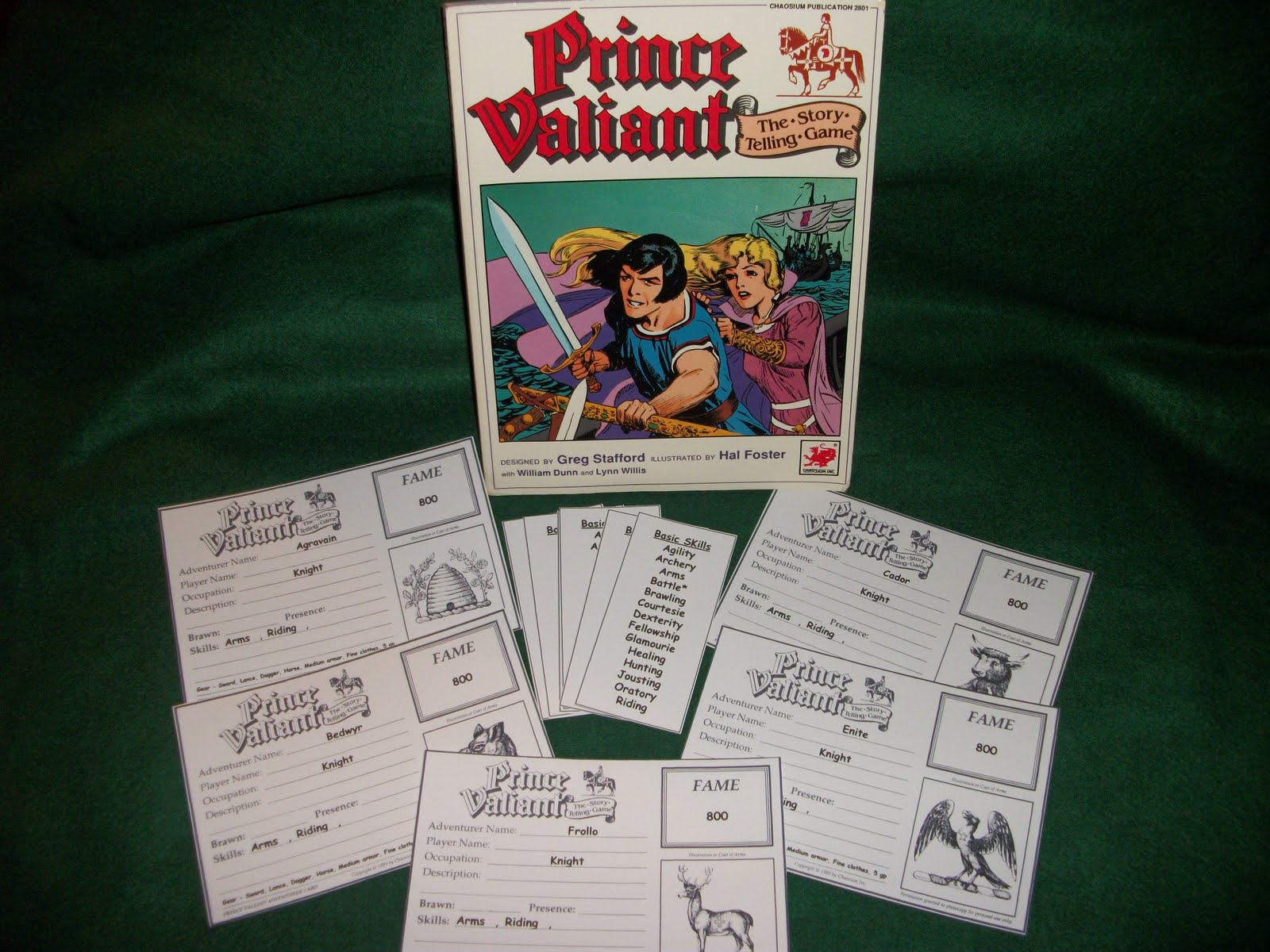
Prince Valiant: The Story-Telling Game was in 1989 an early precurser of that shift we are talking about here, but the big success in that regard was Vampire: The Masquerade. The tag line back then had been very apt, it was a game about playing THE MONSTER. All of a sudden you'd be way above humans in the foodchain, and in a contemporary setting, no less. Still small fries, all things considered, but powerful small fries.

Classic rpg fork [source]
 You could say it was the first time that the power curve in rpgs shifted from being on the system-side to being mostly on the side of the narrative. And that's significant in that once it is established that you can just narrate that you are the MOST POWERFUL CHARACTER OUT THERE (TM), although V:TM offered enough meat with its system that a somewhat prolonged campaign arc was possible.

Still, it turned out to be the starting point for a clear trajectory, with the PbtA games as one high watermark and the Black Hack games as another.

Interestingly enough, there seems to be a trend to glorify the original beginner characters from early D&D towards the extraordinary. My guess would be that it has something to do with loading the characters with some meaning they didn't have before, like PUNK, for instance. It's pretty much the Robert Rankin approach described above, where the lense through which the player/character see the world colors everything mundane in some special light.

There's also a massive manga and anime trend to have ordinary people become extraordinary because they end up in extraordinary circumstances (like a fantasy setting, but are actually very capable in that setting compared to the real world (where they might be nothing!). In other words, ordinary characters turned extraordinary because their extraordinary surroundings are just ordinary for them is a classical trope by now, which might explain the appeal in role-playing (which follows the same meta-knowledge metric: players knowing the rules fare better).

Blades in the Dark is a more recent powerful contender for the "extraordinary characters" category as well and The Spire RPG seems to be the newnew hot in that regard (giving players lots of narrative power, for instance). 

D&D 5e tries very hard to be that kind of game but obviously brings a lot of baggage to the table, which will make it a great example for how different those games actually are and how it's more like a spectrum on the user end of things. Because D&D was the original blueprint of all things rpg, it will have always had room for the story-telling gamers.

You can't, on the other hand, play ordinary characters in games that are designed for extraordinary characters only (unless you go for the comedic break of the ordinary character doing ordinary things among extraordinary characters). We tried, actually, in one of our groups once. Was a new group, didn't last, btw. I had offered to DM the WitchCraft rpg and I told the players that it is about powerful characters in an urban horror/fantasy setting.

All agreed and knew what was what, but as soon as character creation started, half the group wanted to play ordinary characters in a horror setting. WitchCraft doesn't work that way and that led to many discussions why there is no tension for the ordinary characters. They just didn't get that they were talking a different kind of game. As I said, didn't work out in the end, and it was more symptomatic that the game played out as it did. But it illustrates my point: original D&D could have been played that way (and there actually are urban fantasy b/x variants out there), WitchCraft was designed to NOT do that.

There's also the little fact that playing the first editions of D&D will grow a character from wimp to god and one could always just start with a more powerful character along that trajectory (Goblin Slayer would make for a D&D campaign like that).**

But who likes to play what and why?  

Different players altogether?

I might have to start with a disclaimer here. First of all, people will change between the "roles" in their life. A loving mother can be a bloodthirsty barbarian on her weekly gaming night. People play to relax. To be someone else or to be among friends or because the gaming immerses them. This is, in a sense, where we connect a bit with Part 1 of the Motivation Series, but only to (maybe) add another facet to it.

Here's the part I'm talking about (5 positive motivations for players to join your game):

  • DOING something meaningful (mainly socialicing with others for a collective experience ... leveling up & campaign play as milestones, those things)
  • LEARNING something meaningful (collecting experiences & testing approaches to reality)
  • COMPETING meaningfully (negotiation, tactics & strategy)
  • BEING someone meaningful (exploring who you are or aren't & why)
  • CREATING something meaningful (a game, an experience, a story)

I'd say that players going for "extraordinary characters" would, going by the 5 types of motivation proposed in Part 1, be mostly among the people motivated by BEING someone special and those aiming to CREATE an experience. COMPETING and LEARNING motivations would gravitate more towards that are challenging and offer some more skill oriented growth (instead of, say, personal growth). Those in it for DOING it as a social activity could go either way, so we'll have an even split among motivation types. Nice!

The new aspect here would be, then, that finding out what actually motivates people in joining your game is actually quite easy. You just ask them if they'd rather play (A) an extraordinary character doing ordinary things or (B) the other way around. There are three possible answers: A, B or "I could go either way, I'm in it to socialize with friends" (or something along those lines ...).

An "I don't know" shouldn't cut it, to be honest. Sure, talk it out, but if one of the three possible answers doesn't appear naturally relatively fast, it would hint (imo) towards a motivation that hasn't anything to do with gaming. Just something to be aware of, I guess.

Just saying ... [source]
One more piece of the puzzle ...

Still not where I wanted to be with this, BUT another important piece, imo, as we will need to talk about what different kinds of role-playing games are out there and why that matters immensely in terms of player motivation. What we got to explore in this post helps shining a light on some of the distinctions.

That said, being aware of the axis described above should be useful in itself as it should help you in finding an understanding about why we play the games we play and why some will work for you and some won't just because of some design choices that aim to please a ecrtain type of player.

By accident or consciously doesn't matter, if you think about it. Sometimes it's just a designer's raw preference that resonates with likeminded people. What does matter, however, is that is not "all the same".

I hope I was able to make my case here and that you guys enjoyed reading this. What do you think the implications are? Did it change your perception about your preferences? Thoughts and opinions are, as always, very welcome.

------------------------ 

If you enjoyed the above, you might like the blog anthology series I started publishing on drivethru. You can get it here and it definitely supports the blog to drop by for the pdf here.

AND I'm still hustling this one: You can check out a free preview of Ø2\\'3||, that rpg I wrote, right here (or go and check out the first reviews here). I'm (still, but only until end of June) doing a sale on the game proper ...

If you already checked it out, please know that I appreciate you :) It'll certainly help to keep the lights on here! I'd love to hear about that, too.

Just look at that beauty ...

 ------------------------

* I have to figure out how tactic, card and puzzle games figure into that, but I think they might just be something else entirely, leaning towards boardgames and such.

** Okay, here is yet another dimension to this: it is known that many D&D campaign fail when the characters becoem to powerful. Mostly that'd be because the DM didn't shift gears along the power curve and challenged the more powerful characters with something adequate. But in a sense it shows how players who like to play ordinary characters in extraordinary circumstances, actually don't like it when the game turns that around after a couple of levels. Anecdotal evidence, for sure, but nonetheless. It fits the pattern, doesn't it?


Thursday, May 5, 2022

The Disoriented Ranger talks: Gaming Culture (Blog Anthlogy 1)

Yes, this just happened. Something I had announced just got published over at OBS, just a little differently to what I'd thought would happen: we are still celebrating the 10 year blog anniversary. Somewhat. I'll give you the tour ...

It'd make one book, he said!

If you have been around in the last 10 years, you know I didn't write many posts. But when I did, it'd often end up being something lengthy. I like it that way and if you dare to look, there's a lot to look at (and not all of it looking back, ha!). So I scanned what I'd done in the last 10 years, collected all of it, sorted what I'd like to see collected, started compiling what I thought would be the first chapter ... and ended up with 130 pages for that alone, with five more to go.

So I stopped and thought: that'd make a nice pdf for a start of a small series.

Next I had to go deep, see if it holds as a standalone. It is the most general of the six collections, and talking "gaming culture" can be a bit tricky, so caution came natural. After going through this carefully, I think we are good here. I talk commercialisation, community work, social aspects of it all, some econimics, some talk about publishing. Always highlighting some aspect that interested me at the time, but altogether quite a lot to think about, I guess.

Next was layout and some light editing. Now this exists, with the rest well prepared and ready to bounce.

Find it here!
Why bother?

Well, if you ask yourself that question right now, I probably shouldn't try and convince you. So I won't. In my mind this was always something I did for me. I put ten years into this blog, and it's only a little extra work to make the transfer to another medium (pdf) and only a little bit more beyond that to get a PoD. And I really want that book. Or rather, those books (as there will be two now!).

Who knows what the internet will be in ten years from now? Or whenever my kids will be able to read it? We don't know. As a matter of fact, having something in print seems to be a good option right now.

It also always bothered me that old posts are only read by spam bots. So there is that. Having the texts compiled the way I did, allows a different approach to the topics I discussed and allows for different context. I didn't organize those posts chronologically, I went for something more cohesive, hoping the sum of the parts create surplus value. We'll see.

For now, I'm happy this first step is done. I hope you'll enjoy this first compilation. And if you are a long-time reader, there's no better way to show me appreciation for my work here by checking this title out and giving it some love. Goes for all, of course :)

What's to come

You might have wondered. I'm still very close to finishing writing on be67 ... that'll need some editing and layout after that (hopefully all happening this month). Art is in the works. We are good there. It'll be summer, but the pdf will be out asap. PoD would be great for July. I'm working it.

On the side I'll keep doing the anthologies. Here are the other parts:

  • Part 2: D&D and the OSR
  • Part 3: Musings about DMing
  • Part 4: Storytelling Advice
  • Part 5: DIY & Gamedesign
  • Part 6: Theories in Action

I guess I can manage a new one each month ... Then I have to start getting real about that module THE RISE OF ROBO-HITLER. Everything is in place for it and I should get started properly about it in August, aiming for a December publication. Some blogging as well, I guess (that second part about player motivation will be up next week, I hope!). And I've got a couple of other surprises down my sleeve.

We'll be busy here at Disoriented Ranger Publising!

I'll also offer some one shots on roll20. Probably via MeWe? But if here's interest, just drop me a comment and I will keep you informed.

Feels like a new chapter?

Well, it is, in a sense, a logical step to publish some more, especially when I get an opportunity to actually make all of this happen. It's been coming a long time, too. And I still need to write and publish Lost Songs of the Nibelungs (but that I want to be the best I can make, and there's still some way to go for that).

I'll give it all my best shot and I hope you all are along for the ride.

Check out that book, it's just a buck and good readin', too.

Saturday, August 6, 2016

Preview: Monkey Business (a procedural junglecrawl)

I had exams and was quite busy the last few days. But it wasn't all business, as I've managed to complete the draft for one (of the many) things I'm writing for the blog: Monkey Business. I should get ready to publish this in the next couple of weeks and thought it's time to make this a little bit more public. It's definitely not the first thing I started writing here (and all the other things are still happening, too), but it'll be the first thing out there with my name on it. And here's a sneak peek ... 


The tone will be very pulpy and all the test readers agree that the whole thing is wacky as hell. So if the following passage does it for you even a little bit, you might have fun reading, if not DMing Monkey Business:
Tarzang – King (Slacker) of the Jungle 
Not one of the circus people, but totally zoned out by the
drug anyways. His real name is Viscount Lonny
Graustock and he led an expedition into the jungle to rob
some poor natives just a few months ago. Now he swings
naked (and muscular) from tree to tree (mostly hitting
them and screaming in pain because of it or in fear to hit
another one ...) and thinks he is able to talk to animals. 
He seems harmless (and well built), but he will bring a group
into trouble if they believe he really is some sort of king of the
jungle (as he will claim, of course). His primary motivation is
to get the next score and he’ll try to use a group as distraction
against an orangutan pusher on drug delivery, grabs what he
can carry and makes a run for it. If there are females in the
group, he’ll pick the prettiest one and schemes to kidnap her.
He’ll also call her Jane all the time. No one knows why.
This thing has around 160 different encounters, a random jungle location and treasure generator, mushroom pygmies, cannibals and exploding goblins! There is a nice poem by Rudyard Kipling in The Second Jungle Book that pretty much sums up what kind of chaos this module will conjure as the drug conquers its surroundings:
I will let loose against you the fleet-footed vines—
I will call in the Jungle to stamp out your lines!
The roofs shall fade before it,
The house-beams shall fall,
And the Karela, the bitter Karela,
Shall cover it all! 
In the gates of these your councils my people shall sing,
In the doors of these your garners the Bat-folk shall cling;
And the snake shall be your watchman,
By a hearthstone unswept;
For the Karela, the bitter Karela,
Shall fruit where ye slept! 
Ye shall not see my strikers; ye shall hear them and guess;
By night, before the moon-rise, I will send for my cess,
And the wolf shall be your herdsman
By a landmark removed,
For the Karela, the bitter Karela,
Shall seed where ye loved! 
I will reap your fields before you at the hands of a host;
Ye shall glean behind my reapers for the bread that is lost;
And the deer shall be your oxen
By a headland untilled,
For the Karela, the bitter Karela,
Shall leaf where ye build! 
I have untied against you the club-footed vines,
I have sent in the Jungle to swamp out your lines
The trees—the trees are on you!
The house-beams shall fall,
And the Karela, the bitter Karela,
Shall cover you all!
Neat, isn't it? Other inspirations are Super Mario, Ufomammut, Planet of the Apes, Breaking Bad, Futurama and many, many others. It'll also feature some fantastic illustrations by +Mark Van Vlack and his fabulous Monkey Generator (which kind of kicked the whole thing loose).

It'll be out there in the wild as soon as I'm done with the layout and some lose ends. I'm aiming for end of September, but you guys know how it is ... Definitely before November, though, I can promise that much :)

Wednesday, August 28, 2013

H. G. Wells and the "Kriegspiel"

One of the first of it's kind...
Nerds, 100 years ago
"Little Wars is the game of kings for players in an inferior social position. It can be played by boys of every age from twelve to one hundred and fifty and even later if the limbs remain sufficiently supple, by girls of the better sort, and by a few rare and gifted women." (H. G. Wells, Introduction to Little Wars, p. 7)
One of the very early predecessors of the War Games that led to D&D was Little Wars by H. G. Wells (which itself, as far as I know, was inspired by some other game, used by the Prussian Military to train it's officers).
Discussing house rules of playing
with tin soldiers in 1913.

The first edition was published in 1913 (July of that year, to be precise) and is in the public domain now (you can get it here in every format you could possibly need).

It's delightful to read how they worked on the game to make it more and more "realistic", the debates and problems and the fun they had playing it. All that no less than 100 years ago!

Fascinating, not only as a historical artifact, but also as a game. Small shooting toy cannons should be easily enough attainable. No need to mention miniatures, I guess.

More thoughts about it as soon as I've finished reading it.

I'll start a virtual bookshelf for this blog and this will be the first book on it...