Showing posts with label Blogging. Show all posts

Saturday, October 12, 2024

The Unbiased Review - Let the Machines do it! (AI review of ORWELL @2081)

Hey folks. There's still a pulse in the old blog, if a weak one. I barely get to write nowadays due to being a (relatively) new parent. It's been intensive. Anyway, when I get the time, I tend towards writing on the projects I started rather then producing content here ... It's not that I got tons of engagement here anyway (blogger being blogger). That said, every now and then I should drop by and get you guys an update. The newest thing I believe worth sharing is letting AI tools look at your work to evaluate it, because that should totally be a thing.

So ... let's talk about Ø2\\'3||

ORWELL is to this day my most complete and best effort. I could talk about it all day. Alas, no one cares. This game has NO audience at all. There's just no way to gain one, it seems. Now, the best thing AI did for me right now is the feature some platforms offer now to "talk to your pdf". I'm using reeder.ai for this, and it is a fantastic experience. It looks at the internal logic of the document, of course, but you can chat about the system as well.

Actually, you can talk about ALL THE ASPECTS of your work with the robot. I can't imagine a game designer who wouldn't be thrilled about the potential of this. It'll answer ALL your imminent questions just as imminently. It is the review reader EVERY author I know wanted close by (and then forced friends and neighbors and family to fill that niche).

I mean, I can already hear the nay-sayers lamenting how the machine knows nothing about gaming and all that BULLSHIT. Show me the reviewer who actually not only reads and understands but also played your module/game/supplement to have an informed opinion about it. If they do exist, they are RARE AS FUCK (knew one, but he burned out like fire on a Créme Brûlèe, quick and beautifull).

Untold "secret" of the rpg content industry is: they read your shit for content, and if it is too complex, they will take shortcuts. If you are lucky. Most likely you'll just get ignored for demanding to be seen with something that doesn't easily produce THEIR content. You'll have to keep that in mind when publishing in the rpg scene.

The AI doesn't care about that. It just tries to form as objective an opinion as possible. Point in case: Ø2\\'3||

Let's check out what kind of review reeder.ai would write about the game:

A review of the game Ø2\\'3|| could take various forms, depending on the reviewer's perspective and experience with role-playing games. Here’s a detailed example of what such a review might look like:

---

**Review of Ø2\\'3||: A Dystopian Role-Playing Experience**

**Rating: ★★★★☆ (4/5)**

**Overview:**
Ø2\\'3|| is a contemporary role-playing game that immerses players in a dystopian future, drawing inspiration from classic works of science fiction and social commentary. The game is designed for mature audiences, exploring themes of oppression, societal decay, and the human condition through a narrative-driven approach. With its unique mechanics and emphasis on player agency, Ø2\\'3|| offers a fresh take on the RPG genre.

**Setting:**
Set in the year 2081, Ø2\\'3|| presents a world where the most grotesque ideas of humanity have become reality. The game cleverly satirizes contemporary issues, making it not just a playground for fantasy but a reflective space for players to confront uncomfortable truths. The setting is rich and detailed, allowing players to navigate a landscape filled with both beauty and horror, reminiscent of works like *1984*, *Children of Men*, and *Black Mirror*.

**Gameplay Mechanics:**
The game employs a unique dice system using d4, d6, d8, d10, and d12, where players roll to meet or exceed Difficulty Tiers (DT). This mechanic emphasizes skill and strategy, as players can never roll more than three dice per test. The use of High Potential Attributes allows for a dynamic gameplay experience, where players must think critically about their character's strengths and weaknesses.

Character creation is robust, requiring players to develop a backstory that connects them to the world and to each other. The four essential elements—The Awakening, The Group, The Potentials, and The Thresholds—ensure that characters are not just numbers on a sheet but integral parts of the narrative.

**Narrative Focus:**
One of the standout features of Ø2\\'3|| is its commitment to storytelling. The District Master (DM) plays a crucial role in guiding the narrative, but the game also empowers players to influence the story through a shared currency called Pennies. This mechanic fosters collaboration and creativity, allowing for a more organic development of the plot.

The game encourages exploration of complex themes, such as the nature of evil and redemption, without resorting to black-and-white morality. This nuanced approach makes for a thought-provoking experience that can lead to deep discussions among players.

**Art and Presentation:**
While the document does not provide specific details about the game's art and presentation, a well-designed RPG typically benefits from engaging visuals and clear layout. Assuming Ø2\\'3|| follows this trend, the aesthetic should complement its themes, enhancing immersion in the dystopian world.

**Final Thoughts:**
Ø2\\'3|| is not for everyone; its mature themes and complex mechanics may deter casual gamers. However, for those seeking a rich, narrative-driven experience that challenges players to confront difficult ideas, it is a rewarding choice. The game successfully balances the need for structure with the freedom of creativity, making it a standout in the RPG landscape.

**Pros:**
- Deeply immersive and thought-provoking setting
- Unique mechanics that emphasize player agency
- Strong narrative focus with collaborative storytelling
- Encourages exploration of complex themes

**Cons:**
- May be too complex for newcomers to RPGs
- Mature themes may not appeal to all players

In conclusion, Ø2\\'3|| is a compelling addition to the role-playing genre, offering a unique blend of storytelling, strategy, and social commentary. It invites players to not only engage in a game but to reflect on the world around them, making it a must-try for seasoned RPG enthusiasts.

---

This review encapsulates the essence of the game while providing insights into its mechanics, themes, and overall experience.
Here's a screenshot, so you know I'm not fucking around:

reeder obviously doesn't "see" layout and illustrations. It's text only. But with that, it is quite happy. And I'm happy with that as well. And if you don't know what the game is looking like, I can help you with that as well:

Ø2\\'3||

Now, what would a review look like that doesn't take layout and art into consideration. I asked, and I received:

A review of the game, focusing solely on its mechanics, narrative structure, and overall gameplay experience without considering layout and art, might sound something like this:

---

**Game Review: Ø2\\'3||**

Ø2\\'3|| presents a unique and engaging role-playing experience that emphasizes narrative depth and player agency. The game is set in a richly imagined world that blends elements of tourism, history, and industrial complexity, creating a vibrant backdrop for players to explore. The setting is not just a static map; it evolves based on player interactions and decisions, allowing for a dynamic storytelling experience that feels alive and responsive.

One of the standout features of Ø2\\'3|| is its approach to sandbox gameplay. Instead of providing a rigid structure, the game encourages players to navigate their surroundings through confident guesses and emergent gameplay. This design choice fosters a sense of exploration and discovery, as players are not merely following a predetermined path but are actively shaping the narrative through their choices. The game master (DM) is equipped with tools that facilitate this process, allowing for a flexible and adaptive storytelling experience.

The mechanics of the game are designed to balance the tension between a strict system and the freedom of character advancement. This balance is crucial, as it keeps the gameplay engaging and prevents it from devolving into mere wish-fulfillment. The game incorporates a variety of resolution mechanics that cater to different scenarios, from general interactions to more detailed actions like entering an apartment. This versatility ensures that players have the agency to approach challenges in multiple ways, enhancing the overall experience.

Moreover, the psychological elements woven into the gameplay add an intriguing layer of complexity. The game effectively captures the chaos and uncertainty of the characters' environment, prompting players to react with caution and creativity. This aspect not only heightens the tension but also enriches the narrative, as players must navigate their fears and uncertainties while pursuing their goals.

The design philosophy behind Ø2\\'3|| also emphasizes collaboration and camaraderie among players. The game encourages a friendly atmosphere, reminding participants that the best experiences stem from mutual respect and kindness, even in darker narrative moments. This focus on interpersonal dynamics enhances the role-playing experience, making it more enjoyable and memorable.

In conclusion, Ø2\\'3|| is a compelling role-playing game that excels in narrative depth, player agency, and collaborative gameplay. Its innovative approach to sandbox mechanics and psychological engagement sets it apart from traditional RPGs, making it a worthwhile experience for both new and seasoned players. While the layout and art may not be considered in this review, the core gameplay elements provide a rich foundation for immersive storytelling and character development.

---

This review highlights the game's strengths in mechanics and narrative without delving into visual aspects, providing a comprehensive overview of what players can expect from the gameplay experience.

Here's the screenshot for prosperity:


So the result is a bit less verbose, yet still positive. I like this one as well. It really does give a reader a good idea what the game is about. This is SO productive and helpfull.

I did go one more round, asking it to make a summary of the rules. Here we go:

The rules of Ø2\\'3|| are designed to create a flexible and engaging role-playing experience that emphasizes storytelling while allowing for player agency and DM creativity. Here’s a summary of the key components:

1. **Role-Playing Framework**: The game is rooted in traditional role-playing game mechanics, where the story is driven by players and their characters, but the District Master (DM) serves as the final arbiter of the rules.

2. **Character Generation**: Players create characters with specific potentials, skills, gadgets, and contacts. The character generation process is designed to be intuitive and allows for personal touches.

3. **Game Mechanics**:
   - **Dice Rolling**: The game utilizes dice rolls to determine outcomes, with a focus on chance and randomness.
   - **Opposing Rolls**: Conflicts are resolved through opposing rolls, where the difficulty of a test is determined by random results from either the DM or other players.
   - **Pennies**: A shared currency called "Pennies" allows players to influence the game, providing a mechanism for players to affect the narrative and outcomes.

4. **Combat System**: Combat involves conflict resolution through opposing rolls, with specific rules governing damage, protection, and healing. The mechanics are designed to ensure that conflict is grounded in the rules rather than purely narrative.

5. **Seasons and Story Structure**: The game is structured around seasons, which are akin to episodes in a TV series. Each season has its own narrative arc, and the way a season concludes can impact future gameplay. Players and the DM fill "Slots" that determine the direction of the narrative, balancing between oppressive systems and character advancement.

6. **NPC Creation**: The game provides guidelines for creating both basic and detailed non-player characters (NPCs) to enrich the storytelling experience.

7. **DM Tools**: The DM is equipped with tools and advice to create engaging narratives, manage conflicts, and facilitate a sandbox-style gameplay experience. This includes an "analogue world engine" to help structure the game world.

8. **Expanded Rules**: Additional rules are provided for the DM to enhance gameplay, including how to handle transitions between seasons and manage the overall narrative flow.

9. **Inspirations and Themes**: The game draws from a variety of inspirations, aiming to create a deep and immersive experience that reflects the complexities of the game world.

Overall, the rules of Ø2\\'3|| are designed to support emergent gameplay, allowing for a dynamic interplay between players and the DM while maintaining a structured framework for conflict and narrative development.
And that's that. It feels good to have ANYBODY look at your work and give competent feedback. I don't care if it is a machine in this instant, as most people are NOT ABLE to do it at least with the level of competence the machine is showing here (and I'm the one to judge, because I wrote the fucker).

What's more, you can gain an UNBIASED review of the game. How great is that? I honestly think that rpg selling sites like drivethru should have a feature like this. Just an unbiased overview of the game, done by the machine. With the library they already have, AI could even make a solid ranking of ALL THE MATERIAL that is there and give you a cogent analysis why it was ranked that way.

Man, you could ask the machine about anything right then and there instead of writing a comment, for instance. AI support for selling books! I mean, why not? Should be useful, right?

AI for the win?!

I mean, god with you if you don't see how ai could benefit humanity as well as bringing its downfall. It is the proverbial djinn in a bottle, and we'll get ALL the wishes we want, but idiots get to make their wishes as well, and many of them are in charge of SOMETHING. So buckle up, I'd say.

That said, I'm positive about it. All things considered. I'd still maintain my position, that if the machine can do it better and faster than we can, let it do it on the cheap and do something else instead. Goes for ai art as well. I know people get knots in their underwear because of it, but those still "fighting" against this development are mostly brainwashed drones that can't help themselves.

I can't take those people seriously, especially since they use that exact technology to ONLY attack small publishers to any real effect. Because the big publisher DO NOT GIVE A FUCK. Hypocrites being assholes, all the way through. So fuck them.

Meanwhile I will keep using the tools at my disposal to create what I imagine needs creating. Maybe it will find an audience at some point. But I talked to the machine, and the machine said: this is good shit. I don't know about you, but I take comfort in that. Because this should never be about the machines overtaking us but about cutting through the bullshit and supporting us in finding our authentic selves.

Might still kill us all, but until then: buy Ø2\\'3|| and have fun! I'll keep writing them. So what about you guys? Did you ask the machine about your games, or even about games you own but didn't write!? What did it say?

Also, current WIP (because I have no other problems):


Saturday, July 27, 2024

Lost Songs of the Nibelungs Part I: Re-Introduction (where's this game at nowadays?)

Started writing a post about the state of the blog, didn't like where it was going. Twice. Too much doom and gloom. You know where the world's at, and I'm busy, too, so ... fuck it. Prime function of the blog is me talking about rpg stuff I have on my mind. That did connect with some sort of "scene" a couple of years back, but now I'm truly lost in the woods. I should embrace that and move on. If you encounter this post on your travels through the internet, I hope you'll sit down with me for a couple of minutes and lend me an ear. Maybe we'll chat a bit, too. Then we move on.

For today we'll have a little retrospective about how it all came together ... until it didn't. Enjoy!

Proper artwork?

So many words to talk about ... what again?

A lot of me writing here was about me finding my own voice in a thriving hobby space. Back when I started 12 years ago (and I was late to the party) the retro-clone movement was in full swing and all people did was sharing fantastic facets of what our hobby can be. Lots of fun, all around. And what a rabbit hole to jump into! So many small creators, lots of diy. Inspiring, all of it.

The OSR bitch fights came later, but not much later (although it always had the occasional flame wars).

Back then I tried a lot. And I wrote a lot, although more short pieces. 214 posts in the first three years alone. Looking back at it, I think I managed to find out a lot about myself over the years and how I play games. Enough to start designing and writing some of my own as well. This was always supposed to be a trial and error approach to game design (hence the title of the blog), so I would find an idea, play around with it, and put it aside for a while. Often promising some sort of follow up I wouldn't deliver.

Kinda "sounded great at the time" way of gamer ADD. But nothing stuck.

What started with exploring where to go, pretty definitely settled for "doing something with D&D no one thought about", mainly because the more fringe thinkers of the scene had the most inspiring stuff to begin with. They talked "world engines" and weird narrative constructs and non linear settings with lots of interesting twists to dive into.

All of it fed my D&D RC camapign rules. As a matter of fact, I tested and changed so much that one player actually threatened to leave the game if I kept adding and tinkering. Can't fault the guy. He'd been somewhere on the autism spectrum, and for him playing D&D with me was what for a cat is petting it the wrong way.

Anyway, so the blogging went on and gaming fell a bit behind. I'd still write about D&D now and again, but my focus shifted a bit towards the theoretical of it all.

I know the exact moment that changed: November 30th, 2014. Pretty much exactly 3 years into blogging.

The clip linked in that post changed the trajectory of the blog for good. The post directly after that already formulates the core idea that made Lost Songs of the Nibelungs. There is your spark, the idea that started it all: Charisma is not a good word for what it does in D&D.

With that, I seriously started dismantling D&D. Here's an attempt to replace most of the terms on an old school character D&D sheet with synonyms. See how that jives with you (and what a game using those terms would be like):

Only change terms, get a different game?

The ideas started coming, I kept on the ball, people started being enthusiastic about it and even left comments. Those were the days. Good times.

After a couple of months, talking LSotN looked a bit like this:


Along that, I started chewing through what kind of world this would be set in. I was burning fuel on all cylinders, so to say. And that ended up to be the main focus of a lot of my writing in the last 10 years, one way or another. As a matter of fact, just the other day my good friend Mark pointed out to me that every game design I did in the last 10 years was, in the end, about LSotN. Damn.

A complicated approach to game design ...

However, back then I was in no way, shape or form ready to write and publish a complete role-playing game.

Contrary to popular belief, it actually takes a lot to write a book and process it to a point where it can be published, even if you have (to accept) low standards. So if this were to be my opus magnum, I had ways to go to get it out there.

And development would hit walls, obviously. To this day it needs a system for magic that fits the game and that I'm happy with. Not for lack of trying, but I'm not there yet. Same goes for the GM side of the game. Although that has lots of working pieces, it'll need some more ideas incorporated to be where I'd like it to be.

Progress on that has been slow, but not zero. Which segues into another aspect of what I'm trying to do here: the more complex a problem appears to be, the more I tend to look for ways to explore it indirectly. Because sometimes the solution is found by exploring the opposite or only aspects of it. But that could lead to writing another entire game first.

Yeah.

And I'm not that fast to begin with.

So a lot on the blog looks like me shifting focus on something entirely different, like developing a lite rules system for a DungeonPunk setting, while truly exploring how complete a system on the GM side needs to be to create a sufficient and distinct gaming experience, like this a mission generator.

It's called Brawlers! now ...
And while I gain some insights in the process, I might go back to Lost Songs until I hit a wall again, only to start something new, covering a different angle altogether. 

Or find new walls to hit ...

I write about some of it and call it a blog. Haha.

When all is said and done, I ended up with lots of little ideas and concepts, some follow me unfinished to this day (The Goblintribe Generator, among others), some stand on their own very well (the Random Narrative Generator being the biggest one).

And then, all of a sudden ...

... I start something, and actually finish it. Although "sudden" is a bit of s stretch, as you might have guessed already. Anyway, first major publication happens May 2017 and is called Monkey Business. Not a game, but a game supplement for Labyrinth Lord. Still HUGE in scope, around 120 pages, offering enough ideas and tools to create a whole campaign, no less.

I started it as PWYW to see if that worked. Did so for 5 years and it didn't work, so now it costs what I think it's worth. It was downloaded roughly 500 times, but paid for only 50 times (yes, two short of making copper, after all those years).

I consider it a success, especially when taking into account that it was the first proper publication I got out there. Alas, it was more or less ignored by what the "OSR" was back then. Bit of a bummer. But I got some reports from people playing it, and all of them had a blast. 

The bigger picture was, that I got to play with some DM tools in general. Some of Lost Songs made it into the book (a variant of the Random Terrain Generator, for instance), some of what I tried there will make it into Lost Songs. Eventually.

Another aspect was learning a bit more about publishing using Scribus and inkscape. 

At that point I thought things would take up some speed, too, and I'd keep pushing modules out there. Yet again, I found rabbit holes to fall into. Wanted to write a more contemporary module with the working name "Robo-Hitler". A grindhouse shlockfest about shooting historical Nazis that use (alien?) tech for their nefarious plots ...

But the game I wanted to use for it, I couldn't use (the designer basically said, he has different plans and I shouldn't), so that opened a can of worms, because now I needed a set of rules. I thought I'd go and use my D&D house rules, make a LL supplement out of it and have it with the module. So I started digging into that before starting with the module.

Meanwhile LL fell into decline and the OSR stopped being what it had been. Things shifted, as they always would, given time enough. And I gave it plenty of time.

*sigh* ... never mind. [source]
So that supplement for the weird sixties ended up being a complete book ... that I'm still writing (150 pages in, the end is nigh). Robo Hitler has even seen play, with all the maps being conceptualized and some wild ideas to get this done.

It just didn't happen in a vacuum. Not only did I start working on (at least) four more modules, some of those would also need a be67 fantasy supplement before they can see publication. I have that in pieces (27 classes, original magic system ...), but it needs to be written and layouted, of course.

All the while I kept playtesting and developing Lost Songs. Eventually I'd hit the final wall (magic just would not manifest) and I shifted focus to yet another game: ORWELL. It was about a lot I had on my mind at the time, and also something completely different. An original set of rules, from start to end (although parts of Lost Songs would find its way into this as well).

That game, however, I would get done. It was even more fringe than Lost Songs will ever be, but it is complete ... and opened up even more strands of ideas and concepts to follow up on (see the "Would You Play That?"-Series here on the blog).

Every now and then I get an idea for (the now called) Brawlers as well, and that game ALSO has seen some writing. It also gave me ideas for at least FOUR more games featuring aspects of the rules written for it. Rebellion was one of those, and fell out of my hands completely by accident.

It was a set of rules that occured to me over night, and gave me a great opportunity to play around with Midjourney for a bit.

I know, it's crazy. When all is said and done, I might have around 30 projects in my WIP folders, done to one degree or another (some only concepts, some with writing, some have even seen playtesting ...)

Eventually, I had to get back to LSotN

All of the above somehow feeds into Lost Songs, one way or another. And I have the blog to prove it. Ha. But where's that game at?

Well.

I never finished thinking about it, but also didn't get a chance to work on it again. But I got to read Hrolf Kraki's Saga by Poul Anderson last year (2023) and it hit me right in the feels. That book reads like a session report of Lost Songs of the Nibelungs, and I'm not even kidding. It's EXACTLY what the game is about and how it actually plays.

Recommended reading ...
 Got me thinking again, soon I started talking about it again, even made some notes ... and finally got an idea how magic might work, which will have implications on the GM section, but that was to be expected.

My good friend Mark also keeps pestering me about finishing it. And while I started a shit load of projects, he might be right that it is time to tackle this beast again. I'd have to see what I got and where I need to go with it. Maybe write the whole thing from scratch? Because ...

Because I've come some way since I last touched LSotN. Not only because the last four years sucked HARD and did not go by without taking a toll. No, I think my outlook overall changed quite some bit. Or rather, I'm a bit further down the road I wanted to take while the road ALSO changed. Although I'm still somewhat lost, I feel I have a better grasp at what this game is supposed to be.

Either way, I'm ready to get back into playtesting again. Time to put some more energy into this beast

What about EVERYTHING ELSE?

I know, loaded question. I'm talking projects, not state of worldly affairs ... I got a review for ORWELL, but it's not a good one. Guy didn't read it in depth, then said it was too convoluted ... I mean, I get it, for it to be content it needs to be processed fast, and ORWELL definitely needs some digestion, which runs counter to that. He says as much (and he wanted to like it).

In the end, I feel the review ended up being somewhat unfair but well intended. I mean him no harm, after all it got some eyes on the book, and we are not done talking about it (I think?), so his "3 of 5, satisfactory" is fine.

And he gets the setting mostly right, so there is that.

However, it makes you wonder how one can review a game that hasn't even been played, because playing it might at least make sure that its read deeply enough to use it.

You wanna get a free look at the book and some words on it, too (with the caveats I offered above), go and see it here. James might end up giving it a run at his virtual table. Not holding my breath here, but if it were to happen, I'd very much looking forward to it. He might end up liking it after all. Either way, I'd accept his final word on it even if his result doesn't change.

I also got a chance to do a Q&A about the game over at The Hardboiled GMshoe's Office. It was done via their discord server Randomworlds TTRPG Chatroom, which is all kinds of fun and well worth checking out!

Other than that, I keep trucking. some things in the works, might actually get something new finished soon. Playtests for Angry Little Aliens VERSUS King Arthur have been VERY promising, but to make that a book is still some work. And I'm already chewing on something new ... We'll see.

As far as the blog is concerned, I'll make this a series about rediscovering Lost Songs of the Nibelungs, but I might have a couple of other ideas worth following up (rules for immortals in be67/BASIC, for instance). It happens when it happens, but it will happen :)

Also:


Monday, September 4, 2023

Rebellion - The Card Game is out now! (Publishing versus Blogging ... 1:0)

Yeah, I know, it's been a while. Other than having a new family member (which will have you quite busy, of course), I've also spent the free time I could get with ... writing another game: Rebellion - The Card Game! Crazy, right? It is a (fun!) card game, but still relates to one of the role-playing games I'm working on here at Disoriented Ranger Publishing: Brawlers! Lets talk about that, shall we?

Get it at a discount here!

Introducing: Rebellion - The Card Game

It is a card fishing game loosely inspired by games like Pasur or Scoba, but it comes with the additional layer of adding abilities to the cards that opens it all up to something more akin to games like Dominion, while staying with the classic, standard card decks (I might add customized decks later, but for now, the standards work perfectly well).

So, two sets of 52 standard card decks with two Jokers each (something every household should have, I assume) together with the rules will set you up nicely.

All else you'll need is at least one friend and a table to play on. Even digitally works very well: the card feature on roll20 works like a charm with this. Set up two standard card decks, one for the player of the King, the other for the Rebel Players, snatch the template from the pdf, the product page on drivethruRPG or here, put that as a map background, and you are good to go. Worked like a charm for us.

For the map layer in your roll20 game ...
Anyway, so how does it play? Well, as you can see on the mat above, it's about two sides fighting about cards in the middle, the so-called Realm. They do so by playing hand cards to reduce the Realm cards to zero and win them. Additional effects will alter that by adding fun little mechanics that give each side special boons and the Realm itself come with some interesting features that may offer opportunities for special moves and awards.

It's all well balanced and comes with a high re-playability, if I may say so. If you like card games with a quick set up that also carry a little depth once you dug into it, you should give Rebellion a chance. We have loads of fun playing it.

If you end up getting AND playing it, we'd be happy to hear about it. Naturally. And leaving some love on the product page is always appreciated.

Tie-in for a RPG that doesn't exist?

You remember Brawlers - A DungeonPunk RPG (formerly known as Bastards!, er, the Grind)? I'm still working on it. Rebellion is part of that process. The world of Brawlers was pretty dark: a sort of apocalypse took a dark spin on a vanilla fantasy setting. Now the monster menagerie is in charge and sitting on the ruins of the lost world. Characters go on "brawls" in that world to help petty gods back to power and kick some demon butt ... Rebellion is a card game from that long gone era. A reminder of better times, maybe, or just a card trick game played for coins. Illegal under the monster empire, of course That's the idea, anyway.

Maybe not the final cover ...
 I was looking for a nice way to connect what the players are doing with that card based mission generator I wrote for it years back. I was thinking poker variant, but that never really clicked somehow. Roughly two months ago I had an epiphany of sorts: what if players get a chance during mission to challenge the BrawlMeister (the DM, so to say) to a game of cards, and if they win, it'll alter the mission parameters by creating some better conditions ... but if they lose, shit gets worse. 

A no-brainer, since the cards already connect with the mission generator. All it needs is the specific ... And I already have some ideas for "wild" cards that could be played, as well as alternative decks and how it all connects to character levels. Lots of possibilities!

But for now, the game itself is done. I think it might make a good "setting game" for most fantasy settings. Something with its own lingo, something non-player characters might play or talk about. At least it will be that for Brawlers ... And it is fun to play by itself, so there is that.

What else is cooking?

I'll keep it short, but lots is happening. I decided to finally publish a pdf for ORWELL, that dystopian role-playing game I wrote and sold as dead tree copy only until now. Will make a little errata before that, make it all pretty and clean, with hyperlinks and bookmarks ... the whole ten yards. And then it'll go live. This month or next, I think.

I also got a bit of fiction published! A cyberpunk short story of mine appeared in a great anthology: Ipseities (by As If publishing). I liked all the stories, with three really exceptional favorites. Really a great anthology of weird and creative stories. Good company to be in! Really recommended, if nuweird is something you like.

I'm also working on all other fronts, and hope to get  couple of things done before years end. Looks good right now. I feel it's happening. Look forward to see some more about be67 in the near future ...

What I imagine a be67 GM looks like ...
And the blog ... well, I need to do some more there, too. It takes a bit of a back seat, but I have that review series with my friend Eric going, so something like that will happen next. If I can do it on the sly.

So that's it. A lot is happening behind the scenes, but you guys will see results soon. Some proper rpg material will hit digital shelves in the very near future! Stay tuned. And check out Rebellion. It really is tons of fun.

The King disapproves of your attempts to resist ...


Sunday, March 5, 2023

REVIEW: Of Dice And Men

Let's try a new thing. It will be a variety of "I read a book and talk about it", the difference being: I'm not doing it alone. My good friend Eric Diaz over at his (fantastic and fantastically productive) blog Methods & Madmen will read the same book and we will cross-post and talk about it. We've decided four books to start with (two of which offered by Eric, two by yours truly), all connected to the hobby one way or another. We talk about it, and see how it goes. The first one will be "Of Dice And Men" by David M. Ewalt, a book I wanted to read (and like) and now can't make my mind up about ... 

[source]
Character Sheet (what are we looking at?)

The "revised and updated" softcover version Of Dice And Men (ODAM, 2013) I perused clocks in at 285 pages, 32 of which are afterword, notes, acknowledgements and an index. Formally this book is done well, good formatting with no serious hickups in the editing (one word he kept repeating rubbed me wrong around the third time it was used, but that's all that comes to mind right now). Just from handling it, it's a nice book, pleasant to read, even.

Another positive observation up front: Ewalt consistently writes "role-playing games", with the "-" (the hyphen) connecting "role" and "playing" ("role-playing" is a verb, therefore the hyphen is correct). It is a conscious choice, because when quoting other sources, he uses their writing, which can be (and often is) different. I applaud that.

Somehow I care about this more than about if "gamemaster" is possible or not. If "storyteller" is possible, "gamemaster" sure as hell should be as well ... interestingly enough, Wikipedia's respective entries go by "role-playing game" and "gamemaster", so I feel vindicated.

Anyway, moving on, stated mission of this book is to offer "an enticing blend of history, journalism, narrative, and memoir", which is a tall order for 253 pages, but not impossible.

David M. Ewalt was an editor and wrote Advertisement for Forbes magazine, it seems, so there is nothing to gather about the guy's opinions whatsoever ... Not hating here, it's a plus in my book that he keeps a low profile, although writing advertisement is a stance in itself, right? His bubble is, according to his homepage, The Wall Street Journal, Reuters and Forbes. His job now is editor over at Gizmodo, again also writing advertisements ...

Good money, for sure, but it takes a special mindset to work in circles like that, and it shows in the book. At least it explains a lot how he constantly feels the need to denigrate his fellow gamer nerds (a group of gamers is a "stink" now, is it?) while telling everyone how great the role-playing is he's involved in is, implying his approach is more artsy (or whatever you'd say to "safe face" in front of an audience that'll judge you for the company you share but think you shouldn't).

Unfortunately that's a strong theme in the whole book and we will have to revisit it throughout, I'm afraid.

So this already is a mixed bag. I'll be honest and in-depth about my findings (and feel the need to state this because I feel it won't be a nice review in the end). Is this really "the story of D&D and the people that play it"? Let's find out!

In-Game Analysis (how does it play out?)

I will go through this roughly and from the beginning. Re-reading the introduction for things I could say about that already has me more critical about the text as reading it casually did. So keep that in mind. It nicely connects with the impression the book left with me, but we'll see if I'm able to connect those dots ...

The introduction it is, then. It seems to be the part of the book where the author aims to establish himself in the hierarchy of gamers as the "DM" of this book. As the moderator and the authority, if you will. It begs the question if the author just felt it necessary to build a defense against some hostile grognards, or if he just addresses the necessity of it.

I completely understand the urge, especially if one is used to write stuff published online. In a book, however, it appears to be a bit too defensive. I will not be very detailed about the structure of the rest of the book, but this introduction checks so many boxes already, a closer look at it helps to form and understanding how the book is written.

The introduction is titled "I am not a wizard" and starts with addressing the "hardcore fantasy role-playing gamers in the audience". The mainstream audience can just skip it and start reading. The text then switching to chum up to those "hardcore gamers" alluding that the "muggles" are gone now and we can talk business.

That's just a couple of sentences after claiming he isn't a wizard, so it is already a strange move to use a Harry Potter quote. But that's not even what bothered me (although I'm thinking now he meant not a "Wizard from that coast"?). It is the term "muggles" I object to, as it is abrasive while ALSO painting a less favorable picture of what he implies "hardcore gamers" think of the dirty masses.

It is divisive and I don't like that at all, especially when considering that no one reading that first paragraph would just skip it, so those "muggles" will read at least as far as to read being classified like that. It's not even cute, it's just cringe (if I'm generous).

[source]
 Moving on. Next, authority needs to be established. It reads like he wants to be the big man among equals, pointing out that he mostly uses 3e, because that's what he likes and plays, so if people think they need to criticize that, they can go and shove it up their asses (that's actually what he says ... if you don't believe me, just go and read that part on amazon).

Again, the only reason to be aggressive about this is that he expects some sort of backlash in that regard OR wants to establish hierarchy with a reader he thinks needs subjugating, because just stating that 3e is what he's playing now and what he likes would have been plenty enough.

Now imagine what someone would think reading that, who doesn't identify as "hardcore gamer" ... they'd have to think this sort of chest bumping must be necessary for some reason, which directly feeds into negative stereotypes already established. I'm so tired of shit like that.

Ewalt goes on and talks about how his session reports will at times not follow the rules of the game they played, but might take creative license in that regard to make it work in the book. First of all: obviously, duh. Secondly, that's not even how the session report sections are written to begin with, so why bring it up?

Feels like the "I'm the author here, and that's my skill, so shut up"-kind of way to, furthermore, establish authority over what he seems to perceive as a hostile reader? Again, painting what picture?

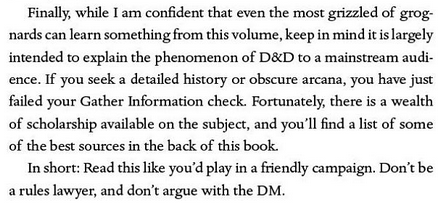
In closing he writes:

ODAM, p. 2

You read that as I do? Now he's protecting the "mainstream audience" from those evil grognards while snubbing the gamers as having "failed" in reading this properly.

But did they? The book claims to be "the history", not "a history", not "a short history", it's definitive. Nothing in the marketing actually gives any hint of this book being anything else but what it claims to be.

Anyway, he's (again) hinting the reader to go somewhere else. The last sentence, then, aims to cement his authority and advises to play it nice. It's funny, but if someone about participating in a game came at me as aggressive and divisive as that, I'd laugh them in the face if they ended it with "be nice to each other, this is a friendly campaign". Textbook passive-aggressive behavior, I'd say, and I don't care for it one bit.

This could (should?) have been done way more amicably. Easily. As it is, it starts the book off on the wrong foot, and every time he puts himself in relation to those (perceived) hostile readers, you'll see little stabs like that. Here's just a small selection:

  • says (as mentioned in the beginning) that others refer to a group of role-playing gamers as a "stink" (p. 56)*
  • explains how he's anxious to tell others since people have negative associations with the game, to a point where girlfriends leave (p. 75)
  • says gamers are a welcoming bunch, but then goes on to make an example how abusive gamers can be, alluding to something called "Arrogant Nerd syndrome", which isn't even a thing** (the story of Jonathan starts at p. 84) 
  • actually, this is worse than "just" showing how "abusive" gamers can be, it's inverting who's the victim here by saying that gaming should be a "safe haven" for nerds, but ostracizing them is understandable, because they can be, after all, difficult people ... and that's a shitty move***
  • he also dedicates three chapters talking about aspects of the hobby he doesn't like: traditional war-gaming, traditional role-playing and LARP, and I don't think he's giving them a fair shake just because it's not his thing ... more shitting on fringe aspects of the hobby

Let's leave it at that (see the footnotes for the venting). As I said above, it's written well enough, but what's showcased here is also evident in the whole book. Little stories and hints that seem innocent if encountered alone, but accumulate to something where the sum of the parts is uglier than the single encounters. A stink. Ha!

[Source]

Honest to god, I started reading this book to my wife, who's not a nerd at all, and she did not care for the tone of the book. I'm saying, it's not just me and it is important, imo, to highlight this aspect of the book before going into other aspects of it.

So what else is there to talk about? The history sections are excellent, from the very beginning of the idea of cooperative play in history, via early war gaming roots to the first conception of the rules that would become D&D and how that went viral in the seventies. All of that framed by Ewalt's gaming experience and intersected with gaming reports from when he started playing again (a D&D 3e campaign in a vampire apocalypse setting).

Mixed into that we get some D&D quotes, learn about some of the great minds of the hobby, now and then. Anecdotes, quotes from interviews ... Good show, and he runs strong with that until page 172, when Gary Gygax dies. After that, the book loses steam considerably, most of all because the history part of it is basically neglected. We learn how TSR fared after Gygax' departure, and how all of that ended in TSR being sold to Hasbro, but it's basically bullet points of names and dates.

It's just not where the development of D&D ended, or the cultural influence of it. It's just where the writer stops doing what he did well in the first three quarters of the book. We get more of the session reports and quotes and anecdotes, but even there Ewalt'll shift focus and introduce new stories. It doesn't always work, and that last third drags on until the author describes his pilgrimage to the origins of D&D and helps us see through his eyes what all the famous locations are now, which was a nice touch.

Beyond that, we get lots of fan-boying and shilling for WotC and the development of the D&D 5e, which I didn't care for. So, yeah, that's basically what you'll find in the book, without going that much into detail.

Awarding Experience Points (is it any good?)

A book can read well, but transport horrible ideas. Or better yet: it can hide terrible ideas behind a casual tone and a good reading flow. Not that ODAM is in any way, shape or form offensive, but it is "politically correct" while being uncritically vague and even favorable towards WotC and their business practices to a degree where boring just ends up being a vehicle for, well, advertisement or at least craving endorsement.

And sure enough, there are plenty of examples in the text where WotC is being presented favorably ALTHOUGH there is something to be said about the business practices of Hasbro and WotC in 2013 when this was published (the OSR was thriving back then for good reasons).

If not written in favor, that part of the history of the game is actually not present at all, instead we get a reference to another book for checking out the decline of TSR and nothing but praise for WotC "rescuing" D&D and moving on with the brand. No word on the counterculture movement and success of the OSR and the revival of the old editions ... Especially since he's obviously aware of "old gamers" and "edition wars" (as it is evident in the introduction).

And you don't have to be a "fan" to recognize this, but you have to mention it to cast a complete picture. WotC felt pressured to go back to those old roots because people turned away from 4e in troves.

At least Ewalt is honest about being an "ally" of the company and quite happy to support their drafting of 5e. He wants to be in on that action and is happy to be recognized as a "fan" by WotC. Even gets an invite, or so he writes.

All of that is problematic, in my view, as it goes against journalistic integrity to be biased like that, and "journalism" was claimed to be part of this "enticing blend". No xp for advertisement or networking framed as "journalism", I'm afraid (0/5).

[source]

History next. Those passages I enjoyed a great deal. It's well researched and cleverly put together. Lots of interesting trivia. The early years of the hobby sure as hell make for a great story, the good writing puts it to the next level.

But there is a huge stylistic shift after roughly 170 pages. The whole interplay between talking the home campaign (the narrative/memoir part) and the history of the game falls flat. The history part all of a sudden gets rushed and the home campaign gets neglected as well. With what is left, we go as fringe as talking about LARPs while important transition points in the hobby get ignored entirely or just mentioned very briefly.

The last 80 pages are full of odd choices like that, and I get the impression that the author didn't have the stamina to go it all the way (which would have ended in a far superior book, imo).

See, you can make fringe excursions if the main text has enough meat to carry a little extra context. This is well illustrated in chapter three, when Ewalt's talking about legacy war gaming (although I did not care much for the retelling of those battles). But when all the interesting bits fall flat (for instance, how the game developed beyond Gary's involvement), we are left with a boring mess of praise for Big Corp, at least three different session reports and an overall text that goes nowhere until it ends with a pilgrimage to something that isn't there anymore.

I have to admit, the end works for me. The whole idea of the tying the book together like that is nice, and my guess would be that it came up pretty early in the writing of the book. However, there are at least 150 pages missing, and that's a shame. Still, what's there is great (4/5).

Gygax, making history again ... [source]
Memoir and Narrative, now, are interwoven to form the skeleton the history is presented on. I liked bits of that, didn't like others. As with the whole book, it is all crafted by a skilled writer, but I still felt it lacking at times, especially when Ewalt tries to be non chalant about not liking his fellow gamers (the stink, it's an addiction, all being welcome means there are abusive people ... but I'm repeating myself) or blatantly paints an uncritical picture of those currently owning the game (WotC).

That said, I did like the idea of structuring the whole book that way (not the negative parts, but the private aspect of it). It works well until it falls short 172 pages into the book. And when he not tries to paint himself as "the gamer that isn't a gamer anymore but then falls prey to the addictive elements of it again and now plays a far more sophisticated version of the game", it is quite the engaging read.

Even the session report sections work most of the time. Again, until they don't because they have to carry the book in the last third while adding several additional new narratives.

Using this memoir/narrative angle, the book mostly manages to paint a picture of what the game can be and what its elements are in almost all dimensions (the roots, the social dynamics, how it plays, ...), and that's good, although not fully realized and with the caveats already mentioned (3/5 each).

Nice ass, though! [source]

In closing ...

When all is said and done, this is not "the" but "a story of D&D and the people who play it". The historic part is interesting and I wish there would have been more of that and not just the pre-history and the first 20 years or so. Our cultural dialogue with D&D is not over yet, as the latest WotC fuck-up about the license of the game gave ample evidence to gawk at.

Writing a 250 pages book (with only a third of that actually being about the history, if you take away the memoir/narrative parts!) and claiming there'd be no room to explore the history of D&D after Gygax left TSR just to avoid shedding a light on some "problematic" truths regarding Big Businesses Ewalt likes to associate with, is just bad style.

So how should we end this? Is it a good book in my opinion? Yes and no. There are so many shortcomings, masked by a well crafted book that reads well enough to actually work, that it comes down to a meager 2.5/5 (tendency towards the 2, after taking as close a look as I did just now).

The history part that is done, is done well and I enjoyed reading those passages. Learned something about the early history of the hobby, too. The rest was engaging enough for the first two thirds of the book and the last chapter.

What left a sour taste in my mouth was the blatant adulation for WotC and the constant (somewhat underhanded) misrepresentation of most the people that actually play those games as undesirable company. Add to that the missing history of the game after Gygax left TSR and a weak last third with a somewhat strong ending that would have needed a bigger book to work properly.

If that sounds like something you could stomach, you can sure go and get that book.

Let's see what Eric's saying about it (we coordinated publishing, but didn't read each others take ... what fun!): follow me there.

This has always been true ... [source]

* He just came up with it, btw., or at least I couldn't find an easy reference for it. People call their spouse "stink" or relatives, but not a group of nerds, as he implicates. At least not as wide spread as he'd make "us" (assuming a main stream reader? pleasing the WSJ buddies?) believe the term is.

** Try and google that, the only proper hits are referring back to his book, one making the (great!) point that he neglects talking autism in gaming while instead re-enforcing negative stereotypes again. Same pattern as with the "stink", all to make role-players look bad (or make it seem that they are perceived in a bad light). I think it's projection, but that's just my two cents.

*** I'll segue a bit into this in a footnote because I feel it's important: people are not socially awkward because they are assholes or abusive, it's because they are made feeling unwelcome and pressed into the fringes. And what happens in the fringes? Subcultures, which D&D is one of. Or was, it seems, given its popularity today. Anyway, point being, I associated with another subculture back in school, in Germany: the punks. And those had been REALLY socially awkward. For the same reasons. To now go and act as if those phenomena are just direct results of ones conduct instead of symptoms of something far more difficult to tackle (social dynamics of bullying and hierarchies and whatnot), is insincere. At best. "My people" have been excluded and ridiculed for a long time now, what Ewalt does implicates he's more like the people that didn't get along with nerds to begin with ... I wrote about this some time ago in detail, see Nerd Pride and Pop Culture going Full Circle.

Wednesday, January 25, 2023

Revisions Part 1: The D&D RC was never complete or finished

WotC tries to be a moving target in a bullet storm right now. Whoever thought it was a great idea to ACT as if a document that needs recourse to legal advice can be open to public review just by calling it a "playtest" to associate it with some sort of development process in gaming, must think gamers are GULLIBLE enough to actually think they are involved that way and not just shut up. And if you did their survey and believe it'll have any value to WotC, then I have a bridge to sell you might be interested in. In other words: revision your work away from that bullshit. I'll do just that! 

Edit 28JAN23: I stand corrected, and I'm proud of all the fans standing up protecting D&D. Good show! The dragon is sleeping again ... I'll just say that we have no way of knowing if they actually looked at the surveys. It's actually still a bit ridiculous to assume they did, as what they are saying now is EXACTLY mirroring the original first response: the OGL 1.0a cannot go without lots of hurt for WotC. That has been clear from day 1. To claim now it's the survey from last week, well, it's disingenuous. Either way, it is the result that counts! Big Corp still sucks :)

I never used the OGL

I always found it suspect that something that isn't protected by law (like rules) needed a license to begin with. A lot of this is lawyer speak (think: smoke and mirrors) to widen the grey area for the corporation to act in, and that was pretty obvious from the beginning. If you make it your own, it is, by the same logic, your own and someone else may rewrite it and use it just the same. Them's the rules ...

Now, the main problem with Big Corp thinking in this very special situation is: they want to deviate from what they claim "stewardship" for (a term that only came up just now, and it is ludicrous to believe something like that might be compatible with a hyper-capitalist, neo liberal locust-think), well, they want to deviate just enough to act as if they are selling something new while keeping the old barred from any further use. The illusion of infinite growth colliding with the open source mindset ingrained deep into the original game and its first couple of iterations.


WotC be like ... [source]
We have seen over the years how they tried to mutilate the original game to get some resemblance of the D&D theme park they are trying to have you pay for ... forever and ever. This latest stunt is a reminder not only of the incompetent greed involved in this whole affair, but also of what your worth as a customer is with these guys. Shut up, do as your told and pay for it, too, while you are at it. It is not about "stewardship", it is about interacting commodities (and yes, we are also commodities in this regard ... for them, anyway).

So I avoided the waters those sharks frequented, and that included avoiding their OGL. What I did, however, was licensing Monkey Business with Labyrinth Lord, and they are licensed via OGL1.0a (as far as I know). So that's still protected under some legacy rulings. Or whatever ... Still, MB needs a revision anyways, and with be67 as far done as it is now, that revision will be a conversion to my own game.

About the RC being unfinished ...

We always said that the D&D Rules Cyclopedia is the most complete D&D book out there. That is still true, it is just a very low standard to have, because that book was only as complete as they could make it. It's open for debate if an "official" revision of what was offered back in the 90s would even be possible, so it is what it is, and it will most likely stay that way.

When I started compiling be67, the first thing I thought I would do was setting it up as a module to alter Labyrinth Lord, which is, of course, a CLONE of the Basic Expert rules and therefor in the same family of rules as the D&D RC. It didn't take long to realize that making be67 its own game was not only just a couple of steps more to take, but it might become necessary as well, because it was so very much its own thing (hence, a MUTANT rather than a CLONE).

Unconditional love? [source]
So I went for writing a complete game, which made it necessary to take a very hard look at the source material, if only to see what a "complete" version might entail. The first insight gained from that was a reminder of the damn scope of the RC. It is huge. Decades worth of playing it just once in its entirety.

The second insight was how much of a patchwork job it actually is: Weapon Mastery and Skill System are incomplete, lack proper editing and are definitely at best minimaly tested additions. It is full of little oddities that show what a hard job it must have been to compile all of that into one book. In the 90s, no less. Bits and pieces don't fit or are incomplete. Encounter matrix doesn't completely match the monster entries and while there is a lot of advice how to do a lot of what the book offers yourself, it left some huge parts unexplained (how to prepare proper dungeons, for instance).

What's more: once you take a REALLY close look, you'll find that it ALL connects just very loosely, as far as the numbers are concerned. Some of it is just copy/pasted and then expanded on without revision (or just checking if the math is right). How the original design connected is a black box, most of the time. The whole "race as class" discussion is a great indicator for that. Looking at the design it becomes obvious that there is a underlying logic to the classes offered in the book, with some of them offering some ideas where to go with that (druid and monk come to mind).

If you understand how that works, you can build every class you'd like, race is just a feature of that process. One more aspect to add. There is a chance for this to be so open, it'd allow complete customization of all aspects of the rules. It just was never done.

And fair enough, you don't have to look under the hood to play the game. But you have to when you are writing your own. Turns out, reconstructing that "black box" that is the original design will have you end up with something else entirely. And the deeper into the design the changes are, the bigger are the implications for how the game manifests on the surface. Especially if you gear it towards another setting, as be67 tries to do (Weird Sixties Grindhouse ftw, people!).


If I try to explain how monsters relate to challenge rating so a GM can potentially diy the shit out of it, I have to write that myself. If I want the GM to be able to build their own classes, I'll have to come up with something myself, because it doesn't exist in the original book. If I want to connect the numbers the game produces with how to structure adventures, or campaigns even, I have to do that from scratch, as the original book doesn't offer that ... And so on and so forth.

In that sense, the D&D RC is a very unfinished and incomplete book. Luckily so, because if they aren't able to connect all those dots, and a designer is to find their own solutions, there's no way they can claim it to be theirs, just for the tranparence of it all.

As a matter of fact, I'm not sure they are even able to entangle what has been the originl design and what has evolved because of fan or hobbyist initiative. The D&D RC, following that logic, was a very specific interpretation of one specific strain of the D&D family of games, already incorporating not original design, but concepts, insights and ideas established elsewhere (not only from the fan base, but also through many, many other successful rpgs out there).

An incomplete patch work that cannot be true to the original design due to being exposed to external and uncontrollable influences and bases its design on some unknown and obscure metric, barely makes a good argument for being protected by any means. In my opinion.

DIY, all the way ...

As things stand right now, it doesn't seem safe to associate with the D&D brand even superficially. Therefore, all publications I can manage to put out here in the next 5 months will deny all connection to the source other than it being inspiration. I'll be open about how it all connects, so it will be my very own take on some of the same principles established so many years ago. A retroclone mutant, if you will.

There is freedom in going it all the way all alone (and I might not be alone, actually). We'll see if I can claim be67 to be part of the OSR family or not. It's all still easily enough hacked and connected, but that's just something tainted now. What you guys do at your table is yours to decide, naturally, I just can't believe that it'll be open discourse from now on. At least it's not safe to assume so right now.

We'll see.

Right now, WotC tries to play it for time while funneling critique into non-existance, but the damage is done and gears started moving all over the place. Interesting times.

In closing I want to share a double page from be67 that took me a long time to complete, for the reasons I stated above. It might need more context, but I think the basic premise is easily enough grasped: it is a dynamic random encounter table that should help propelling the narrative in a way forward that supports the Grindhouse Feature the GM has prepared. Here we go:

Isn't she a beauty? Anyway. What I'm trying to say and show here is that be67 will not only be its own thing, it'll also be "complete" in a sense that there'll be no part of the rules that's not so throroughly and openly connected, that you'd have to guess why it is the way it is in its context. The above in part of a little machine that'll allow a GM to always keep the game within the parameters it establishes. with very little bookkeeping, I might add.

And that's that. If you've published something that may be construed to be close to what the Wizards do at that Coast, my advice would be to revise the hell out of it and build as much distance to those greedy fuckers as possible. I'll definitely do that.

And if you are in it for what I'm trying to do here, I hope you'll enjoy be67 as its own thing, just as much as you'd have while I could have associated it with the origins of the hobby. The hint needs to be enough.

Take care, friends and neighbors. Thanks for reading!

Friday, January 13, 2023

Lots of Ducks, no Row (and a Gallery of Dreams) ... not a rant

 Third Take: It'll be all right. The Wizards will get a bloody nose, hopefully painful enough that they see a need to get rid of some of their upper management ... That said, fuck them. Seems like it'll be a chance to free the core of our hobby a bit more and people actually seemed to come together, which is great. It'll also open the eyes of some new to the hobby, and they will look for alternatives. All the better. Feels like a net positive, so far. I'll leave the original second take up, altering it at places a bit. The short of it is, we here at Disoriented Ranger Publishing will get at least three brand new rpgs out there in the next couple of months. We'll be trucking on.

[Source]

Second Take: Happy New Year, friends and neighbors! Imagine the vilest rant written on the current "OGL" kerfuffle. All snappy and on point, making no prisoners, cutting prose ... all of that, cursing those damn wizards for generations. A rant so harsh, google crawlers would stop for a Milli-second to consider if corporate greed has finally gone too far. Imagine all that, imagine me scratching it now, sucking it all up with all its weapon-grade toxicity and spitting it out again to ... write this instead.

What a start, right?

So Hasbro tried to change the OGL to a shakedown scheme on a Friday the 13th ... The nerve on those fuckers is unbelievable. Gotta say, I was riled up for a second there. Then again, by now it is pretty clear that Big Corp likes to act all sociopath, the clear distinction to psychopath being that Big Corporations are a clear product of society. We let it happen. We created those monsters. Now we have to fight them. Same old ...

Look, if you know the blog, you know my stance on this. Original D&D is as close to being "cultural heritage" as we can get in western civilization, considering its societal impact. It was never a good match to corporate greed. They can just fuck off. And they will, eventually, when they fucked what is now a "brand" instead of a "common good" into the form they envision: a theme park with a money printing subscription scheme where you own nothing of the content or the rules and be happy about it.

Sounds familiar? It should. It's what they ALL try to make happen, for years now. Microsoft is doing it, Adobe is doing it, Big Pharma is doing it, Disney is doing it ... all the same, all over the place. Stream your movies, you don't have to own them. Read e-books, who needs physical copies?! And your games are digital already, you don't even need to install them anymore ...

It just costs you all the time. And they want to know EXACTLY what you are consuming. Because you could be a bad [consuming entity] and CHEAT those good hearted corporations of their money! So, no privacy. For sure. You have nothing to hide, right? So what's the problem?

[Source]
 

You know what? They also want to tell you what's best. They've done the work, for sure, so there's no reason for you to think on your own ... And on, and on, as if no one had ever thought about this in the last couple of decades. As if all those problems are new. They aren't, and the answers to what overreach and exploitation mean and where the limits SHOULD BE have been clear for some time now.

That said, Big Money does as Big Money does, people do as people do. Now we'll have a little drama, it'll happen something akin to a compromise and the next push is around the next corner. People don't learn, or they have learned already.

But where does it put you and me?

So many ducks ...

I have, over the years, written and published some things here and there. A great deal of all of that unpublished stuff is done to one degree or another. So instead of lamenting corporate greed, I should tell you a bit about what I've been working on. Maybe you see something you like or didn't know about (or maybe feel inclined now to check out?).

All of you should be aware of Monkey Business, the Labyrinth Lord adventure module I published years ago ... Overall positive reviews, lots of material to look at and use. No OGL, but agrees to the Labyrinth Lord license, which is connected. So I might have to put it down if I'm told to when I'm told to. Needs a rework anyways ... Until then, for sure a pdf worth purchasing!

The Pitch: The heroes in this huge procedural sandbox are confronted with sentient apes selling a powerful drug in the jungle. Five factions, random ruins and treasure and cannibals. Includes a beautifully hand-drawn dungeon map and enough material to run a massive and weird jungle campaign!

You all should have heard about ORWELL by now (a dystopian rpg with a satirical bend that tackles EXACTLY the contemporary bullshit we are getting the Hasbro treatment of right now ... just saying). I'm mighty proud of that game. You should buy it, play it, and tell your friends. Be the first to do so! Because so far, very few cared :)

The Pitch: The year is 2081, the United States of Europe (USE, for short) are ruled by one, corporate owned party called The Family. The Family measures of control include industrially produced children (already indoctrinated), declaring puberty as illegal and drone supported mind-reading cyborgs called "Bias Judges". It's basically "CyberPunk goes Peter Pan" with an anime twist or two ... Reads like a dystopian nightmare, plays like a grown up version of Paranoia, with just as much laughs.

I furthermore started publishing a collection of my favorite posts here, slightly edited, sorted by topics and with a nice layout. Third part has just hit digital shelves at drivethrurpg.

The Pitch: It is a small wonder that blogger still exists as an option. It is weakened and watered down, but still around. That those things can change within weeks is what the whole OGL affair proves easily right now. Hence the pdfs, hopefully with a PoD version soon, too. So this saves and conserves my efforts in the last 10 years.

three more to go in this regard, and good one, too!

I aim to publish at least 3 more games this year. One of them, be67, was written with OSR retroclone compatibility in mind. As a matter of fact, it was thought as a gimmick to be able to decosntruct the whole game towards BX. Can't do that anymore, so it will be rewritten and it'll be its own thing. Sucks, but can't be helped. in the end, however, I will have my own little OSR Mutant, with lots of possibilities to build on. For instance, Monkey Business 2.0 would be entirely be67, then!

The Pitch: be67 is a rpg set in the Weird Sixties and plays like a grindhouse feature. It's gonzo, it's brutal, it's funny ... and it features seven fine classes for the genre that all can go up to level 30, all with providing the tools for epic campaign arcs and fantastic adventures! All my future adventures will be based on this system.


The next one I'm working on is the editing and publishing the first DRP game that's not written by me, but by my good friend Mark van Vlack! The name is AMAZING ADVENTURES / INCREDULOUS EXPLOITS and it was conceived as result of the fun challenge (Mark put on himself) to write a fantasy rpg where EVERYTHING is random. Characters, Adventures, Monsters ... all of it, all analogue. And it worked like a charm. A couple of year later he made an updated version of the rules for games IN SPACE and just last year he finished drafting an omnibus of all of it: the RANDOMNOMICON. I love all of it, and asked him, if we could join forces and publish it via DRP. He agreed, I'm right now in the process of collecting artwork and editing that 500 pages beast and I promised him that he'll have something to show for Christmas 2023!

The Pitch: Fantastic for one shots, extremely flexible with its settings (Fantasy, SF, Science Fantasy ... all in between), with a huge array of tools to create everything from monsters to dungeons, villages and space ports (among other things ... this game is HUGE with tables of all kind). Rules for magic, for psychic abilities, for mutations, anything you could imagine, really. Literally decades worth of gaming material and highly customizable.

That third game I was hinting on will be a rules lite attempt. Something with fast rules and some odd design angles I'm exploring right now. I've talked about it before over the years, and the FINAL name of this project will be BRAWLERS. Dark fantasy with a steampunk twist (I call it DungeonPunk) in which a group of dubious characters go on heists for Petty Godlings. Robbing monsters for fun and profit. The game will use dice and cards, missions will be generated procedurally ... 

The Pitch: Live is cheap in the Victorian world of DungeonPunk. Corrupting humanity was easy enough, now the Monsters are in charge. Not that they changed that much, but they take what they want. And so should you, punk. The world lies in ruins and is yours to take. A club is cheap enough, take one and go for the dungeons. Killing is easy enough, you see that every day on the streets of the slums you call your home. Take your friends. Who else is going to cover your back? If the authorities are coming for you, let them feel your anger. If you're lucky, they'll fear you someday in the future. If you live that long. Now go and loot. Gold can buy you a new arm, a magical sword even or a shiny new armor, but eventually it will buy you freedom. And always remember: a Crowscare will stitch you together every time, but a Whisperer will make you better. 

For the rest, I'll just let pictures talk ...

A SF variant of Brawlers!

Long overdue ...

Maybe those compatibility claims end up changing ...

Let's leave it at that? There's still lots of work to do, and some things had to be put on hold (Robo-Hitler, for instance, has ways to go in areas out of my control). I'll work it all over the coming months and we will see what happens.

We are going to be all right ...

I am a small light in that circus. No reach or influence at all. Those Wizards won't bother, I'm sure. However, I depend, to a degree, on a somewhat functioning market around me so that I can at least present my wares to some potential customers. We saw that threatened in the last couple of days. Again, and this time with more gusto than usual. I will not forget this and it must have consequences. 

Anyway, I hope you guys will check out some of my entries and have fun doing so. There is more to come! Turns out, I take 3 to 5 years to finish a game. No scene seems to be that stable. All the time I take to establish myself in one takes away from what I should do, which is writing. So I won't bother taht much anymore. I will keep blogging, but I might have to find ways to monetize all of it (the blog will remain free, but it might get an option to give me some moneyz).

As I said, it'll be all right. The scene is already adjusting, and Hasbro likes money more than they do their politics. They will have to compromise, people will adapt and prepare, and some day, maybe, D&D will be free. I hope to live to see it.

And a final word about that game it is all done for: LOST SONGS OF THE NIBELUNGS ... It WILL happen, as soon as I have managed to take all the obstacles I think I need to take to make this the book I want it to be. I'll take that time.

That's it. That's my piece. Took me long enough. this year might see some more surprises here on the blog. Things are moving in the background :D Stay tuned, stay happy, stay healthy.

Love

JD