Showing posts with label The Cleric. Show all posts

Saturday, May 16, 2015

State of mind, state of projects (Goblintribe-Simulator, S!A!C!, Lost Songs, Community Projects ...)

Since I'm right now up to my elbows in various projects here on the blog, I thought it's about time to give you all (and myself ...) a short summary of the state of affairs. I'll try and keep it fresh (or at least short).

The Analogue Goblintribe-Simulator:

It's developing slow, which is a shame, since it got quite popular and I fear loosing the wave here. I will dedicate a weekend in May pushing this forward. Here a glimpse of how that sheet is filling up:

A "0" indicates a place for a die, there'll be different forms of storage and you
see the angry/happy scale somewhat improved ... lots of stuff to discover if
you knew the last incarnation of this thing. This is still happening :)  

The idea to use a deck of cards to build a dungeon got quite some legs. +Eric Nieudan and +John Payne took the ball and came to some great solutions in this regard (check here and here). I love it when those things happen. It's all far better than anything I could come up with.

Anyway, that's not what S!A!C! - Combat is about. Instead it's about cleaning random space stations from alien scum. And how far am I in finishing this baby? Well, I need to test it, that's how. The girlfriend and I are trying to make a test run happen, but no luck so far. We'll find the time this weekend, I'm sure. What I could do until now (it's what needs testing ...) is streamlining the combat as far as possible.

So instead of having armor and health, you have just one stat and loose action points as soon as you drop below 10 (when wounded you get slower). I came up with an idea to make firing a gun a bit more than using a die and bookkeeping ammunition (I think it's a dull exercise to keep track of those things).

What happens now is that each clip is a d6 and if you hit the target (roll d20 above card number, 11 is a true hit), you loose as much ammo as you rolled above the target number but never more than a d6 (this way you just change the die number or just take the clip from the sheet). If you miss, you roll the d6 to see what's left in your clip (keep the number you rolled and a 6 means the clip is emptied). We'll see if it holds in play-testing.

Another little problem I have is with what I call "Card Intelligence" (C.I.). How should cards move and all that. Should they move towards the player or take cover and let them come?. Again, we'll be testing all this the next few days.

Lost Songs of the Nibelungs:

We are still testing this in our Friday group and it's still developing further and further. Combat is getting somewhere but still not at a stage worth writing home about. Magic is a big gap and I need to do something about that soon, but level advancement is more important right now, as the players are already asking for it (not surprising, three sessions in).

I think the most important development so far is how ability scores are handled. Everyone starts more or less the same and the narrative (fate) decides how characters are shaped. Organic character growth, if you will, mixed with a level-based advancement system that allows some freedom in how a character develops in that regard.

Character creation takes 5 minutes and still creates unique snowflakes individuals.

In my head it keeps manifesting more and more. So much even, I'm way behind in writing this stuff down. And it's not just one thread either, but at least three sub categories that need updates. Let's see:
  • Reading the Nibelungenlied: Will take time. I might even switch to writing about each chapter in a separate post. The first post was received quite well, as far as I could tell. We'll see if I can keep people interested, but I think it's a great story with some beautiful verse and really very much like a session report of sorts.
  • Bare-Knuckle Fighter/Pub Brawl (the mini dice-game series): A bit neglected on the blog, but I test this stuff as often as possible. What needs to be happening is a complete re-evaluation of how the rules are presented. I got some ideas and I talked a good friend of mine into writing a guest post. As soon as this happens (or I know for a fact that it doesn't ...) I'll start with the updates and give this stuff a permanent home somewhere on the blog. I plan to make similar mini games for magic combat and armed duels. All of this should in it's final stage work as a skirmisher and I still plan to use this combat system for lost songs. It will take time, though.
  • The Lost Songs Page here on the blog: Needs updating. ASAP, as they say. There are already lots of strays to collect and put there. Also need to do some work on the logo. Ah well, it will happen soon enough.
  • Loose ends: Level advancement will be the next thing, but I'll start talking about layout and design of the game very soon. DM procedures will also be a topic in the near future. What I have in mind here is a method using 3d10 to generate a fully developed region for the characters to explore. I have some vague ideas how to make that happen, but all I can say is that it'll happen some time this year. Which is a shame, really, since I think it will be great fun exploring some old ideas further ...

Lost Songs is a big project and will most likely expand in many more directions I didn't think of right now. Being a weekend blogger doesn't help with all that either. I need to have some food and shelter, though :) Anyway, I'm getting there, step by step.

Community Projects

As of this writing I'm participating in two awesome community projects. Both were initiated by +Charles Akins over at Dyvers. The first will be about revenge, murder and mayhem in role playing games. I aim for two entries in this: one will be my first attempt at short fiction here on the blog and the second is a surprise (as in: no idea ...).

The second community project is about writing love letters for role playing games. I really love that idea, as it will collect a huge amount of essays about the games out there and what makes them special. It'll also get a pdf release and I imagine it a great help for introducing new people to the hobby. If we can spread it that far, which I really hope.

But look at the line-up linked to above! It's 5 names short of a Who's Who in the OSR, so it's sure to generate some noise. My entries will be the D&D Rules Cyclopedia and HackMaster 4e. Both are a big deal for me and I'll do my very best to do them justice.

So far it's been a great experience working with all those creative writers. As those things usually take lots of time to come to some sort of conclusion, I wouldn't hold my breath waiting for this to happen very soon. But it will happen eventually :)

Smell what (else) the Ranger is cooking!

Yeah, sorry, there is more. I'm going to take a close look at the blog and check it for loose ends. I need to come to a point where I actually finish the things I've started. Right now I'm thinking of one adventure and a series about clerics that need finishing/reactivating. I'll do this whenever I get the feeling I need some variation in what I'm writing about at the moment.

I also want to start doing interviews around the blogosphere to learn more about the people I read so much on a daily basis. A first shot on this will happen soon, featuring the great +Adam Muszkiewicz, finding out who he is and where he's going (if you for some reason never heard of his fantastic blog Dispatches from Kickassistan, go and check it out - you're in for a treat).

If it works, more of the same is going to happen on a monthly basis (I think).

And there is a vague idea to write about great old school products out there that people already lost out of sight (like this great D&D supplement by Cygnus, for instance). But it's just that for now, a vague idea.

That's it, folks. A lot is happening, it's just not happening fast ...

A picture of an OSR logo by Matthew Adams, because
it's fantastic and for other obvious reasons ...


Sunday, February 8, 2015

An Expanded Petty Gods cult-preview: Way of the Shroom (with some bonus Shroom Wisdom)

I got the chance to write a bit more about King Shroom (link is in the preview), one of my Expanded Petty Gods entries (one of two, to be precise) and thought I'd share the result as a preview (did ask if it's okay, too). For all those unaware of it and reading this (couldn't be many, but anyway): thanks to +Richard LeBlanc the Expanded Petty Gods community project is in its final stages right now and we can expect to see the final product some time next month (March 2015). It will be a massive tome with close to 400 pages full of great ideas and lots of fantastic artwork. I really can't wait to get my hands on it!

 +Greg Gorgonmilk deserves a honorably mention here,
since he initiated the original 
reboot of the project. Thanks, man!
Please, enter the weird:

Way of the Shroom

The Way of the Shroom is a philosophy associated with cults formed by mushroom eaters all over the known worlds worshiping King Shroom, the Patron of those indulging the mind-expanding qualities of certain shrooms, aka Cannibal Godspawn of Mushrooms and Devourer General of the Lizardwars.

These congregations of like-minded enthusiasts are, due to their diversity and strange behavior, often enough dismissed as random phenomena. But this might as well be intentional and some scholars argue that even a random or accidental consummation of psychedelic mushrooms may somehow be part of King Shroom’s weird schemes to activate a devote following in a specific area for some bizarre reason or another (see King Shroom post for specifics).


True Priesthood


To become a cleric devoted to King Shroom a follower has to forsake his physical body and embrace the world of the shroom. A ceremony to this end involves a deadly overdose of poisonous mushrooms in a remote area prone to mushroom growth. The decomposing body will then feed the fungus network and form, in time, a new body for the follower’s soul to inhabit and with the locale of his initiation as his chapel. This is the only known ritual to fully divine the Way of the Shroom.

In his new form the cleric may move freely among the fungus network of his holy site, dissolving it in one place and spawning it within minutes at another. He’ll also have the ability to camouflage himself as a group of mushrooms, effectively hiding his presence 95% of the time (the change takes 1d6 rounds minus the cleric’s level, but at least 1 round).

He’ll furthermore have the ability to regenerate any damage he sustains at a rate of 1 hp per level per round and may regenerate his whole body within a day if fertile ground is available by releasing spores shortly before his demise. Those spores remain dormant in an infertile environment until the opportunity arises to travel somewhere else, for instance on the clothes of some adventurer or the fur of an animal passing by.

For all other purposes this new body functions and (almost) looks like a normal human body.

Spells are those appropriate for the cleric’s level, but the fungoid nature of his clergy has a way of twisting the effects of said spells. Healing spells, for instance, come with a (rather harmless) fungus infection that goes away after a period of time equal to the natural healing process of the wounds treated. The dead would be animated by mushroom roots replacing the nervous system of a corpse and a blessing might have rather psychedelic side-effects.

Priests of the Shroom have access to all kinds of mushrooms and love beer above everything else. They are by default under the influence of very strong psychedelic mushrooms (being cannibals, of sorts) and their sermon is (at best) opaque for those not seeking the higher enlightenment of the shroom.

Holy Sites of the Shroom

Mushroom groves are places of worship. If a cleric resides in such a grove, its size will be related to the holy man’s level. Although high level clerics are very rare, their cathedrals would be vast mushroom forests, with fungus networks spanning even further underground.

A cleric is aware of everything that happens within such a network.

There is a 10% chance per level (every new level allows a new check) that such a grove attracts 2d4 giant crickets, whose eerie choirs then haunt the site every sunset, praising mighty King Shroom. In times of war a number of [cleric’s level] times d100 Fruggar (see +j garrison's entry for the EPG on his blog) will defend the temple under the clerics command.

Apologizing to a mushroom one stepped on by accident when visiting a shroom temple is totally appropriate.


Symbiotic Priesthood


On rare occasions (chance 1 in 8 in a situation involving mushrooms) King Shroom might “lead” clerics of other faiths to the Way of the Shroom by facilitating an accidental psychedelic experience. The cleric will then in his intoxicated state see the true wisdom of the shroom and act towards the King’s agenda. Not that anyone would understand what’s going on. Even a cleric’s true god would most likely assume that the resulting strange and erratic behavior is just the result of some ill-advised quiche (chance of 1 in 12 to realize what’s going on).

Enlightenment follows (artwork by +Richard LeBlanc)
King Shroom controls how long the cleric will be hooked and will release the cleric as soon as he has fulfilled his purpose. Sometimes he forgets, though (chance of 1 in 20).

Some say the Lizardwars started because the Cannibal Godspawn made a lizard shaman cook an omelet out of some dragon eggs he was supposed to protect, binge-eating them with a smile afterwards. But that is highly disputable. Anyway, the lizard ate the eggs, maybe it started the rumor, too.

Shroom Wisdom

“Never tell a bear who ate the wrong mushrooms about his purple fur, but ask him for relationship advice instead.”

“A rose is but a pimp anyway, although the lizard disagrees, licking its thorns in disgust.”

“Rejoice! You are fermented! Now bicycle that yellow.”

“Cellar door.”

"The Shroom abides." (bonus)

"You don't choose the Shroom, the Shroom chooses you ..." (bonus)

Sunday, June 22, 2014

There are Square Meters on my Chart! (Sanctuaries and Believers Edition)

Did you know that a hexagon with a 10 km flat-to-flat distance covers a surface area of round about 866 square km? Yeah, it's an odd number. But on the other hand, if you were to take a number easier to the eye, you'd end up with strange numbers for the distances on the maps we use, right? But do we need distances on our D&D maps? Is there a, well, let's say pseudo-realistic approach worth using other then the plain old idea of using hex maps with a fixed distance of ... yeah, of what of exactly, to be honest? Flat-to-flat distance? Corner-to-corner distance? And what does that mean again? Where is it helpful? Where is the altitude? And how does it affect the distances on a map, for that matter?

What I'm trying to say is that I understand the appeal, but never understood the value of "old-school" maps. Frankly, in my opinion it's utter bullshit crap a relic.

Maps are lies!

Every cartographer will tell you this, maps never reflect reality. They might help you navigating an area, but often enough they'll just betray and mislead you. Nothing to do about that but to accept it, I guess. But what does it mean for the game? For our understanding of how it's to be played and presented? My answer to that would be that if a DM were to fully understand the system, if he is to make it his own, he'll (A) either ignore the discrepancies (which is a time-honoured tradition) or (B) he'll try to get to the bottom of this and develop his own system from scratch (which is a crazy huge amount of work ...).

Let's not ignore this and go for (B)?

Any solution to this problem would be, as anything in this game, an individual one. And it'd go far back into the early mechanics of the game: the war gaming roots. As so many other rules that just got copied and pasted from edition to edition of the game, the idea of moving pieces over a map (and all the baggage it brings forth, like movement rates and flat 2d dungeons or 5-foot-steps, you name it) is, in my opinion, one of the great annoyances of D&D that just can't die out, but instead spawns ever so many new ideas, expanding that nonsense.

To counter this one would have to go back even further and think about what a role playing game is and what it tries to accomplish. This is, of course, where it gets tricky. Arguably, what back in the day inspired the idea to have single characters instead of army units, was the desire to experience individual story lines. The game emerging from there on used as tools what ever was available, that's where the wargaming heritage gained some mileage.

I think one of the reasons why those rules still exist and keep on trucking is the false assumption that the illusion of accuracy - as far as measurements go - an essential part of a fair game is. Anyway, far more expedient would be to see what happens if those parts of the rules are dismissed that have their origin in the idea of anything related to rules regarding distances in D&D.

What the DM needs to know ...

Any role playing game lives from the information available to the players. Not the truth of that information or it's accuracy, but it's usability is what makes it spin a narrative at the table. Let's say the players want to travel north through a wilderness and ask for the way. A local ranger tells them the easiest way to go by using local landmarks and how much time they'd need in his experience to get there. As easy as that. The players won't need more information than that. If anything, more would only cloud their judgement.

The DM, on the other hand, should make sure that his data of a gaming world is as much as possible derived from actual game mechanics, not from arbitrary assumptions and decisions. He'll need some house rules for that ...

So why are there square meters in yesterdays post?!

Cutting a long story short, to be true to my assumptions and produce yesterdays chart (which, I now realize, needs to be updated, because I didn't get the numbers right ...) I'd have to make some rather unorthodox decisions. Or better yet, connect some old ideas I had since I started writing this here blog.

As far as those square meters are concerned, my main inspiration was a post I wrote about monster territory back in  May 2013. Mainly this chart:


So for the area of influence I'd go as per the above formulated rules and add all the radii in correspondence with all the levels associated with a specific shrine (the smallest shrine is level 1 (2 meter radius) and has a level 6 cleric caring for it (plus 60 meter radius), resulting in  the (now correct) 12.076 square meters (pi times (62 x 62)) or approximately the area of a Manhattan City Block according to The Measurement of Things or, taking a tenth of that before going for the area, 120 rooms in a dungeon environment.  Sounds about right. Right?

True believers

The next hurdle was to find a ratio for how many true believers should be expected for a cult. Main source of ideas for the result was a post I wrote about settlements back in July 2013. I decided to go for the sum of all the levels of clergy and shrine a cult had to offer as the number of D6* (D8) rolled (level 1 holy site (shrine) and a level 6 cleric means 7d6 true believers).

Sanctuaries

What is needed to get a temple build is a level 9 cleric and lots of gold (like in that other post about careers I wrote back in July 2013. And you'd have to start somewhere to build it, say, with a shrine. A shrine could become an altar, an altar might become a temple, which could become a cathedral with time and, given the gold to achieve this is paid, could end up becoming an extremely popular holy site (like Mecca). Some of those ideas started a few months back and I wrote about it here

All those ideas and assumptions together result in the following table (it also gives an impression where I aim to go with the 2d6 part of that idea ...):
----------------------------------------
Sanctuaries and Believers

Level         XP     Status     # of d6* believers with 2 to 9 HD (or level)**
                                  2   3   4   5   6   7   8   9 ...
  1            0     Shrine       0
  2        2.000     Shrine       0
  3        4.000     Shrine       1
  4        8.000     Altar        2
  5       16.000     Altar        2   1
  6       30.000     Altar        2   2
  7       60.000     Altar        2   2   1
  8      120.000     Altar        3   2   2
  9      240.000     Temple       3   3   2   1
 10      360.000     Temple       3   3   3   2
 11      480.000     Temple       3   3   3   2   1
 12      600.000     Temple       4   4   3   2   1
 13      720.000     Temple       4   4   3   2   2
 14      840.000     Temple       4   4   4   3   2
 15      960.000     Temple       4   4   4   3   2   1
 16    1.080.000     Temple       5   5   4   3   2   2
 17    1.200.000     Temple       5   5   4   4   3   2
 18    1.320.000     Temple       5   5   4   4   3   2   1
 19    1.440.000     Temple       5   5   5   4   3   2   2
 20    1.560.000     Cathedral    5   5   5   4   4   3   2
 21    1.680.000     Cathedral    5   5   5   4   4   3   2   1 ...
 22    1.800.000     Cathedral    6   5   5   5   4   3   2   2 ...
 23    1.920.000     Cathedral    6   6   6   5   4   3   3   2 ...
 24    2.040.000     Cathedral    7   6   6   5   5   4   3   2 ...
 25    2.160.000     Cathedral    7   6   6   5   5   4   4   3 ...
 26    2.280.000     Cathedral    7   7   6   6   5   5   4   3 ...
 27    2.400.000     Cathedral    7   7   6   6   5   5   5   4 ...
 28    2.520.000     Cathedral    8   7   6   6   6   6   5   4 ...
 29    2.640.000     Cathedral    8   7   7   7   6   6   5   5 ...
 30    2.760.000     Holy Site    8   8   7   7   7   6   6   5 ...
 31    2.880.000                  8   8   7   7   7   7   6   6 ...
 32    3.000.000                  8   8   8   8   7   7   7   6 ...
 33    3.120.000                  9   9   8   8   8   7   7   7 ...
 34    3.240.000                  9   9   9   8   8   8   8   7 ...
 35    3.360.000                  9   9   9   9   9   8   8   8 ...
 36    3.480.000                 10   9   9   9   9   9   9   9 ...

*D6 for shrines, D8 for altars, d10 for temples, D12 for cathedrals and D20 for Holy Sites.
**Sum of all levels of a Church's active clergy plus the sites level as the number of dice, use a die according to the status of the site (as described above). Part of the result might be NPC with more HD than 1. The listing above shows how many of those higher level NPC are part of a faith and how they are distributed among that number (inspiration for this was the number of spells available per level for magic users ...).
----------------------------------------

This should be enough for now.

So all the above needed to be done to produce yesterdays post. And then some. I'm still struggling with some of those ideas and I'm far from finished. But I hope I managed to gave those interested enough to read all this up to here a somewhat comprehensive and understandable impression of what I'm trying to do here and how I came to the decisions I made so far to get there.

I'll expand on those ideas as soon as I have the time to do so :)

Saturday, June 21, 2014

Instant Church Hierarchies Part 2 (1d6 variant for cults)

[So I had to edit it, because I got the numbers all wrong, darnit. Now all is in order, sorry for that, folks ...]

So I crunched the numbers and tried to summarize all this in a table to make it more accessible. It's part of the larger idea, but works fine on its own.

Roll 1D6 and interpret result ...


Here is a link to part 1.

Further explanations will follow tomorrow.

Thursday, February 27, 2014

Instant Church Hierarchies Part 1 (and yes, I see the irony)

I was talking about this end of last year (looky here or see down below). Some people thought it interesting enough to discuss it somewhere in the internet as potentially promising, but not enough. True that. Well, it's about time to finish what I started. So here's a more serious take on the subject. I'll start with some basics and reiterations and will close the first part with some easy examples.

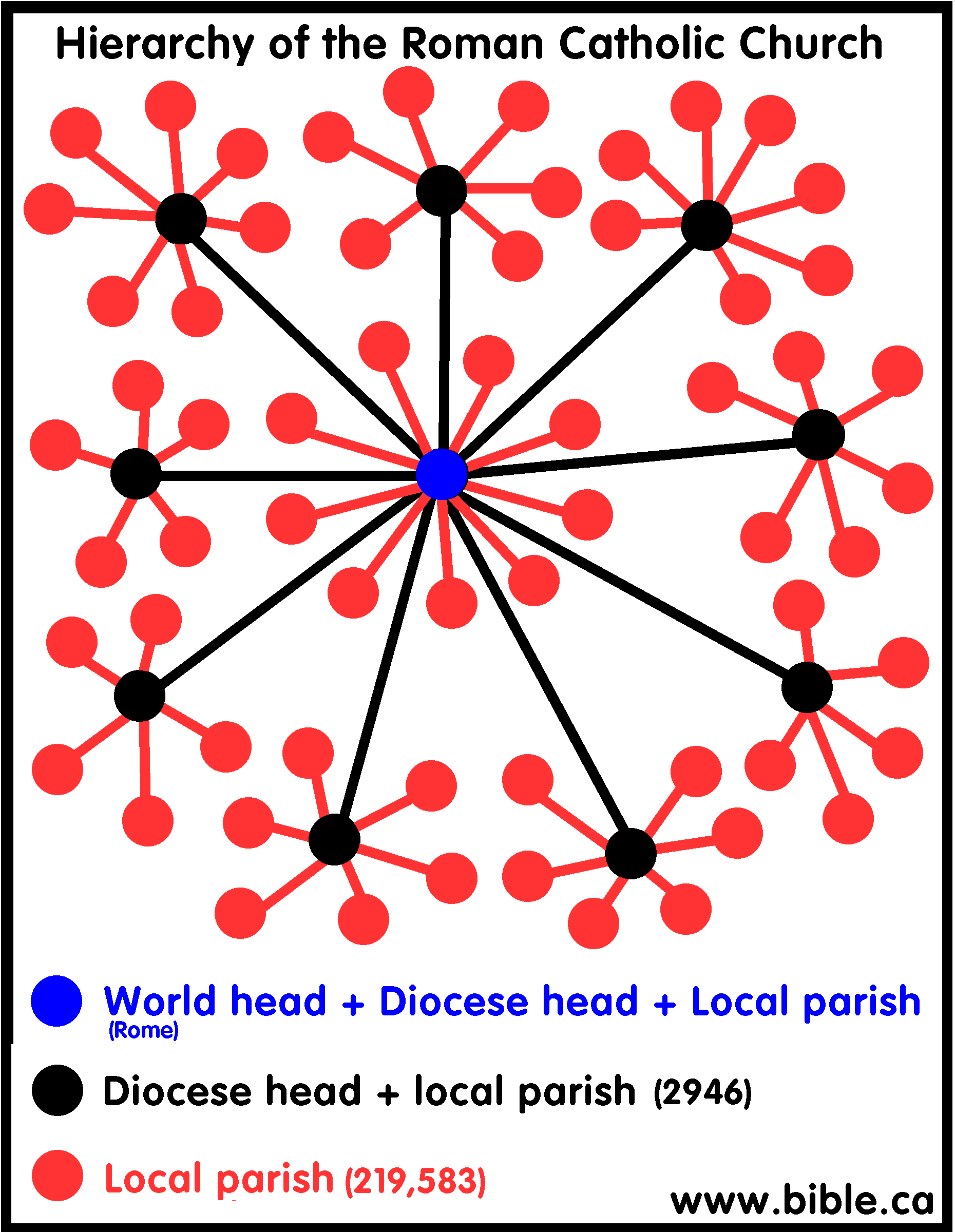
Real world hierarchies (catholic church)

The catholic church is a lot about worldly hierarchies, which makes it ripe to borrow ideas from. Let's see ... For starters, it seems to be a simple pyramid hierarchy with the following titles:

  • Pope/head of the church
  • Cardinals
  • Archbishops
  • Bishops
  • Parish Priests
  • Missionaries
This being a bit two-dimensional, I'd go and look for something closer to what could be used in The Game. Something like this:

[source]

All right, here we have a point of origin and some smaller groupings subordinating themselves to it. This (or something like this) is what I want to see in the game and I want o get there as fast and as random as possible. Hence the above linked idea about instant hierarchies. Here's the gist of it:

Roll 3d6 and interpret the results:
  • The plain numbers would be the whole clergy of a church. I'm assuming very small groups, obviously, with the level 1 player being the lowest in the food chain. I'd say a die means one temple. More dice in the beginning would result in a bigger church. But they would be all in one region.
  • Every 6 gets rerolled and indicates the number of those travelling holy men that spread the word without having a temple of their own (other than the player). They would be missionaries, so to speak.
  • Pairs allow for another roll of 3d6, the church just got a bit bigger and expanded another region.
  • Triples not only expand the church, but give it some holy (or otherwise important) site (could be a university, a site where a saint is buried, stuff like that).
  • If the first roll with 3d6 shows three time 1, the player character (or NPC) is the only cleric with access to a lost faith. Maybe he found a holy text, something like that. It's on him to spread the word now.
  • Other than that, 1s indicate lost lore and legends directly connected to that particular faith/deity/whatever, another roll with 1d6 per rolled 1 determining the number rumors, legends, MIA clerics, etc.. Could be the story of a cleric that got lost on a mission, some legend of saints and where their bones might be found, stuff like that. A pair of ones doesn't result in another roll of 3d6.
Doubles and triples will result in higher numbers and other than rerolled sixes, every rolled number relates to the first three (example: a first roll of 3 3 5 and a second roll of 2 1 5 results in two pairs (3 3 and 5 5) and will expand the church further in the second roll, may even produce triples along the way... or quadruples, but I've no ideas for that right now).

Now we need to expand on that.

How many dice for my church?

The basic idea was to roll 3d6 and read the results, but it's only logical to use more dice for a bigger church or less for a smaller one. What the initial post lacked was a ratio by which a DM is able to adjust what seems right for him.

This is has to be, to some degree, arbitrary. The basic question is, what level needs a cleric to have at least to be a fit leader of a church. Name level seems a bit to high for the smallest possible church (1d6), but level 3 a bit to low (I'm using the Rules Cyclopedia here, so the cleric's getting his first spell at level 2 and has only 2 level 1 spells at level 3, to name but one argument ...). A cleric would get his first level 3 spell when reaching level 6, so this seems like a good point to start*. So as a first set of rules:

"Every d6 means 6 levels for the head of a church. If more than 5 dice are used, the level of the head of a church is not relevant anymore, he's just a representative. As a guideline I'd take the numerical result of the initial roll as level.
The rest is politics."

So with 3d6 you'd have a level 18 cleric as boss. Very well, now for the clergy. It's a tad more difficult, mainly because of the huge variety in the results. Okay, one of the already established rules is that every die stands for a temple in the region/diocese. This is definitely something done at name level (using only one die is the exception and may mean there is only a shrine or altar ...**). 

If you use two d6 you got a main temple with the head of church as level 12 and another temple with the local authority (a cardinal?) at level 9. Now the minimum result for a church with 2d6 to have an active clergy is 5***. We already have a level 12 and a level 9 cleric, that leaves us with three more slots to fill. My initial instinct is to go with two more clerics with level 6 (two archbishops) and one with level 3 (a bishop, no less). To summarize, we have now as the lowest possible result with an active clergy of one roll with 2d6:
  • 2 churches in one diocese
  • One level 12 cleric as head of church
  • One level 9 cleric as head of local chapter/parish
  • Two level 6 cleric (I'd say each one of them working in one of those churches)
  • One level 3 cleric (active in the main church)
  • 20 payed retainers (going by the average CHA-score per cleric)
Add a few hundred believers to that and you have a small cult going. I'm quite satisfied with this result and I feel a table coming summarizing all the results ...

By the way, a player character would always be a missionary at first and not part of the number rolled (in the example above he'd be the sixth member of the clergy and, being level 1, the lowest in the food chain) and when used during character generation, I'd suggest to keep those 3d6 per faith.

Distribution, distribution

Those concepts will have some wild results and that makes it hard to see a pattern at first. But let me try anyway, starting with 1d6 and 2d6.

1d6 (results 2-5) - A cult, not a church
  • active clergy is 2-5
  • no temple but a shrine (if a 5 is rolled, make that an altar)
  • head of cult is level 6 cleric
  • there are at best two clerics with level 3
  • with more than 3 members every addtional member is a level 1 cleric
1d6 (fringe results)
  • a 1 indicates that this cult had once existed and left some traces (roll another d6 for the number of relics like holy texts, a shrine, some holy bones, etc.)
  • a 6 means a reroll, but if only one die is used to beginn with, the result of the reroll is read as another cell and interpreted as the initial roll (which means another level 6 leader with his cronies,etc.)

2d6 (results 3-11 + with doubles, triples, etc.)
  • at least 1 temple, might have holy sites, etc. due to triplets
  • active clergy is 2 to 11
  • head of this church is a level 12 cleric
  • the next highest level is 9
  • the number of clerics holding level 9 is the same as the number of dice that resulted in a temple
  • the number of level 6 clerics is the same as the number of dice that produced a temple (or less)
  • the number of level 3 clerics is the same as the number of dice that produced a temple (or less)
  • the rest are level 1 clerics
2d6 (fringe results)
  • a 1 always means some lost lore or relic (roll a d6 to see how many of those exist somewhere)
  • a double of 1s make this religion a thing of legend, reroll both ones and interpret the new results as the size of this particular lost church (which will give you some ideas how many temples existed (there might be ruins), how many clerics preached the faith (skeletons in a dungeon, stuff like that), etc.)
  • a 6 means a reroll, the result is the number of missionaries a church has running around:
1: 1 cleric level 1
2: 2 clerics level 1
3: 2 clerics level 1 and 1 cleric level 3
4: 3 cleric level 1 and 1 cleric level 3
5: 3 clerics level 1 and 2 clerics level 3 
6: 3 clerics level 1, 2 clerics level 3 and 1 cleric level 6 (and a reroll)
  • double 6s mean there is a camp of missionaries somewhere in another churches realm of influence (a triple means 2 of those, etc.)
So much for Part 1

I think that's enough to digest for today. I know, all that seems a bit complex and over the top, but when all is said and done, it's just one roll (with an option of exploding dice) and reading/analyzing the results. Here is Part 2. The next part after that (some time in the future) will deal with 3d6 or more and I'm working on some charts right now to illustrate the idea further.

It's also an opportunity to give me some feedback ...


*And forget about level names. The idea is nice on paper, but if you had to do it for 36 levels per class, you'd run out of alternatives fast.
**Which reminds me of a post I wanted to write and forgot about. Okay, it will happen the next few days ...
*** Rolling a 2 and a 3 are the first results that won't either expand the church (with 2 and 2 being a double), leave it with two active members (a rolled 2) and a lot of legends (because of the 1 ...) or make it completely a thing of the past (two rolled 1s).

Monday, November 11, 2013

Instant Hierarchies

Sorry for the lack of posting. I'll spare you the boring details how busy I'm right now. But I wanted to share this idea. At least the outlines. There's more to it and I believe it deserves further exploration. But that's not for today. Here's the idea so far.

Roll 3d6, create a hierarchy

Still got the cleric on my mind and I realized a few days ago that a churches hierarchy or the number of active servants of a faith is something that could be very useful for a DM (and the player of the cleric). An easy way to achieve this would be to roll 3d6 and interpret the results.
  • The plain numbers would be the whole clergy of a church. I'm assuming very small groups, obviously, with the level 1 player being the lowest in the food chain. I'd say a die means one temple. More dice in the beginning would result in a bigger church. But they would be all in one region.
  • Every 6 gets rerolled and indicates the number of those travelling holy men that spread the word without having a temple of their own (other than the player).
  • Pairs allow for another roll of 3d6, the church just got a bit bigger and expanded another region.
  • Triples not only expand the church, but give it some holy (or otherwise important) site (could be a university, a site where a saint is buried, stuff like that).
  • If the first roll with 3d6 shows three time 1, the player character (or NPC) is the only cleric with access to a lost faith. Maybe he found a holy text, something like that. It's on him to spread the word now.
  • Other than that, ones indicate lost lore and legends directly connected to that particular faith/deity/whatever, another roll with 1d6 per rolled 1 determining the number rumors, legends, MIA clerics, etc.. Could be the story of a cleric that got lost on a mission, some legend of saints and where their bones might be found, stuff like that. A pair of ones doesn't result in another roll of 3d6.
  • I'm imagining a simple pyramid as far as hierarchy goes, so there is always something like the head of the church (the one with the highest level) and those below. Should make a table for that (in another post...). The higher the number rolled, the higher the levels of those in charge. For now I'd go with something like this:
3 - Only legends and the one guy spreading the word.
4 - Old wise men (level 6) with a lot of stories to tell (and the one green guy that listened and goes on a mission from god, i. e. the player's cleric).
5 - 1 Leader (level 6) and 2 disciples with moderate support of their deity (level 4) .
6-10 1 leader (level 9) 2 clerics with level6 and as many level 4 disciples as dice are rolled.
...

Doubles and triples will result in higher numbers and other than rerolled sixes, every rolled number relates to the first three (example: a first roll of 3 3 5 and a second roll of 2 1 5 results in two pairs (3 3 and 5 5) and will expand the church further in the second roll, may even produce triples along the way... or quadruples, but I've no ideas for that right now).

I should go on, but I guess that explains the idea. I will write more about it as soon as I have the time. Ideas and comments are always welcome, of course. As it is, this could easily be used to create a thieves guild or any other group that needs a hierarchy. For now I'll go for churches... 

Friday, November 1, 2013

Pimping The Cleric - Intermission (Holy Places and a Clerics Motivation)

When writing about the cleric I realized I feel myself being more defensive about my ideas as usual. Everything religious, I've come to believe, is veiled with the threat of opinion above argument. So when I started writing about holy places, it became more of an intermission to explain the structure I try to implement within the game mechanics (because I see it missing and think it could be of use). Terminology and precise arguments seem to get very important at this point. Inadvertently it leads to a very close look of what the cleric means in the game and what he could mean. I'll try.

Ideas so far

I've written about the cleric two times already (Part 1Part 2) and talked about using the Petty Gods as the Pantheon here. For the holy sites it needs two more ideas. It will be a mix of what I wrote in Settlements as Class with some aspects of Territory in them. The result should be a holy site which, depending on size and importance, will have an influence on it's surroundings. Level will be the core element here. But that will be topics for future posts and just showing some possibilities and directions.

This intermission, on the other hand, is more about what I see lacking in D&D as I know it and how I think it could be improved.


Holy or Unholy places

This is not about unholy places. As a matter of fact, the question needs to be asked if something like an unholy place is a possibility in a D&D game. Even the temples of evil priests are holy to them at least. But "evil" and "unholy" are merely expressions of people opposing foreign ideas, at least as soon as it is about religion.

That it is not to say, that cults as some of those associated with Satanism (to give but one example) aren't something real and amoral, often associated with heinous crimes. It is very real (if very rare in it's extremest forms). But within a game and the three-folded alignment structure law/neutral/chaos, evil acts are not something preordained by the system.

So if holy sites are solely connected to what the system defines as clerics, the nature of the rituals and beliefs of all those fictional entities referred to as immortals, gods or deities (even demons or devils), stays within the frame associated with the 3 alignments. Following this logic, something like an "unholy shrine" isn't part of the system, but a descriptive term, only expressing prejudices between faiths.

Terminology and Meaning

As far as places of worship are part of the system I'll be proposing here in the future, they are all considered as "holy". That doesn't mean they are all holy as the general definition of the term suggests. No, the characters will most likely encounter as much sinister shrines and temples with dark rituals, as they will lawful ones. But those worshiping and using those places will consider them as holy, even if they worship an evil immortal like, say, Orcus.

The benefits of this approach are self-evident. If those places are considered to be the same and hold power, destroying them will result in more damage than just the structural variety, regardless of alignment or idol. But there is more, places of worship are a beacon of the faith they endorse, a symbol of the power any entity might muster on earth. More places of worship means more power, more power means suppressing other belief systems, which, naturally, leads to conflict. Conflict, in a rpg-context, is good.

Make pioneers out of them clerics

A player in the role of a cleric should, in my opinion, have the means to use his faith within the game mechanics to some effect. And I don't mean spells. They should be the reward for it. How rituals could be a part of that was already discussed in Part 1. It is somewhat connected, but what I'm aiming for here is a system that encourages clerics to be on the road and preach or claim some land for their god. He needs to do this or he will loose his powers (or at least gets them restricted...).

It's an idea that's not to foreign to D&D, as several adventures and setting descriptions hold the notion that a clerics connection to his god can be interfered with. Mostly this means some very evil places, directly under the influence of some god or another. But what if it is wilderness itself or just that other cult down the street that threatens a clerics connection to his god? What if reclaiming a dungeon would mean to establish a shrine in it and destroy the other shrines in it?

If we now assume a plethora of different deities, as they were (and will be!) presented in the Petty Gods supplements (to give but one example...), we could go as far as saying that every cleric is an important figure within the hierarchy of his faith. It's just more personal. I'd go as far as allowing the players to come up with their own local deity. Now the character is in a very different position. He is one of the few to preach about his god, one of the few that travel the wilderness in search of riches and relics*.

It could make a holy symbol very important, like it's an individual focus of power, just for this cleric. He looses it and his connection to his god will be so much more fragile**.

All of a sudden a cleric has all kinds of motivations to leave a mark on the landscape, hunt for gold, convert folks or search for relics that could help strengthening his faith. It's a clerics trade, it's where he strives. All his investments would be in his faith. But not just the empty pit that is called church. No. There is a career in order, where every money spent will finance the own temple for the mid-level game. If a player wanted to build a shrine, the DM should have rules how such a shrine could become a temple with time and the player should have a chance to make that happen.

Of course, a good DM could just wing it and improvise all those things as options for the player. But that's not what this should be about. Making this part of the system gives the player a chance to develop ideas beyond what a DM could give as options. It's not a place where a DM could shine with his creativity, but a place where the player decides the fate of his character. In this regard, the system may be considered as neutral territory, or better yet, as a basis where interpretation and individual choice is so much more important than a funny d10 table of strange believes the DM could come up with (which has it's place, of course, as part of the setting).

Giving the DM tools for destruction and creation

Preparation and improvisation are the basic trades for every DM. The system he chose could be considered the textbook that shapes his game. There are, again, two different kinds of usage for a system. One is what exactly to use as rules (AC descending or ascending, three saves or 5 or 1, you know the drill), the other is creations stemming from those rules (setting, adventures, campaign, characters, monsters etc.).

These distinctions are important when one is to understand and interpret the underpinnings of any system and it's usage. What is lacking in the "textbook", needs to be improvised and the difference between selecting rules and creating from those rules gets imprecise. This is to be expected in the process of shaping a game to the individual needs of a DM and his group. It is problematic as soon as the gap is to big, because most improvisations won't produce results that are repeatable without a lot of work.

Anything related to "faith" in D&D (including the cleric) has such gaps in the game mechanics. It's just not part of the system, not in a satisfying way anyway. A DM is expected to produce a pantheon, different churches, power structures and factions, acolytes and clerics as part of a setting. Or at least buy the book where it's already done by adding little subsystems, monster book entries, some random tables and flavor text like what underwear a cleric prefers. It's not helping. It's the reason for so many unhappy people as soon as the cleric enters the discussion (and so many claims to just dismiss the class entirely).

But if recognized and not just hand-waved, it should be a chance to improve the system and make changes where they count.

Holy places are one area where I see possibilities to improve the game in a way that enables a DM to prepare them in a meaningful way (with powers, size, influence and acolytes) and without to much work and also, on the other hand, improvise and convert them (if found in an adventure) with ease and as needed in the game. If there are rules how power structures influence each other, it's far more easy to improvise a cult and see it's impact on the surroundings in abstract terms. It being part of the game mechanics will also make it repeatable.

There you go

Not sure how much I was repeating ideas from earlier posts here, but it felt good to give them some (new?) form. Now comes the hard part in finding solutions for those problems. But I'm looking forward to it and believe it's worthwhile to give the cleric a chance to be the class he should be (and those being worshiped the punch and power structure to go with it). We'll see how it turns out. Anything I wrote is, of course, open for discussion, suggestions and ideas.


*If I were to compile this stuff some time in the future, I shall call it Riches & Relics...
**Thinking about it, I always felt a bit underwhelmed by what a holy symbol meant in D&D. Guess I expected something more... divine?

Friday, October 4, 2013

Rules Cyclopedia Oddities Part 2 (The Druid)

One of the odd birds in the Rules Cyclopedia is the druid-class. It's advertised as an alternative to the cleric, some sort of prestige class you can switch to as soon as your cleric reached level 9. If changing classes at level 9 doesn't seem odd enough, look at level advancement, the new spells and the special abilities. It's a bluff package. Level advancement is the same as with the cleric, there are no special abilities, only restrictions the cleric didn't have and the spells may be good for some flavor, but aren't anything special. So it's less than the cleric for the same xp and you loose Turn/Control* Undead (which is a shame). There is really no good mechanical reason to switch to the druid.

Although it seems not enough material to make a new class from it (which I believe to be the reason for this oddity), I hate it when material is not accessible. Other than googling for a druid variant usable with the Rules Cyclopedia, I can think of at least 3 possible ways to make this happen just by using the book at hand.

Variant 1: As written, but from level 1

Spell progression is the same, level advancement is the same, hp are the same, just change/add the spells as suggested, use the restrictions as written and you got a complete class going. As easy as that, just not that different to the cleric. And lots of restrictions without any benefits. Nonetheless, it's an easy fix and it only uses material already presented in the book. So that's something.

Variant 2: Add special abilities, calculate new advancement

This is a slightly tweaked variant, also derived from ideas already present in the Rules Cyclopedia and with the calculations for level advancement as proposed here. I wouldn't go for a straight conversion of the AD&D druid just yet. It's the opportunity to create a new class from the material already manifest in the Rules Cyclopedia and I'll try and use it. So what do we have:
  • I'd go and borrow some ideas from the mystic like I did here to give the druid a special advantage. This leaves us with %-chance to identify animals, plants and pure water after the following formula:
d% roll vs. ([3 x Wisdom] + [2 x Lvl])
  • I'd steal the Turn/Control Undead Table and repurpose it for the druid to Turn/Control Animal. Consider this: Turning is ranked by hd, one hd per column on the Turning Table. A druid won't be able to slay living creatures with this, so every result of "D" is an attempt to control the creature. Intelligent animals get a save vs. spell if the result is "D" and the attempt is "control", a successful save treats them as turned instead (intelligent animals are those with an INT of 3 or more, humans and halflings count as intelligent animals, penalties for low intelligence should count for the save).
  • Take cleric spells, add druid spell, take away those spells connected to good and evil. Spell progression as the cleric.
  • All other special abilities and changes suggested in the book apply.
  • I'd also steal the hide (outdoors) ability from the halfling.
Prime Requisites: Wisdom
Experience Bonus: 5% for WIS higher than 12, 10% for WIS higher than 16
Hit Dice: 1d8 per level up to level 9, then +1 hp per level (no CON-modifiers)
Maximum Level: 36
Armour: All, but restricted to organic material, shields are allowed, but with the same restrictions
Weapon: No edged or pointed weapons, only made from organic material
Combat Progression: like Cleric
Weapon Mastery: like Cleric (normal)
Saving Throws: like Cleric

xp needed to reach level 2: 1800 (progression like the Cleric)

Variant 3: Add shape-shifting ability

Gains the ability to change into another animal as per the spell Polymorph Self at level 4, usable 1 time per 4 levels. I do not think it is necessary, though. But it makes the class feel a bit more like D&D. This lifts the xp needed to gain level 2 up to 2200 (still, level progression like the cleric).

There are several attempts to achieve this for the Rules Cyclopedia and clones, of course. The three above are just what I would use if I had nothing else but the Rules Cyclopedia at hand. I hope some of you find it useful. I'll go now and build a ranger class for the RC. It's something I wanted to do a long time ago, but the druid needed to be done first.

If you liked this post, you might want to check out the other oddities in this series. Comments are, as always, very welcome. Especially if they praise the Rules Cyclopedia :)


* I allow Control Undead as an option, just like AD&D suggested (allowing control for some time with a "turn" and absolute control with a "destroy"). So it's not RAW. Anyway...
[Edit] Forget that this is not RAW, the Avenger could control undead, so the RC is already doing that one, too. Thanks to the Random Wizard for pointing me in the right direction!

Friday, September 6, 2013

D&D 30 Day Challenge - Day 6

Today's question: What's my favorite deity?
[A plea for the DIY attitude and a Rules Cyclopedia Oddity...]

I looked for a comprehensive list of D&D gods and was appalled ("sad" a few sentences ahead links to a wiki-list...). So: None. Seriously. They're all crap not that good. It's not their fault. Those poor guys couldn't help it. So many companies invented, reinvented, censored, added, subtracted and changed them, they never were consistent enough to be anything more than an unstable accessory. Not one as iconic as, say, Cthulhu or as mainstream-compatible as Crom or... Ah, it's just sad. Add a Satanic Panic or two and some copyright infringements and you're left with a incoherent clusterfuck of boring ideas, spreading and meandering through the game like cancer.

Or should I just write Lolth...

No. There are better ways to handle this. And I'm not just thinking it would be a very good idea to let Orcus finally ascend to godhood and be done with it. Well, I it is a good idea, but not what I'm aiming for.

Another Rules Cyclopedia Oddity

There are no specific Gods here*, only some general words about what they call the Immortals. Just using the Rules Cyclopedia will force a DM to build his own pantheon. It's a boring and/or difficult task, but a huge step in the right direction. Plus: the problems with this tell us something worth realizing about this iteration of the game.

An Immortal must have walked the earth before he could become one of the mighty few. He had to manage to get to level 36 before he even could start to become a immortal being. We're talking at least ( for the cleric) 2.900.000 xp here! He had to leave a huge footprint in a setting. Even if half of that was gold pieces, he moved in his time 1.450.000 of those. What did he do with all that money? What did he build, etc.? And this is about one who at that point only tries to become a god. What if he failed. How many shaped the world and did fail in the end. And those that made it, are they all still well known? For what?

I could go on, but I won't. I believe the main point is already made: the game has a very huge (if not intimidating) scope. To do this the way it's intended to be done is difficult. It needs plausibility and consistency. The Immortals are the roots of a setting, the power-structure and a DM needs to stay on top of that to make it work. In my opinion, it's worth trying. Or...

About my favorite list of Deities:

If a player wants to play a cleric, he might choose a deity from the Petty Gods supplements or make his own Petty God in the same fashion**. If I need a god or two for a region, I'll just randomly choose 1d4 of them, maybe play a bit with the names. If I have another idea or two for the collection or see something I like, I'll write a short description and add them to the roster. All are Immortals as per the RC.

It makes for a very colorful pantheon where a cleric's profession is more an individual expression of what the player had in mind than some pseudo-spiritual ideas forced upon him. It also fits the idea of a world where civilization struggles after some big apocalyptic event, where small fractions of communities are isolated enough from each other to have a different belief system.


*May be true for all the older editions. I am not that familiar with those. But the D&D Rules Cyclopedia was supposed to be the final Edition of "old" D&D and they didn't even call them "gods" in the end.
** For those not familiar with the Petty Gods Project (are there still people out there in the OSR who aren't?) or those new to my blog (more likely...) are two examples of some Petty Gods here and here.

Saturday, August 31, 2013

Pimping the Cleric Part 2 (REVERSE THEM ALL)

Just an idea about pimping the cleric further (here is Part 1) that occurred to me yesterday: why not make it possible for a cleric to reverse all his spells?
Seems to be a famous meme. It's kind of funny, too...
(source: here)

Why?

He basic impulse came from thinking about making a witch class (well, just a thought experiment) and my first thought was to give witches an option to do it either the good way or the bad way*. A comparison to cleric spells was imminent and unavoidable.

How?

Pretty much writes itself. I took a look at the Rules Cyclopedia list of cleric spells and it seems very possible with some interesting spells as a result. Let's see some of those results**:

  • Vulnerable to Cold could be the reverse effect of Resist Cold (freezing temperatures do hurt people as if they were naked, just reverse the rest).
  • Spoil Food and Water is an easy enough reverse to Purify Food and Water. And it wouldn't be that powerful, because it would be obvious to see that the food and the water are spoiled and to be avoided. Useful, though.
  • Hide Traps instead of Find Traps could mean a tactical advantage for the cleric. It could, to give but one example, hide a pit trap in front of him when Monsters/Adventurers are charging him. Again, not to powerful, because directly connected to the clerics position.
  • Don't need to explain Vulnerable to Fire as a reverse of Resist Fire, I guess.
  • Snake Taunt (as a reverse to Snake Charm) leaves you with a very pissed off snake, who attacks the closest target (not necessarily the cleric).
  • A reverse to Speak with Animal could be a bit more difficult. My take would be to reverse it to Irritate Communication with Animal, which would lead to the animal having a -2 to reaction rolls and understands every command given to it as it's opposite. Now imagine a knight charging an evil cleric and the cleric casts Irritation. The horse would come to an abrupt stop, because the knight wants it to gallop, etc.. So there is  value in it.
  • Cause Blindness is treated like a curse and not to be healed by its opposite Cure Blindness. It's a bit redundant, but Cure Blindness itself isn't exactly the greatest idea ever.
  • To reverse Speak with the Dead seems a bit difficult at first. But what does the spell do? A cleric is allowed to ask a spirit up to 3 questions, which are to answered to their best knowledge and, as a worst case, it might be in riddles. Murderers would be caught quite fast with such a spell. I'd suggest to reverse it to Erase Memories of the Dead, allowing a cleric to erase up to 3 memories of a spirit (which should be as useful as speaking with them...).
  • Slay Undead could be the reverse to Animate Undead. Seems a bit redundant, too, but at least it allows for a fast destruction of undead.
  • Dispel Magic is a hard one. Revive Magic might be a good reverse of it. Yes, I'd go with that. Same difficulties as destroying it, as the spell suggests. Might be useful, too.
  • I suggest Disconnect instead of Commune. It allows a cleric to disconnect another cleric from his god for 3 turns (target needs to hear the caster hear praying for the presence of his deity, no save to avoid).
  • Create Hunger (instead Create Food) make for 12 very hungry persons. All the effects of starvation apply for 24 hours, regardless of what they're eating and drinking (no save, because it's a level 5 spell?). If there is more than enough food, this could lead to some serious damage as soon as the spell wears of (drowning because of too much water, internal damage because of too much food. Here are some very creative results possible (what if the only food source left is other people...). 

I could go on (and maybe I should at some point in the future...), but this was supposed to be a short post and I think I made my point. There are some difficult decisions with the spells on higher levels, but that shouldn't be a problem for a creative DM.

It gives the cleric a few more options and variety with just a little bit of work.

Any further suggestions? Alternatives?


*As a side note: I think witches could work using the cleric as is. I mean, Satan could be the petty god of lies or something. Need to think a bit more about it...
**Interesting note: Detect Evil is reversible in the German version of the Rules Cyclopedia (Detect Good would be the reversed version). This need's to be explored further in the future, too.

Sunday, August 4, 2013

Pimping the Cleric Part 1 (Rituals)

Clerics are the stepchild of D&D. So much so that I read several times it should be dismissed as a class. And I agree in as far as it is a very difficult class to do right. This is where I see the main problem: A fighter has his choice of weapons and armor to define him, a magic-user has his choice of spells and a thief, even simpler, has a set of skills. Set your priorities and your done. Not so much the cleric. He's not defined by his choice of weapons or spells, he's defined by a God.

In this series of posts I will offer some ideas and house rules to make the OD&D cleric a more worthwhile (and visible) class.

What to do about it?

The easy way out was always to use the cleric as fighter support and/or heal-bot. Using him only for that makes it a very unrewarding class to play. Makes the player feel like taking a bullet for the team. I've been trying to get away from this since we started playing Rules Cyclopedia.

First part of the solution, although I didn't realize at the time, was to allow a dwarven cleric as a class. In retrospect it's quite easy to see why that worked. The God worshiped being the God of the dwarves made it easy for the player to emulate that as a believe. Which means, he didn't have to alter his perception of what it means to be a dwarf to be a cleric for them. But the player mostly criticized the lack of spells on level 1 and the weak development later. It needed one more change to make him happy.

So the second part was to allow sacrifices. Inspiration was the (excellent, but canceled) tv show Rome. In one episode one of the main characters, Lucius Vorenus (an officer of the roman army), gets his blessings in a temple. An ox is sacrificed and Lucius is bathed in the blood. They are pretty accurate about the multicultural daily life in Rome and the effects of polytheism. In addition to this scene, there are on a regular basis little shrines or cultists roaming the streets. It gave a good impression of how important those small rituals (and religions in general) were at the time. Clerics were a vital part of society. And mostly strange individuals with odd opinions and weird clothes. Here is what we did:

Sacrifices in D&D

An ox about to be sacrificed (source: Wikipedia).
What counts as a sacrifice depends on the individual believe and can be everything from treasure to creatures (alignment should be an indicator here). The ritual is concluded with a successful WIS-check (which may get bonuses for ritual knifes, oils or other materials, inferior materials will result in penalties, a critical failure means the cleric somehow insulted his God, etc.).
Whatever is used for the sacrifice, is always useless after the ritual (destroyed, buried, vanished in thin air, the DM is to decide what works best in his campaign). If the God accepted the sacrifice, a cleric gets at least 1 point Gratitude. This is cumulative as long as the cleric keeps a regular schedule of additional prayers (that is, the player mentions it in the game). Gratitude may be tested with a d100 in times of need. If successful, a minor wonder happens to aid the cleric. If a wonder occurs, Gratitude is reset to 0.
The value of the sacrifice defines the points in Gratitude a player might get gets. Every 500 gp or 1 HD are worth one point of gratitude. The worthiness of the offer in Gratitude Points, divided by the cleric's level is the duration of the ritual in days (but at least an hour).
Every true convert to the clerics believe is worth one point of Gratitude (assuming that the player put some work into it, makes a WIS-check unnecessary).
When using a shrine, altar or temple for the sacrifice, the cleric needs to state his intent. Pure devotion is for the benefit of the holy place*, seeking a blessing for a future endeavor is for Gratitude Points.
If he wants to use Gratitude points to help a fellow players, the penalty on the d100 is -25 for non-believers, -10 for casual believers and -5 for true believers. All points are lost, if the wonder occurs.
One try per situation is advised. A second try in the same situation is allowed (with a -10 penalty), but all points are lost, even if no wonder occurs.

It's a house rule we use for some time now and it worked like a charm. To get gratitude points, the player made very clear what he needed from the other players. He even converted two of them in the process. With a little tweak in the system, his god's name became a visible part of the Game and enhanced the overall experience.

There are some wider implications for the Game a DM might consider. For instance, knowing what kind of sacrifices are needed for an evil cult, could give some hints for the players about what they are dealing with. Or the magnitude of the ritual. In a more investigation oriented game, some stolen relics could hint towards the cult behind it and what kind of ritual is planned.

By the by, an impressive number of small cults to make the groups live more interesting and give some ideas what they might need for their rituals, is (of course) the Petty Gods Project.

Next up will be a selection of cleric spells, some mechanics for holy sites and I guess I'll write up the dwarven cleric we used in our Game to conclude the series.


*This will be part of another post. Basically it will effect the power of a holy site. Something that is not very much explored in the game.