Sunday, October 5, 2014

Introduction to some German Urban Fantasy Storybox set in the 90' (WitchCraft, a Campaign and how to feed a Brain)

So I'm finally back to DMing a game and we already have 3 sessions under our belt (session reports will follow the next few days). Although I miss playing D&D*, it was time to give another game some room at the table: C. J. Carella's WitchCraft. Here is an exclusive behind the scenes of my new campaign.

Preparation

In the beginning were the X-Files. The girlfriend had never seen any of it and i had never seen all of it and in order. So we started with season one (which is 20 years old now, by the way!) and loved it. It was the start for a healthy diet of TV-shows, movies and music that got me back in the mood for some Urban Fantasy. Here is what's what and why (a selection):

The X-Files: Gotta love that show. 20 years old and still some of the strongest TV you can get. The first 4 seasons are pure gold, in my book. You get a supernatural twist to almost every topic still in the news today (dangers of artificial intelligence, factory farming, genetic engineering, war, capitalism, media, you name it, they probably made an episode about it). That is scary because it means that nothing has really changed for the last 20 years (or we really believed it back then to be science fiction, to see now that they were right all along and I can't decide if that's even scarier). It's a strong theme and one of the reasons to put the campaign into the nineties. All those alien mythology shenanigans are just a bonus (and entertaining at that).

Also quite refreshing was the fact that they stayed true to the shows basic premise for as long as possible and that means, it's a "show about two FBI agents who investigate supernatural phenomena" and not a "show about two FBI agents who investigate supernatural phenomena and the stories of their past, their mothers past, their boyfriends erectile problems, social misadventures, blah blah, blah" like you see it in almost EVERY TV-show nowadays. I blame Buffy. Anyway. Doesn't happen here (that much).

Twin Peaks: There's no X-Files without Twin Peaks and we soon enough started (re-)watching it, too. It is a strange beast, to say the least. A small town with lots and lots of dirt behind closed doors, corny music, even more corny drama and some supernatural threat that stays in the background, humming like an angry wasp. Add some early nineties visuals, great humor, a lot of weird, all that with a great cast and you are in for a treat. And it was helmed by David Lynch, no less.

Great potential for a show and excellent execution, way ahead of it's time. Until they killed it by solving the mystery of Laura Palmer's death in the beginning of the second season. For the campaign I took the idea of a small town in the woods with lots of mystery and secrets in it. I'll also try to remember that strange unexplained events and an eerie atmosphere go a long way to make a memorable story.

American Horror Story: If you need an example how too much of a good thing might be a bad thing, American Horror Stories does the job. What you get is a serialized amalgamation of all horror tropes sorted by sub-genres (so far: haunted house in Season 1, a (religious) mental institution in the 60's in season 2 and a coven of witches in season 3, next up is a freak show ...). Mode of story-telling: if it could turn worse, it will turn worse. All the time. And it doesn't really work, as far as drama or effective story telling go. Lots of ideas to steal, though. And I love those opening sequences (link to youtube):


Cabin in the Woods: Great and fun story and an unusual view behind the curtains. Not alone that the movie's basic premise works great for one-shot horror adventures, it also reminded me that a strong mythology (like in the X-Files) is a must have for every attempt to create a serialized story (The Truth is out there!). Because, you know, it's where it all makes sense (even if it doesn't).

John dies at the End (movie and books): If H.P. Lovecraft had written his books in the 21st Century, something like this might have been the result (or, the other way around, if Pynchon had a love-child with Philip K. Dick and that had decided to channel H. P. Lovecraft ... you get my meaning). Strong basic theme, filled to the brim with great ideas (how to open a ghost door with a phantom hand, how you couldn't remember someone if he was annihilated out of time and space ... and how such an act will influence reality, even how to implement Quake 2 in your horror scenario ...). I can't recommend it high enough.

Arvo Pärt (music): A brilliant modern composer. Great inspirational themes. Check it out (link to youtube):


Ghosts I-IV (Nine Inch Nails): A model project in modern music publishing (public domain, creative commons, all that jazz) and a showcase what industrial music is capable of. Complex, creative and  at times quite haunting. Very inspiring. If you don't know it already, give it a shot (link to youtube):


Now I needed a game to emulate all those sources and inspirations into a campaign  ...

The System

I always had a weak spot for Vampire: the Masquerade, you know, the prototype of what one would call a "storyteller" role playing game today. We'd had some great times with the system, but in the end it had run it's course and we moved on. It wasn't until, I don't know, 2012 maybe, that I read somewhere about WitchCraft and that it's not only free but also that it's the game V:tM always had tried to be. Three sessions in I have to say: it doesn't disappoint.

WitchCraft is quite fast and flexible, so it allows for improvisation, while keeping the transgression between idea and system nice and smooth. The assumptions and underpinnings they set for the gaming world are (especially those about spirituality/the supernatural) in such a way that they work fine with almost everything you might throw at it (from Paranormal Activity, over Walking Dead, the X-Files or Planet Terror to Halloween and Cabin in the Woods, you name it). It's part of the Unisystem line of role playing games (famous for Conspiracy X, All Flesh Must Be Eaten and many others) and to my surprise, it totally works for an Urban Fantasy setting I had in mind (and for almost anything else, really).

I believe it to be superior to the World of Darkness books and rules and even if I were to play again in the Vampire universe, I'd use WitchCraft/Unisystem as the engine of choice, as all of the concepts are easily enough ported and the system is less flawed. Another plus is that WitchCraft reminds me of Cybepunk 2.0.2.0. and I love that game ...

Anyway, WitchCraft is not perfect, as story-driven games so often tend to be. The advice for DMs is mostly bad (like telling a DM to fudge die results to help the "story" or how to railroad players, all that bullshit) and although it has some NPCs, stories and examples, it lacks stats for the most basic creatures (needed a dog, couldn't find one, etc.). There are a lot of ideas and concepts I might have to import to make the game tick just right (random encounters/contents I miss the most). So about that ...

The Storybox

The Barking Alien came up with the term some time ago. For me, it makes a lot of sense. When a game has a heavy focus on simulating the environment (like D&D does), a sandbox is one way to use such an engine. But in a more story-driven game system, the sandbox approach will fall somewhat flat, because the characters have a very different connection to the game world.

To give but one example, it is quite easy in WitchCraft to create a filthy rich cocaine addict with a small army of undead to protect himself from some angry Colombian drug traffickers he crossed a few years ago. And that's a starting character, just to be clear. Those characters are have very deep roots from the very beginning, which is something D&D characters might get with time, but won't have (need?) with Level 1.

So instead of shifting the world politics, powers and hidden treasure a campaign consists of when building a sandbox, you shift the social surroundings, dark powers and hidden secrets the characters might connect to** when building a storybox. That's not to say that there isn't a huge overlapping area in between, but the focus shifts somewhat.

This the story-pieces I got so far:

  • We are in the year 1999 (07/07/1999, to be precise) to see it ain't that different from today. It's easy to google, to get information and pictures and whatever was news that day. Even the weather of a specific day in a specific area, if you want to. TV-programs, trends, advertisements. Easy to access, easy to twist, close enough to memory to remember and connect. The looming Millennium. So much more. 1999 is a very good year to start a campaign.
  • We are in a small town (pop. of ca. 35.000) called Dirkterwalde in East Germany, somewhere between the Spreewald and the German/polish border. So we have organized crime from beyond the border, a Sorban minority, a very weak economy and the infrastructure that goes with it (to name but 4).
  • The town has a castle and a historic district, linking it to the Dark Ages. If something like this can be preserved, some local traditions and folklore will continue to have strong roots in the population, too.
  • This being Germany, the town will have some history with the Third Reich, of course. It is quite the popular trope, of course, to have the Nazis dabble with the supernatural (and fail) and it has great potential for some seriously dark horror. I have some ideas already ...
  • It's located in the former German Democratic Republic (that had lasted until 1989), so there's a lot of history, too. In this campaign the Stasi was relentless in hunting, dissecting and destroying the supernatural. Dirkterwalde became a safe haven for many during that time.
  • For the supernatural I got room for every and all ideas I want to realize in an Urban Fantasy setting. I got Grimms' Fairy Tales, elements from the World of Darkness (mostly closer to what they quote, to be fair) and Cthulhu, some Dark Fantasy (the players already had a glimpse into a dark future where a dragon and some Zombies had roamed a destroyed version of Dirkterwalde ...). Some classic witch coven with all the politics that go with it. And the town itself is a mystery, the reason for the magic obscuring it's location lost in the Middle Ages. Layers and layers of mystery and enough opportunity to stumble across some of them, even to be part of some of them.
  • There are lots of interesting locations and scenes to connect to, like a disco, some theaters, bars, restaurants, the castle, museums, a stadium, a local newspaper, some punks, incompetent cops and whatever else I can come up with to put some life into this little town. 

Somewhere in there are the stories of the characters, connecting, dissolving, triggering their personal interpretation of what is happening around them with as much freedom as I could give them ...

Still a lot of work ...

Those thoughts, links and ideas are, of course, just the campaigns bare bones. And there's still a lot to do. But since we've had already 3 sessions and people keep coming back, I'm confident when I say that whatever I wanted to get done six weeks ago when we started, will get done in the near future :) On my to-do list are the following items:

  • A map of Dirkterwalde and surroundings (80 % done, but not finished).
  • Session reports 1, 2 & 3 (I want them finished before our next game, which would be in two weeks).
  • Re-reading Violence The RPG for it's urban random generation tables (wanted to write a review, since it is a very interesting game (and still free, so go and check it out ...) and I need to loot some of it's mechanics for our next game ....
  • Find a way to build NPCs fast, easy and random.
  • Reread Cyperpunk 2.0.2.0. to search and exploit possible connections.
  • Hunting down hard copies of those Unisystem-books ...

That's it so far. Now I should stop writing about it and start doing it! That and more work for the Goblintribe Simulator and something else I need to get written soon ...

* Main reason for this blog to exist is to come to a point where my own Frankenclone matures up to a point where I would be able to launch a major campaign. It's problematic ...
** I wrote about this a few weeks ago. For those interested enough in following my train of thought into that direction, feel free to read the whole story here.

Saturday, September 27, 2014

Another couple of copper pieces about the OSR "history"

I don't do blog-politics (usually), but often enough when the shit hits the fan, I'm around. Listening and thinking. Forming my own opinion. As soon as I have digested the problem, I focus on something more worthwhile to share and that's that.

Now +Erik Tenkar started a series of posts about an aspect of what the OSR is about, the RPG Pundit, for lack of a better word, attacked this (still unfinished, I might add) service to the community as being an attempt to alter the "truth" about what the OSR really is to fit some vague ideology. The word revisionism was used, implicating some sort of hindsight bias and ulterior motives. +Wayne Rossi (among others,I'm sure) wrote a rebuttal to confront some of those allegations.

Since I have the logo on my blog, I might as well say a few words how I perceive what is called a "movement" nowadays: the OSR. This is where I enter the fray. Not to attack, but to state my position on the topic.

Origin Stories of the OSR

Let's start with where I come from in this. That I took the D&D RC back out of the shelf was by mere accident, but still, a campaign emerged from it and it was during one of my random journeys through the internet that I stumbled across an excellent post about dungeon crawling on a, at the time, new blog called Playing D&D with Porn Stars some time in October 2009. It got me hooked to a group of people that held the "old ways" of the game as a high standard and talked a lot about how The Game is not about buying stuff, but about DIY. It didn't take long for me to discover Grognardia and Jeff Rients and from there on it was down the rabbit hole. First I started to tinker the hell out of the Rules Cyclopedia, then I started blogging about it November 2011.

It's also around that time that the OSR-logo bloomed into it's final iteration: in April 2011 Stuart from the blog Strange Magic proposed a version of the logo that found some huge resonance among bloggers. For me it is the point where the OSR got a flag, a condensed visualization of what the OSR wants to be and a compromise people could unite under. So even if there was some talk about an OSR before that, it (arguably) didn't become recognizable as a movement before that. This right here is the focal point, not some loose ideas one could compromise upon.

The OSR as a child of Web 2.0, Creative Commons and dtp

There would be no OSR without the internet and an easy access to technology that allows everyone to publish their own content for free (and the idea that this is a good thing). The fact alone that one can produce and share those contents or talk about those ideas with people all over the globe just by accessing the internet is the prime requisite to align something (that would otherwise be rather local and insignificant) up to a point where it might get some traction. There is no agenda in this, no politics, it just occurs naturally because it is possible.

So yes, you get your OSRIC, BFRPG, Encounter Critical, all those clones and spawns for free because people wanted to do this, you get your communities because like-minded people wanted to talk about this and you get your traction because finding and joining those people is just a click on the browser icon away and people have a tendency to label the groups they frequent. But this is all there is to it.

Marking your Territory, OSR-Style

I believe there is something like a smallest common denominator for the OSR: you do it yourself, share it and talk about it. It's the spirit of the first role playing game ever published (that's why it's "old school" and it really doesn't matter if you talk about your sessions, your campaign world, the Frankenclone your building, some house rules you came up with or your interpretations of some rules in the games you use. It is, initially, system agnostic, as there are no really big gaps between role playing games. They are all alike, just different flavors of the same idea, easily enough ported from one game to the other (new or old). Why should there be more? Isn't just this more than enough to make dialogue and co-existing possible, indifferent to what your "origin story" is?

Obviously not, as people will be people and start bringing their own problems and misconceptions into the fold. This is where you get your politics and agendas, not the OSR itself (or what I believe it stands for, anyway), but the people acting up for some reason or another. As they say, haters will be haters. It can't be avoided, but it can be dealt with.

That being said, I don't think that Tenkar has a hidden agenda (if you check out his first posts in 2009. you'll see that what he did in his series about lapsed gamers is what he did from the beginning), but the Pundit doesn't seem to act out of character, either. And he did it in public, arguing his case with those who oppose him. Maybe this needed clarification. I don't know. We'll see if they come to terms.

In the end it's just not what blogging in the OSR should be about ...

Friday, September 12, 2014

Gone hiking

Civilization allows me to post a little something from my mobile while we're resting ...

The most dangerous encounter we had so far (I hope it shows a picture now):


Wednesday, September 10, 2014

Talking about an Analogue Goblin-Tribe Simulator 2.5: Putting a Map on the Tribe-Sheet (pre-beta single-player version)

There was more meet on the menu in Part 2 than I did deliver: I totally hand-waved how the dice on the sheet also are the beginning of a map! Well, the main idea of posting about the process of building this game is to see which parts need more exploration. Alright, what information could be gathered from 4 dice lying on a piece of paper:

Random distribution, but, as of yet,
meaningless for the dungeon!
The numbers shown by the dice are already used to establish the tribe to some extent. To load them any more impact would be overdoing it, in my opinion. What might work, though, is using the numbers on the side of the dice for our purpose here. It is maybe an unusual choice, but I believe it has some merit. Let's see ...

1. Passages leading to the lair

One corner per die indicates a passage leading away from the lair, the numbers on the sides closing to that corner are the points a player might use to buy features of that passage:

So we have  4 passages with 4, 6, 8 and 11
points to distribute ...
Problem and solution

The only problem I'm aware of, so far, is that the dice may land in a way that makes it hard to decide which corners are pointing away from the lair. One solution might be to allow a player to move each die 2 cm in one cardinal direction until the result is satisfactory, or he decides arbitrarily which corners should lead (which would give him more flexibility in creating a final form).

What are those points for?

This is were I'm about to chicken out again. The basic idea here is to assign costs to several features a cave could and should have (it needs at least one exit to the surroundings, for instance). Yesterdays post gave some indications what exactly I had in mind with this. Beneficial features (like high ceilings with alcoves or very low ceilings, water might be interesting, too) will cost a lot, additional but not rudimentary features (intersections, holes in the ground) will have medium costs and the most basic features will be quite cheap (long passages with normal height, etc.). Here is an (for now) incomplete and unsorted list:
  • An exit costs 1 point (needs to be bought at least once).
  • 10 yards of passage (length) cost 1 point and is called a section (with a base height of 3 yards and a base width of 3 yards, if you chose 20 yards of passage, you have 2 sections ...).
  • Manipulating height and width per section costs 2 points per yard .
  • Alcoves cost 1 point each (better for the defense).
  • Steep slopes (up or down) cost 1 point per yard (will influence the AC).
  • Slopes (up or down) cost 1 point per 3 yards.
  • Break slope (up or down) cost 1 point per yard (will influence AC).
  • Boulders or stalagmites cost 1 point per section (will influence the AC).
  • A branch-off costs 2 points (will get important for further exploration).
  • Small body of water costs 2 points (will help with the Nosh).
  • Medium body of water (fills half a section) costs 4 points (will help with the Nosh).
  • Big body of water (blocks passage) costs 6 points (will help with Nosh, further exploration is somewhat difficult).
  • Flowstones, bedding plain flake or fissures would be 1 point (will make mining easier later on?).
  • Natural hole in the ground costs 4 points (makes for a good trap later on ...).
  • Twists and turns cost 2 points per section (may be taken more than once per section, will influence visibility for defense).
That's it so far. Maybe it's a bit too much. I don't know. But with this it is more or less possible to make some useful decisions when distributing the points. In the end, every decision should influence something on the tribe-sheet one way or another (it's still a bit vague, but I believe it'll connect quite well to the rest) and should transfer quite easy into any role playing game.

2. The Lair

Measurements for this is in 10 foot cubes (for now, but either way, should translate easy enough between yards and feet). The number of Goblins a die indicates is the lowest possible number that needs to be spend on the cave, the sides not yet used will be added and used as the points available per cave (for room-size, features and connections):

The distribution would be: 10 (at least 5 for the room);
8 (at least 4 for the room); 6 (at least 4 for the room) and
6 points (at least 1 point needs to be spend for the room)
Distribution

This is all in 10 ft. cubes. One cube stands for a more or less even surface, but that doesn't mean that the whole surface of a cavern/room is flat! On the contrary, even without spending further points, these cubes may share the same room, but don't connect to one flat surface. Add features like above to it, and you'll have a unique complex of caverns:
  • A cube costs 1 point and should be used to build connection between rooms (at least one cube needs to be spend to connect rooms) and to manipulate a rooms height or depth (one goblin per cube, so planning a little for the future might help).
  • To manipulate connecting passages on a smaller scale, use the rules above (10 = 3 yards, costs two points per change).
  • Alcoves cost 1 point each (better for the defense).
  • Steep slopes (up or down) cost 1 point per yard (will influence the AC).
  • Slopes (up or down) cost 1 point per 3 yards.
  • Break slope (up or down) cost 1 point per yard (will influence AC).
  • Boulders or stalagmites cost 1 point per section (will influence the AC).
  • Flowstonesbedding plain flake or fissures would be 1 point (will make mining easier later on?).
  • Natural hole in the ground costs 4 points (makes for a good trap later on ...).
This needs to be a bit more structured and streamlined to allow faster access, but so far it shows what direction this is going.

Final Thoughts and Preview

Next up is an example how a set-up could turn out (with the symbols needed to get the map started!). I just don't have that time today or the next 7 days (we'll go trekking for the next couple of days ...).

All in all I believe this is a lot of raw data taken from only one roll of 4D6. You get a complete tribe (including warriors, women, children and some weak) and a lair with some features, an exit and some passages to go deeper into a cavern. As it is, it could be used in every fantasy game with almost no preparation. That's where I wanted to end up for now.


Monday, September 8, 2014

Taking Spelunking Seriously since 2013

Ever since I went down into a real dungeon in the beginning of 2013 I'm trying to figure out how such a random chaos of tunnels, slopes and rooms might be expressed in a game of D&D. Basic geology, where do natural caverns develop and how, what entrances occur naturally, what vegetation, how much water, all that stuff. And it's a lot. Here are some of my findings:
  • Here is a nice pdf that summarizes the topic in a way that's easy to access (it's teaching material).
  • This is an interesting page about the various classifications of caves and caverns. 
  • And here is even more information about the science called speleology.
But the most inspiring thing is a map drawn by somebody that actually went down into a huge underground cave. Check this out:

It's basically ready to be used in a game ... [source]
Ain't she a beauty? And it gives a fair impression of what spelunking is really about (heights and depths, slopes, areas to climb), adding a variety of features that would upgrade most rpg-material I know. This is how it's done, in my opinion.

What else to use in a game?

How to get into those caves and caverns is another interesting topic. If you got a classic solution cave (that means, it's a cave where chemical reactions dissolved whole streaks of soluble rocks ...). There are several ways possible to get into caves like this:
  • Small fissures (might be big enough for a kobold, but the human fighter in full plate might get stuck ...).
  • Wherever a spring erupts (lots of water, sure way to get an encounter).
  • Cave-ins (might be an easy way in, but it might also require some climbing ...).
  • Man-made (might be because of some mining, or just an extension of a fissure; will be well hidden, if still active).

And they are most of the time difficult to find and/or to reach.

Sentient creatures living at such places should have huge advantages: they know fragile passages and places to hide (there should be thousands of those), they know where a little diving could get you to safety and where it might lead to certain doom. 

Resources are really important for wild passages, I get that now. Use lights and climbing gear, have enough food with you. If you enter it's not guarantied that you come out again (at least not the same way) or how long it will take (camping in the Underdark should not be fun, either).

It might rain in  caverns and there might be floods at times. Huge bodies of water blocking the way are no uncommon thing. How to get across those is a whole new problem (and there might be predators in the water ...).

Sound will carry far in caverns and warn those living there about intruders.

Everything is much more complicated than one would like it to have. No tunnels 10 feet wide and ten feet high. Footing is a problem almost everywhere. It's also full of small tunnels and grottos on every height level: perfect for ambushes, almost impossible to map.

Magic and Monsters make this a much more crowded space and allow for much more complex environments (huge mushroom forests, unique predators and unique prey,etc.). But that's no new insight.

Anyway, I need to make underground expeditions way more more difficult to access and to navigate than I did before.

But enough for now. Next up are some ideas how to implement this into the Goblin-Tribe Simulator ... 


Peer Gynt Suite by Edvard Grieg

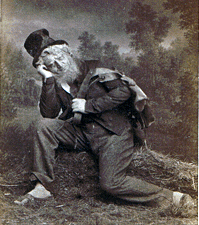
In the Hall of the Mountain King will tell most people something, but that it's part of a whole (quite popularcomposition based on a play that was inspired by Norwegian fairy tales.

Henrik Klausen as Peer Gynt in 1876 [source]
42 minutes of beautiful classic music to spur one's imagination! Take the time (which would be rare enough nowadays), write an adventure, draw a map or just listen to it and let the music do the rest ...


Enjoy!

Sunday, September 7, 2014

Narrative Control vs. D&D

More posts about the Analogue Goblin-Tribe Simulator will be up very soon (as I have some free time to get things DONE right now), but since we just started the WitchCraft game I talked about almost a year ago, I'd like to share some (yeah, well, I tried to keep it short) of my observations about that in between ...

WitchCraft is a storyteller-game, D&D not so much

While there are several notable attempts to establish some point-buy systems for D&D (starting with the rule of "4D6, drop lowest"), none of them really went beyond giving players some more room in deciding what they're going to play*, because D&D works within a very strict class-system that's way to narrow to allow for a completely unlimited character creation as it is the case with, to name one example, WitchCraft.

The main difference here is the narrative control a player is allowed to have and the impact it has on the game. With D&D the first real compromise you have to make as a player is what function you're willing to play in the group**. This can be a good thing since it (potentially) connects a character to a group. It can be a bad thing if a DM is not very clear that this is how it goes down. You just can't "do everything, because it's a role playing game" as everyone and their grandmother would like you to believe. No, when you're playing games like D&D, you're allowed to move your pieces in a (more or less) very strict game, with freedom only within what the rules allow and the illusion of freedom for everything else. Freedom to choose, for instance, always goes along with the awareness of the possibilities. If a game just doesn't care to produce this kind of awareness, it won't be big about giving players a true choice.

On the other hand one could argue that a more structured game produces fairness and allows a focus on what should be important in the game. And yet, it's not rules that produce or guaranty fairness and "what the game is about" is still (for good reasons) a matter of debate.

But a neglect of narrative control and a narrowing of choices are a merit of their own, if all can agree of what is to be achieved in any specific version of the game. Rules-light variants of The Game, while still being structured, produce a different kind of freedom (less narrative control, more freedom of ... let's say: expression?) because of their lack of rules.

It is something a group can easily agree upon (and it is somehow part of D&D's popularity, up to the bloated straitjacket that is 3E and maybe even beyond that). It's not a bad thing either, but it's gets problematic as soon as it's believed to be the only option. As always, it's a lack of awareness that produces dis-harmonies, so to say.

So what is narrative control?

When I went and proposed to play a game of WitchCraft until I get to a point where I believe I'm able to DM a game of D&D again***, I got 3 Players confirming for the first session: a Newbie, a Veteran (that also is a regular in my group) and a player new to our group that had some experience with other systems (more like D&D, storyteller games not so much). The best mix I could wish for in the argument I'm trying to make here.

This is what they got to work with: A small strange town deep in the woods somewhere in East Germany and near to the polish border (Dirkterwalde, see link above for more information). The year is 1999, the genre is Urban Fantasy (I'm talking Twin Peaks, X-Files and, to some extent, American Horror Story: Coven here). They are free to build their own characters as long as they fit into this setting.

This is what they did:

The Newbie

Being completely new to role playing games gives a unique perspective to the hobby. A conscious DM will use this to his and the players advantage, because whatever approach a DM is choosing when explaining the system, will stick and inform later decisions of said player. So I tell her that the most important thing is to have an idea what person she wants to play, then we distribute the points she got in a way that makes the idea work.

There are 3 basic categories to choose from: Mundane, Lesser Gifted and Gifted (you might want to call them "classes", but they really just shift the available points on a scale from no magic to magical creature). She opts to play a lesser gifted witch, when asked for reasons to live in this town, she offers that her character somehow gives shelter to girls in trouble and she wants to have something burlesque to the character. In the end we agreed that her character owns a small Vaudeville theater that acts as a front for her coven to shelter young discovered witches until they know what's what.

Before she even started to distribute points she had a pretty clear picture of what she was aiming for. Now it was important to stress that for expressing her ideas in a character sheet she needs to spent the points to make it happen. It's where either the player or the DM gets narrative control. She wants a contact in the coven that helps her every now and then? The points she spends decide how effective that contact will be. And so on. She spends points on resources, so her etablissement is quite successful, her character is an artist with a specialization on dancing with blades, so her character can deliver on stage and gets a combat skill in there, too. She also spends the points to get that contact working.

The result is a character with great potential for a DM that does what the player wanted it to do. She has narrative control in the things she cares about, is connected to the setting in a way that allows for some stories that fit the character (a troubled-young-witch-of-the-week-feature would be my first thought ...), which is some sort of narrative control in itself, and offers a social scenario where the characters could have met. I couldn't have wished for a better result and she's quite happy with it, too.

There is one other form of narrative control she exercised: her character is an orphan and single with no children. No emotional links a DM could use against her. Good for her ...

The Veteran

This is a great example of someone that has played his share of different role playing games, because he did what all skilled players with some experience under their belt do: he covered all bases and formed a narrative around it, then he looked for weaknesses in the system to exploit them. It was a bit scary to behold.

Playing a Mundane was his first choice and a good one, at that. As far as points go, all three choices are pretty balanced, so it will be a character that works within the setting without feeling inferior****, plus it cancels the need to learn more than the basics of the magic system WitchCraft offers. He just needs to know how to protect himself from magic and how to hurt stuff (basically).

We wrote a few mails back and forth to discuss the specifics: His parents are already dead (anyone else seeing a pattern here?) and he has loose contact to a cousin that dabbles in the arcane (not a bought contact, but a connection to the supernatural for me to do with as I please: his decision to leave narrative control in my hands). He has a military background and we agreed that he had been in the Nationale Volksarmee (links to the English wiki-page) around the time the German Democratic Republic fell apart. In 1999 he's a sales rep for a sausage factory, living in Dirkterwalde and travelling East Germany. A job he uses as a cover for his real calling: he's a cat burglar, stealing from corrupt politicians and others that made a great deal of cash utilizing the German reunification to their advantage (and the disadvantage of others ...), giving all the money away for charity (again, he leaves narrative control in my hands: all he needs for his character is the skills a cat burglar has to have, not the money, nor the criminal connections ...). He also recently joined a Dojo to learn Karate.

You see, his approach is totally different to the one the newbie player chose. His character is ready to function in the game. He doesn't need narrative control because he's able to face what I'm going to throw at him. The areas where he exercised narrative control, where those he thought important in ensuring that he got the character he had in mind, leaving almost no room for me as a DM to threaten his character with something he decided to have on his character sheet. He wants to be a free agent in the story he's a part of and achieved exactly that.

Of course his character was finished when he arrived at the game.

The New Guy

Entering a campaign as a new player and complete stranger is always somewhat difficult. Knowing a DM is half the battle, in my opinion, so there is that. Add a completely new system with a different gaming philosophy than what you are used to and narrative control is the least of your concerns during character creation. And yet, there is some interesting symmetry to his choices that express exactly the dilemma I described and produce a well crafted character that has to ignore narrative control.

His choices: He wants to play a gifted psychic (so of the three choices the game offers, every player chose a different one). His character had pretty early discovered that he was different and had played it close to the chest. His way of  finding out what exactly was different about him was not by reaching out, but by studying the human mind instead. So he graduated in psychology and learned as much as possible about the occult. As of yet (before the first session) he is completely oblivious of others with the same or similar powers. Being poor, he had to move back to his parents after finishing his studies. So he's fresh back in town with nothing to do but playing computer games (before they were cool) and starting to learn Kendo (in the same Dojo the veteran's character is frequenting ...).

So yeah, it's a Nerd.
Maybe not a picture the player might agree upon,
but it's definitely the right direction [source].
A cynic might say this character is the perfect victim. Or it's Carrie waiting to happen. Either way, it's a fantastic character in that the lack of narrative control (intentionally or not) in nearly all aspects of the character's background should give a good player the opportunity to get a feeling for the new group, the new DM and the new system just because he's the perfect sounding board for all those things.

What does it mean for D&D?

It is quite difficult to see how this could work in D&D. The main reason for that is how players in WitchCraft are able to create a character by using the setting. They know the 1999's and the cultural background (or may google them) and have a fair understanding of what Urban Fantasy might be, so they can make (somewhat) informed decisions about what they want to play. I really like this kind of direct connection between a player and a setting and WitchCraft really does a fine job in facilitating this.

There are fantasy role playing games out there that use point-buy-systems  that work just fine (D6 Fantasy comes to mind) and don't define themselves as storyteller systems (D6 at least is older than the term itself ...). But is something like this even possible for D&D? The short answer: not the way it is done in WitchCraft and similar role playing games. One good reason: the discrepancy in power-levels between normal folks and high level heroes are far to wide a gap to produce a dramatic pressure strong enough to make it count in a game of D&D. Sure, you could do something like getting the mother of a level 25 character kidnapped, but D&D as a system has no connection to drama like that. It would be ruled with either a subsystem or just playing on a players real-life sense for what's appropriate.

The way I see it, a level 1 character in D&D doesn't need more than a club and an attitude. Character-development is something that isn't done during character creation, but by playing the game. The stories that are being told are not serialized events within a structured narrative, but picaresque stories of epic random fantasy that also evolve from the game. And this is what narrative control shifts to in D&D: it's a simulation of all the parts that, when used and interpreted, will result in a story, with the players and the DM working different parts of the machinations that make the game tick. You can play D&D without ever telling a story about your character, but as soon as you play the Game, a story is being told same goes for the DM that just starts with the dungeon crawl and nothing else).


*HackMaster (4E) is the only exception I know of, that bypassed this in allowing for a huge variety of results on the one hand and a  Drawback/Quality-system with an option to buy ability score points, etc. to an extent where class wasn't that important anymore (which means AD&D could be able to achieve an effect like this, too), but still, there's this huge distinction: Narrative Control (see above).

**In accordance to your possibilities, of course, but since there is such a huge variety of rules how to create those stats, the real first choice is the class.

***As in I'm still in the process of building my own Frankenclone and don't wanna do it while we're already playing  D&D(especially because world-building is next in line ...).

****Man, I need to write about this character at some point. His stats are that good, we started to call him "Captain DDR" pretty much from the beginning ...