Thursday, February 27, 2014

Instant Church Hierarchies Part 1 (and yes, I see the irony)

I was talking about this end of last year (looky here or see down below). Some people thought it interesting enough to discuss it somewhere in the internet as potentially promising, but not enough. True that. Well, it's about time to finish what I started. So here's a more serious take on the subject. I'll start with some basics and reiterations and will close the first part with some easy examples.

Real world hierarchies (catholic church)

The catholic church is a lot about worldly hierarchies, which makes it ripe to borrow ideas from. Let's see ... For starters, it seems to be a simple pyramid hierarchy with the following titles:

  • Pope/head of the church
  • Cardinals
  • Archbishops
  • Bishops
  • Parish Priests
  • Missionaries
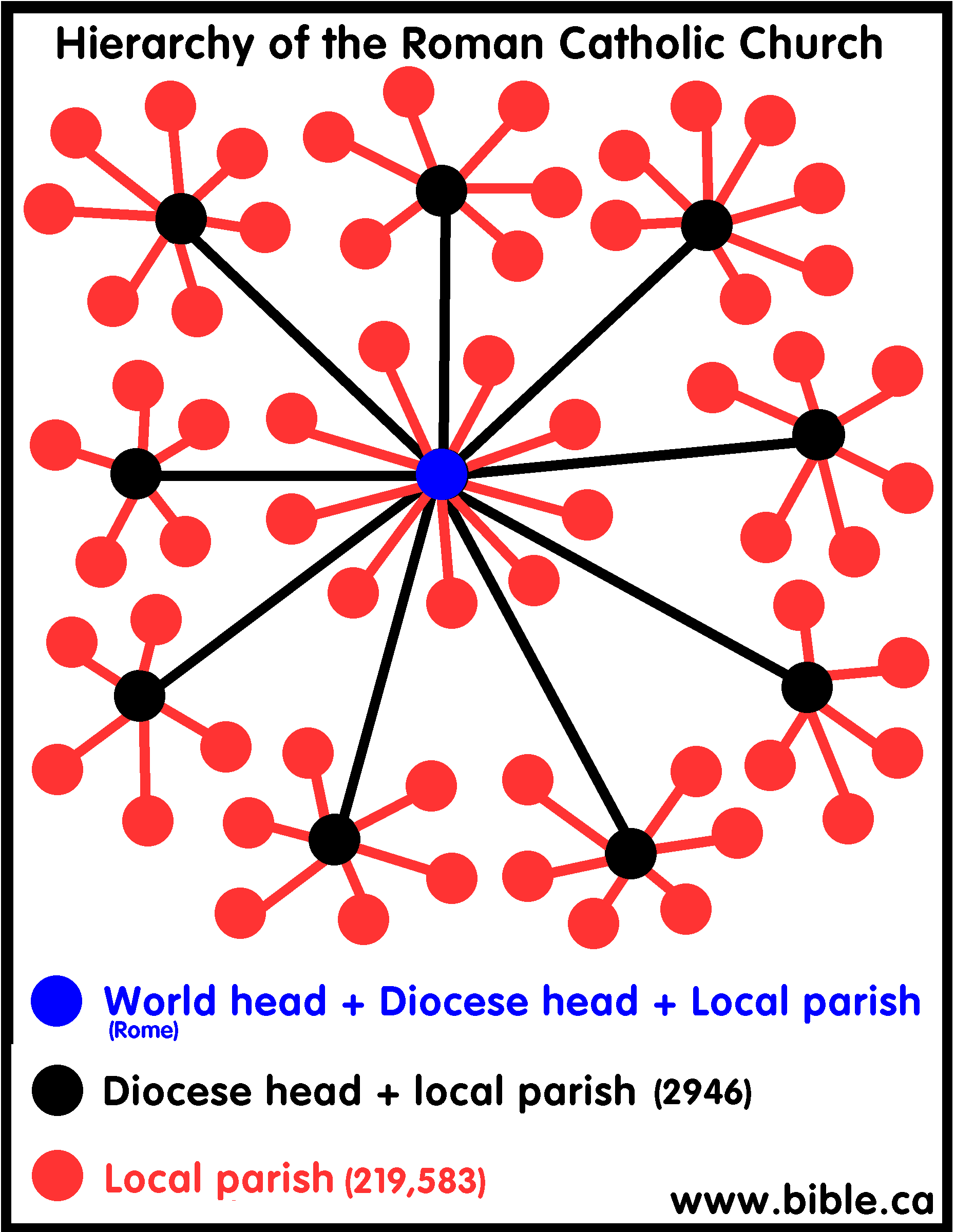
This being a bit two-dimensional, I'd go and look for something closer to what could be used in The Game. Something like this:
[source]

All right, here we have a point of origin and some smaller groupings subordinating themselves to it. This (or something like this) is what I want to see in the game and I want o get there as fast and as random as possible. Hence the above linked idea about instant hierarchies. Here's the gist of it:

Roll 3d6 and interpret the results:
  • The plain numbers would be the whole clergy of a church. I'm assuming very small groups, obviously, with the level 1 player being the lowest in the food chain. I'd say a die means one temple. More dice in the beginning would result in a bigger church. But they would be all in one region.
  • Every 6 gets rerolled and indicates the number of those travelling holy men that spread the word without having a temple of their own (other than the player). They would be missionaries, so to speak.
  • Pairs allow for another roll of 3d6, the church just got a bit bigger and expanded another region.
  • Triples not only expand the church, but give it some holy (or otherwise important) site (could be a university, a site where a saint is buried, stuff like that).
  • If the first roll with 3d6 shows three time 1, the player character (or NPC) is the only cleric with access to a lost faith. Maybe he found a holy text, something like that. It's on him to spread the word now.
  • Other than that, 1s indicate lost lore and legends directly connected to that particular faith/deity/whatever, another roll with 1d6 per rolled 1 determining the number rumors, legends, MIA clerics, etc.. Could be the story of a cleric that got lost on a mission, some legend of saints and where their bones might be found, stuff like that. A pair of ones doesn't result in another roll of 3d6.
Doubles and triples will result in higher numbers and other than rerolled sixes, every rolled number relates to the first three (example: a first roll of 3 3 5 and a second roll of 2 1 5 results in two pairs (3 3 and 5 5) and will expand the church further in the second roll, may even produce triples along the way... or quadruples, but I've no ideas for that right now).

Now we need to expand on that.

How many dice for my church?

The basic idea was to roll 3d6 and read the results, but it's only logical to use more dice for a bigger church or less for a smaller one. What the initial post lacked was a ratio by which a DM is able to adjust what seems right for him.

This is has to be, to some degree, arbitrary. The basic question is, what level needs a cleric to have at least to be a fit leader of a church. Name level seems a bit to high for the smallest possible church (1d6), but level 3 a bit to low (I'm using the Rules Cyclopedia here, so the cleric's getting his first spell at level 2 and has only 2 level 1 spells at level 3, to name but one argument ...). A cleric would get his first level 3 spell when reaching level 6, so this seems like a good point to start*. So as a first set of rules:

"Every d6 means 6 levels for the head of a church. If more than 5 dice are used, the level of the head of a church is not relevant anymore, he's just a representative. As a guideline I'd take the numerical result of the initial roll as level.
The rest is politics."

So with 3d6 you'd have a level 18 cleric as boss. Very well, now for the clergy. It's a tad more difficult, mainly because of the huge variety in the results. Okay, one of the already established rules is that every die stands for a temple in the region/diocese. This is definitely something done at name level (using only one die is the exception and may mean there is only a shrine or altar ...**). 

If you use two d6 you got a main temple with the head of church as level 12 and another temple with the local authority (a cardinal?) at level 9. Now the minimum result for a church with 2d6 to have an active clergy is 5***. We already have a level 12 and a level 9 cleric, that leaves us with three more slots to fill. My initial instinct is to go with two more clerics with level 6 (two archbishops) and one with level 3 (a bishop, no less). To summarize, we have now as the lowest possible result with an active clergy of one roll with 2d6:
  • 2 churches in one diocese
  • One level 12 cleric as head of church
  • One level 9 cleric as head of local chapter/parish
  • Two level 6 cleric (I'd say each one of them working in one of those churches)
  • One level 3 cleric (active in the main church)
  • 20 payed retainers (going by the average CHA-score per cleric)
Add a few hundred believers to that and you have a small cult going. I'm quite satisfied with this result and I feel a table coming summarizing all the results ...

By the way, a player character would always be a missionary at first and not part of the number rolled (in the example above he'd be the sixth member of the clergy and, being level 1, the lowest in the food chain) and when used during character generation, I'd suggest to keep those 3d6 per faith.

Distribution, distribution

Those concepts will have some wild results and that makes it hard to see a pattern at first. But let me try anyway, starting with 1d6 and 2d6.

1d6 (results 2-5) - A cult, not a church
  • active clergy is 2-5
  • no temple but a shrine (if a 5 is rolled, make that an altar)
  • head of cult is level 6 cleric
  • there are at best two clerics with level 3
  • with more than 3 members every addtional member is a level 1 cleric
1d6 (fringe results)
  • a 1 indicates that this cult had once existed and left some traces (roll another d6 for the number of relics like holy texts, a shrine, some holy bones, etc.)
  • a 6 means a reroll, but if only one die is used to beginn with, the result of the reroll is read as another cell and interpreted as the initial roll (which means another level 6 leader with his cronies,etc.)

2d6 (results 3-11 + with doubles, triples, etc.)
  • at least 1 temple, might have holy sites, etc. due to triplets
  • active clergy is 2 to 11
  • head of this church is a level 12 cleric
  • the next highest level is 9
  • the number of clerics holding level 9 is the same as the number of dice that resulted in a temple
  • the number of level 6 clerics is the same as the number of dice that produced a temple (or less)
  • the number of level 3 clerics is the same as the number of dice that produced a temple (or less)
  • the rest are level 1 clerics
2d6 (fringe results)
  • a 1 always means some lost lore or relic (roll a d6 to see how many of those exist somewhere)
  • a double of 1s make this religion a thing of legend, reroll both ones and interpret the new results as the size of this particular lost church (which will give you some ideas how many temples existed (there might be ruins), how many clerics preached the faith (skeletons in a dungeon, stuff like that), etc.)
  • a 6 means a reroll, the result is the number of missionaries a church has running around:
1: 1 cleric level 1
2: 2 clerics level 1
3: 2 clerics level 1 and 1 cleric level 3
4: 3 cleric level 1 and 1 cleric level 3
5: 3 clerics level 1 and 2 clerics level 3 
6: 3 clerics level 1, 2 clerics level 3 and 1 cleric level 6 (and a reroll)
  • double 6s mean there is a camp of missionaries somewhere in another churches realm of influence (a triple means 2 of those, etc.)
So much for Part 1

I think that's enough to digest for today. I know, all that seems a bit complex and over the top, but when all is said and done, it's just one roll (with an option of exploding dice) and reading/analyzing the results. Here is Part 2. The next part after that (some time in the future) will deal with 3d6 or more and I'm working on some charts right now to illustrate the idea further.

It's also an opportunity to give me some feedback ...


*And forget about level names. The idea is nice on paper, but if you had to do it for 36 levels per class, you'd run out of alternatives fast.
**Which reminds me of a post I wanted to write and forgot about. Okay, it will happen the next few days ...
*** Rolling a 2 and a 3 are the first results that won't either expand the church (with 2 and 2 being a double), leave it with two active members (a rolled 2) and a lot of legends (because of the 1 ...) or make it completely a thing of the past (two rolled 1s).

Wednesday, February 26, 2014

Days 25 & 26: Campaigns and Groups [D&D 40th Anniversary Blog Hop]

Day 25: Longest running campaign/gaming group you've been in.

My longest running campaign had nothing to do with D&D because Midgard had been our system of choice back then. Two out of three fridays for up to eight hours over a 5-year period. Good times, but that group is long gone and disbanded (including all the drama this could entail ... ah well). My cousin is the only player from that time that is still a regular in everything I could come up with.
 
Anyway, that was my longest going campaign and the most consistent group I have been in and I don't expect something like this to happen again before I retire ...

Day 26: Do you still game with the people who introduced you to the hobby?
 
Well, no. My brother and I bought our first set of rules when we were 13 after I had learned about those books from magazines and fantasy novels. You could say we taught ourselves how to play the game. I've been doing that ever since, but my brother has lost interest a long time ago (I did get him to play some HackMaster a few years ago, but now he's a father of twins, living 50 km away from where I live, so that's that).
 
But I still own the book that introduced me to the hobby.

This is a Blog Hop - So get hopping!

Stelios V. Perdios is hosting.

Tuesday, February 25, 2014

Les Cousins Dangeroux (a review of the retro-clone Epées & Sorcellerie)

This is not about Arrested Development but about the translation of a fantastic french OD&D retro-clone I came to read the last few weeks: Epées & Sorcellerie by Nicolas Dessaux (translated by David Macauley; here is a free pdf at lulu). Yes, this is a review.

Initiative? What initiative?! (or how to begin a review ...)

I had this collecting dust at my hard drive for 2 years now, I guess. Back then I gave it a quick glance and decided that it's the perfect game if no dice but d6s are available (which is still true). The occasion never occurred, so to say, and the game returned to the "to read"-pile.

Now, with work being the life-sucking, time-consuming beast it became, I had time to read some books. Nowadays I'm very slow in processing new data up to a point where it produces any results worth sharing, but I'm still collecting. So one thing I did, to get to a point remotely related to E&S, was checking the systems I could get my hands on for their initiative rules*.

Epées & Sorcellerie presented (in my opinion) the best result so far, in that initiative in combat is a by-product of the attack roll. Check it out:
"Both combatants roll their dice simultaneously, but only the one who rolls the highest hits, provided his roll exceeds his opponent’s AC.
If both fail to roll higher than the other’s AC, neither managed to find a gap in the opponent’s defenses.
If both combatants roll the same score on the attack roll, they both roll for damage. Whoever rolls the highest breaks the weapon or shield of his opponent (loser’s choice). If the damage rolls are equal, both weapons break. Magic weapons never break." (Epées & Sorcellerie, p. 19)
What an inspiring display of creative game design! With this, combat becomes a fluid and much more personal affair. A direct confrontation instead of the usual "I hit - You hit - I hit"-routine, with only one roll for initiative and attack/defense (plus breaking weapons and/or armor, just because they could include it ...).

I mean, wow.

Honest to god, I didn't sleep well that night, the mind buzzing with the possibilities, looking for connections. Why? Because the main "problem" is that this system works best when 2d6 are used (as E&S suggests) and it doesn't translate that well to systems using a d20 for attacks (it's bell curve results (2d6) vs. linear results (d20), with bell curve results having more overlap, which I believe to be preferable ...).

So adaptability is something I tend to look for in retro-clones. If it's a good idea and easy to steal, it has a good chance of becoming part of my own D&D bastard-brew. With this, not so much. It's best played RAW and I started to wonder if the rest of E&S was as good as this one rule implied.

Indeed a dangerous cousin of D&D ...

Further reading was unavoidable and done fast. The English translation is 68 pages short, with the main rules being only 24 pages, the rest are spells, monsters, a short page about treasure and an appendix with all tables and an index.

Now for the content. All the basic trappings and terminology one would expect from a D&D clone are present. It offers 3 basic classes (warrior, sorcerer and priest) and an option to add elves, hobbits, dwarves and orcs (race-as-class with some special abilities in the mix).

You'll still have the well-known 6 ability scores, yet here's another twist: not 3d6 make a stat, but 2d6 do. That may sound a bit limiting, but it really isn't, seeing that those 2d6, as implied earlier, define the whole game and connect all relevant mechanics in an elegant and easy-to-grasp way.

Here is another example illustrating this: Dexterity is considered the base armor class unless armor is worn (3 types are available, ranging from AC 8 to AC 12), shields give +1. So being dextrous has a palpable effect on the game.

The magic system is nicely done. Every spell a character has imprinted in his memory allows the caster to perform minor and harmless cantrips related to that spell, to give but one more example. There's a light skill system, based on ability scores. Good stuff. I could go on and on ...

This might very well be my favorite take on OD&D so far.

Résumé

This game deserves way more credit than it got in the community since its publication in 2011. This game begs to be played. Nicolas Dessaux not only did an excellent job capturing the vibe of OD&D, he also managed to create an elegant and, for the lack of a better word, evolved version of the game with more than one twist to make it superiour to most (if not all) the variants I've had the pleasure to read in the last few years.

If you never played D&D and want to find out what that buzz about the OSR is all about, check out this game. If you go camping and there's just not enough room for all the dice and miniatures and books, take this game instead. If you need some ideas how flexible D&D from a mechanical point of view can be, read E&S as an example of how it's done right.


The pdf of Epées & Sorcellerie being free, I'm reluctant to write anything really negative about scope, layout and presentation. It's functional and that's good enough for me. A bit more support for beginning DMs would have been a nice touch, because I believe it's the perfect system for people new to role playing games in general. As it is, it needs an experienced DM.

For those able to read it in the original, there is a second edition out with more spells, more monsters and two introducing adventures (if my google fu didn't fail me). It also lives here at lulu. I really hope they do a translation of this one, too**.

Go! Play good games!


*Why? Because the D&D initiative rules suck and I'm not very happy with what I came up with, that's why. They all work well enough, but reflect more the board game elements of the game than the narrative parts. What I'm looking for is a fluid structure, if I had to describe it. But that's for another post ...

** By the way, if anybody responsible is reading this and cares for a German translation, I'd be more than willing to fill that gap ...

Monday, February 24, 2014

Days 14 to 24 : A whole lot of answers [D&D 40th Anniversary Blog Hop]

I'm back, eager to answer the rest of the questions and happy to see that I'm still a part of this (as it is not entirely on me to decide such a thing ...). So without further ado, the next 10 (sorry!) answers.

Day 14: Did you meet your significant other while playing D&D? Does he or she still play? (Or just post a randomly generated monster in protest of Valentine's Day)

No, I didn't meet my significant other while playing D&D, but I believe it helped (a bit at least). At the time we met, I still had a regular group and she was living in the neighbourhood. Now, when we played, it had been a rather loud affair, with a lot of laughing involved (as it should be, I believe) and that had garnered some interest.

Me writing stuff about the hobby on a blog did collect some points, too. To be perfectly clear about it, those weren't the reasons for us to be together right now. But it showed some compassion and creativity and those are (for some, at least) valuable character traits. Lucky me :)

She's still interested to try the game, which, sadly enough, only means that we as of yet didn't get around to play the game. But it will happen and I'm looking forward to the occasion ...

Day 15: What was the first edition you didn't enjoy. Why?

3E, hands down. The "why" is spread all over my blog like breadcrumbs. In short, it's a hard game for the DM to be the authority in. Thousands of unreflected splat books, five-foot-steps (as a stand-in for all the board game elements of that edition), the hours of preparation needed on higher levels and all the small unfortunate rules that make it a power gamers wet dream took, for me at least, the fun out of the game really fast.

This is, of course, to some degree a matter of taste.

Day 16: Do you remember your first edition war? Did you win? ;)

I know I had those discussions at some time or another, but do I remember the first one? No. Anyhow, it ain't about winning, either, because seeing it like this already implies an unmovable stance on the subject (any subject, really), which renders a discussion completely useless from the start, in my experience. Worthwhile discussions usually involve people open enough to positions they don't agree with to get to a satisfying conclusion for all involved.

Any topic should be considered a free agent and opinions aren't more than a status of your own knowledge, which I believe to be not set in stone, but subject to change. In the end, defending an issue isn't more than rhetorics, but it involves to be able to see the arguments presented to you in relation to your own.  So a "win" would at least mean you got something out of the discussion worth thinking about ...

Day 17: First time you heard D&D was somehow "evil."

"Funny" story right there. The first time I realised this is something "they" are serious about, was in the late nineties. I shared the way home with a classmate. He and his family had recently moved from Bavaria (south Germany, traditionally a bit more conservative then the rest of Germany, I might add) to the neighbourhood and he hadn't befriended that many people yet. Well, we got into talking and role playing games were a subject close to my heart, so some of that talk was about playing the game. He was interested enough and thought about joining our small group of nerds.

The thing is, he was a pastor's son and when he'd told at home what he was about to do, his parents wouldn't allow him to do so. I was, of course, shunned after that, too. When confronting him about it, he'd told me (and I kid you not) that his parent's had a book at home with advice about what activities would be unsafe (even dangerous) for their children to participate in. Their son starting to play role playing games was for them like he was about to join a satanic sect.

There was nothing to do about it but feeling sorry for him.

Day 18: First gaming convention you ever attended.

The first convention I attended had been the MaRT (Mannheimer Rollenspiel Tage). Not much to tell you about it, because this was a really long time ago (almost 20 years) and I barely remember the event.

Five things stayed with me, though. The convention had been held in a park (which had been quite idyllic), a friend of mine had brought his (very strange) girlfriend, it was the first time I encountered Cyberpunk (and fell in love with the system) and Deadlands (not so much, but a nice enough game) and there had been no option to stay over night. But the fifth and most important thing that had happened was that they gave out flyers for yet another con in the area. But this one was over the course of 3 days with an option to stay over night. A convention we would visit for years to come from then on.

Day 19: First gamer who just annoyed the hell out of you.

The stereotypes illustrated in Knights of the Dinner Table are no strangers to me. I've known guys like that and even played with them occasionally or had them in my group.

A classic: the first KotDT comic strip (full story here).
So over the years I have had my share of strange and adverse gamers with all the struggles, discussions and drama one might expect with such people. I tend to forget about those things and don't think they are worth remembering so it took some time to think of one. Here I go ...

One of the first, if not the first, that "annoyed the hell out of me" had been a guy in our Vampire: The Masquerade game in the late Nineties. While everyone else at the table was playing the game, he had been drawing some stupid picture. After an hour of trying to get everyone at the table immersed into the story, I had enough of him being so dismissive and told him to either go somewhere else to do his thing or give the game at least a chance.

It's something that still bothers me every now and then. Basically I believe if I took the time to prepare and DM the game, I at least want to share it with people that take it as serious as I am. If that's too much, those people could as well do something else instead of wasting my time.

Day 20: First non-D&D RPG you played.

Midgard was my first non-D&D RPG. There is no English source page I could link you to, but I wrote a bit about it here.

Day 21: First time you sold some of your D&D books--for whatever reason.

I have never done that, but, being a bookseller by trade (well, at least it's the job I have learned), I always had a hard time parting with the books I own ...

Day 22: First D&D-based novel you ever read (Dragonlance Trilogy, Realms novels, etc.)

That had happened long before I started to play D&D and I read it because I had been told it was good fantasy. And indeed, I had a great time with the book just for the story and world it presented.

So my first D&D-based book (without me realizing what I was reading about, but enjoying it nonetheless) had been The Verdant Passage by Troy Denning:

[source]
Great books (as far as I remember, anyway) and a great setting I always wanted to check out further ...

Day 23: First song that comes to mind that you associate with D&D. Why?

This seems like a strange question at first, but I believe every gamer has a song just like that. Mine is connected to a time were we still had been enthusiastic enough to play (or make characters or draw maps or daydream about campaigns ...) at every given opportunity.

So it was nothing special that we (me and a friend of mine) were sitting in a garden, enjoying the summer sun, slinging dice. But the neighbours daughter, on the other hand, sunbathing topless and barely veiled by the shrubbery dividing the properties had been a welcome change of pace the day I'm talking about (and maybe this is why I remember it so well?) ...

Anyway, I digress. So we were sitting there with some cold lemonade on the table and the radio playing in the background, giving some barbarian a run for his xp. He had just entered a tomb and was about to confront a few skeletons when the radio started playing an old classic:


So we cranked up the volume, went with the flow and started rolling initiative. But most of the time we were too busy laughing.

Day 24: First movie that comes to mind that you associate with D&D. Why?

Easy, but I guess it seems to be a strange choice at first (or not - I mean, it is kind of obvious, isn't it?). Behold:

One of the coolest movies ever made ...
Big Trouble in Little China is, in my opinion, more D&D without being D&D than most that try. A group of heroes (led by a wizard, no less) enter a big dungeon (with beautiful and mystical underground passages, full of traps and monsters) to defeat what might as well be called a Lich and rescue a few damsels in distress! It even has potions and a beholder:


All that and Kung Fu. What's not to love?
---------------------------------
That were a lot of questions. The rest will be easier and I have the time to write them all (and a bit more, I hope).

This is a Blog Hop - So get hopping!

Stelios V. Perdios is hosting.

Monday, February 17, 2014

Resuming the Challenge

Sorry. Valentines Day turned out to be a Valentines Weekend. Sometimes posting is less important than life ;-)

I'll continue answering the Challenge a bit later today. Have a nice start into the week, you all!

Thursday, February 13, 2014

Days 12 & 13: A Fantasy Forest and Hero Quest [D&D 40th Anniversary Blog Hop]

First store I bought my gaming supplies?
&
First miniatures I used for D&D?

The first store I bought my gaming supplies from goes by the name Fantasy Forest and is in Mannheim, Germany. And yes, online research revealed that it is still around (which is amazing in it's own right). My last visit must have been in the last millennium. Here are two pictures:

Just like I remember it ... [source]
This was the store where I bought the Rules Cyclopedia! I'm planning on visiting them again some time in the next weeks. For nostalgic reasons and some treasure hunting ...

-------------------------------------------------------
 
This may come to you as a surprise, but I'm not a big fan of miniatures. For me they have no place in role playing games where the mind should roam free without visual aids tempering with the illusion. The emphasis the companies put on the relevance of little plastic figurines in D&D was what ruined 3E for me (well, it had been one of the main reasons ...) and made it easy for me to ignore 4E entirely.
 
If I want to play a board game, I'll do just that.

But I had to try before coming to this conclusion, right? So one of the first sets I looted for D&D (and I guess I'm not alone in this) where the miniatures from the legendary Hero Quest. Here is a picture of the German edition of the game:
 
Formed my vision of how the game should look long before anything else ...
And that's it for today, folks. The next two questions demand separate posts. And I really should write something else in between. Let's see if I'm up to that. The weekend is fast approaching, after all.

This is a Blog Hop - So get hopping!

Stelios V. Perdios is hosting.

Tuesday, February 11, 2014

Days 10 & 11: A Joker and a No-Show [D&D 40th Anniversary Blog Hop]

Sometimes these questions really put me back in time. So much stuff I haven't thought about for years. Turns out my answers are not so much about D&D this time, but about my earliest experiences as a gamer. Some very early impressions, if you will. And some more German gamer paraphernalia.

First bought gaming magazine?
&
First splat book I begged my DM to allow?

At first I thought I had nothing to say about this question. I asked myself what a magazine is supposed to do. Inform, support, inspire, stuff like that. I couldn't think of a gaming magazine that ever did something like this for me. Or could I?

Before I really was into role playing games, me and my brother had owned an Amiga 500. We had loved that machine, of course. We had played a lot of games back in the day. And now that I was sitting here, thinking what my first gaming magazine had been, I wandered back to that time when the fourth official Indiana Jones installment had been a computer game.

And yes, I remember those journeys to the next newsdealer, eager to get the newest issue as soon as it was published and reading like a holy text. Right there it was, the first gaming magazine I've ever purchased: the Amiga Joker (the following examples are from this archive):

March 1992! Where is all the time gone ...
Monkey Island 1 & 2, Lemmings, Worms, The Chaos Engine, Eye of the Beholder, all those beautiful games and memories. But there was more than just computer games. The Amiga Joker had been one of the few magazines that had a two page column about board games and (wait for it ...) role playing games! They'd called it Stromausfall (Eng.: power outage). Look:

A board game about neanderthals ...
... and a pen & paper role playing game about teddy bears.
It was fascinating, opening new worlds for me every time. Most of those games landed on my wish list. Most of them would stay there, too. But I that's the way it had been, knowing and dreaming about those games had been more important to me than owning and playing them.

So one of my early sources for ideas and information about role playing games was the Amiga Joker, a German computer magazine. Now I have to revisit that archive. A trip down memory lane is in order ...

-----------------------------------
 
Not so much luck with the splat books, unfortunately. I'm really a DM most of the time so I never was in that position and my players are not invested enough to buy stuff and argue about using it after the fact. Not even during our 3E buying frenzies.
 
So no, never happened.

This is a Blog Hop - So get hopping!
Stelios V. Perdios is hosting.
Those questions really do it for me. Gumball machines, old gaming magazines and grand schemes about games, that's my youth right there!